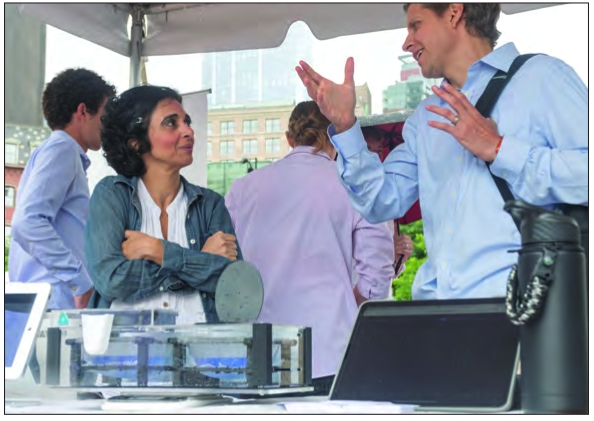
Diana
Yousef (left), founder and CEO of change:WATER labs stands at her booth
at the Climate Tech on The Plaza event outside City Hall July 24.
Yousef’s company has created a portable toilet that evaporates water
from human waste to increase sanitation in parts of the world without
regular access to indoor plumbing.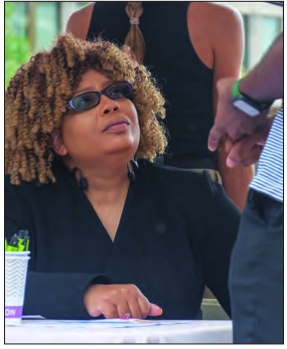
Beth Griffith, a
founding worker member of the Boston Community Solar Cooperative, chats
with an attendee at the Climate Tech on The Plaza event outside City
Hall July 24. The Cooperative is launching a community-owned community
solar program with an array on top of the Dorchester Food Co-op, with
hopes of launching more projects as well.
Across City Hall Plaza on July 17, climate technology companies scattered under white tents to show off the technology that they hope will make a dent in the ongoing climate crisis.
About 40 companies used their time at Climate Tech on The Plaza to network, exchange information and demonstrate what their technology can do. Some of the companies were just beginning their journeys while others like Schnieder Electric, one of the event’s sponsors, have operations worldwide.
For companies of color present, many of whom are just starting out and looking to grow their reach or expand funding sources, the event on City Hall Plaza was an important opportunity to get more eyes on what they’re offering.
Beth Griffith, a founding worker member at the Boston Community Solar Cooperative, said the event was a good opportunity to meet both community members and potential subscribers as well as other companies they could partner with.
“We’re really excited about the exposure, and also being able to talk with and potentially collaborate with other firms here. So that’s a really great experience that we’re having so far.”
The Cooperative is running an effort to install a solar array on the roof of the Dorchester Food Co-op to operate a local community solar program that would connect residents to the benefits of solar energy even if they can’t install panels on their own roof. In the future, they hope to launch other local arrays for further energy generation.
Lina González, founder and CEO of SpadXTech, said the event was an important opportunity to get more eyes on her
company and the products they’re making. The company uses microbes to
create a kind of cellulose-based material that mimics leather without
having to raise cows — and the potential environmental impacts of the
livestock industry — or the plastics that leather alternatives often
employ.
“It means a lot, it means we’re getting some visibility, it means that people are getting to know us,” she said.
For
Diana Yousef, founder and leader of change:WATER labs, was excited to
get the opportunity to meet with community members and find increased
support for change. Yousef used her education in biochemistry and the
roots from her Egyptian immigrant parents to develop a portable toilet
to evaporate the water from sewage, shrinking waste without the need for
water or plumbing, a technology she hopes will help address poor
sanitation worldwide.
The
event on City Hall Plaza also, unofficially, served as a celebration of
the steps the state has taken in supporting climate technology
development, efforts that Mayor Michelle Wu said are important on
multiple levels, given a “very limited window” to take action.
“This
is going to be the arena where our future is fought for,” she said.
“What does it mean to be that leader in climate resiliency, climate tech
and innovation? It is saving lives. It is being the healthiest, most
welcoming community that we can be.”
That work has included a focus on the way climate equity overlaps with job equity.
“This
is not only about creating lots of jobs for people who have all kinds
of backgrounds and having all these great companies start here and
expand here, it’s also about doing the right thing,” said state Economic
Development Secretary Yvonne Hao. “This is the existential crisis of
our time. And we always led in Massachusetts and in our city by helping
make the world a better place.”
Joe Curtatone, whose organization, the Northeast Clean Energy Council
works with and supports climate technology companies across the region,
called Boston a hub of climate tech investment, highlighting as an
example the 40 companies gathered on City Hall Plaza.
“They
[the sampling of companies] speak to the ecosystem that is supported by
the Healey- Driscoll administration, Secretary Hao, MassCEC and the Wu
administration in Boston. That’s big because we can have a big role in
the wealth that’s going to be created over the next decade plus in
Boston and Massachusetts.”
Wu’s
time as mayor has been marked by climate efforts, often at the overlap
between environmental issues and other areas of work, like, in 2022,
launching Boston’s PowerCorps — a green industry workforce development
program which focuses on areas like urban forestry and building
operations — and pushing efforts to make affordable and public housing
greener.
“For
us, climate is about jobs; climate is about health and wellbeing. It is
exactly in line with what the legacy and history of Boston and
Massachusetts have always been,” Wu said. “This is the place where
people come to do the big things that change the world.” Wu said.
Companies at the event said that support has been key to getting them to where they are.
Yousef said that the ecosystem in Massachusetts, including its educational institutions, has made change:WATER labs possible.
“It
has been a long haul to go from idea to validated product, but I don’t
think it would have been possible anywhere else” said Yousef, who
incorporated her company in 2015, but first came up with the idea in
2009, while consulting for NASA on how to recycle water.
Griffith
said she feels lucky to be doing work with the solar cooperative in
Massachusetts, and in Boston specifically, saying she thinks the state
gets an “A grade” when it comes to renewable energy.
“[Boston
is] really taking it seriously and really mobilizing, especially with
something as complicated as the Inflation Reduction Act,” she said. That
federal legislation, passed in summer 2022, introduced a range of tax
credits and incentives for expanding green energy resources.
For González, an event like the one at City Hall Plaza is a significant show of support.
“We’re
grown here, right in Massachusetts, and the fact that the government,
the city, is supporting us means a lot. It means that we can continue
growing here and doing great stuff here,” she said. “The city is taking
this initiative to bring these climate techs to get people to get to
know them or help them. To get them that visibility means a lot to us.”


