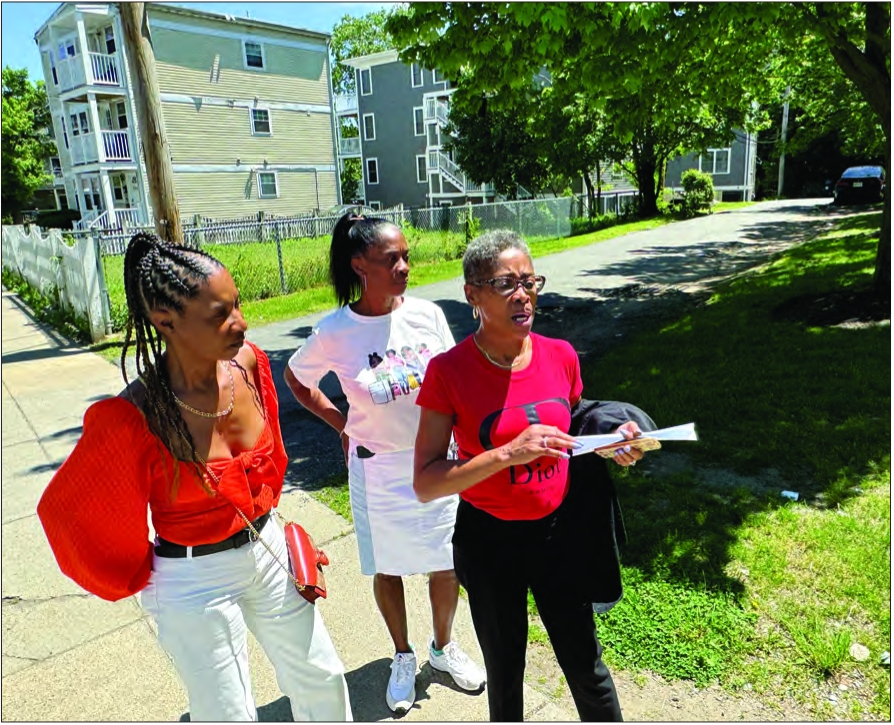
Three
daughters of James Saucer – Brenda Saucer, Tracee Carter and Pamela
Saucer-Richardson – visit a property that their father used to own that
the city of Boston has now given to a nonprofit organization to build
affordable housing. On a spring afternoon, Pamela Saucer-Richardson stood in a grassy vacant lot on Erie Street, a block from Franklin Park in Dorchester, and remembered when her father owned the property more than 30 years ago.
“It was a beauty salon here,” she said. “My stepmother used to do hair. It was a building … a building with storefronts.”
In 1992, the city of Boston notified her father, James Saucer, it planned to take the two-lot property because he owed nearly $5,000 in unpaid taxes and interest. Four years later, the city boarded up the buildings and then bulldozed them — and sent Saucer the bill — leaving the urban landscape abandoned for years.
Now, the city is planning to sell the land for $200 to a nonprofit as part of a program called Welcome Home, Boston, meant to fast-track construction of affordable housing in some of the city’s lowest-income areas. It’s part of Mayor Michelle Wu’s landmark effort to build affordable housing backed by nearly $60 million in federal COVID-19 relief funding.
GBH News found that most of the properties slated for the Welcome Home program — dozens of abandoned lots owned by the city of Boston — followed the same path as the Saucers’ property: Black and brown homeowners in the 1970s and ’80s lost their land to tax liens and overdue water bills.
Saucer-Richardson, 63, said the city made no effort to reach out to her or her family, and she doesn’t understand why a social services organization with no background in construction is basically being gifted land her father used to own. The city’s 2023 appraised value of the lot was $735,000.
“Why can’t we buy it for $400 and do something with it?” she said. “Why didn’t they talk to someone whose name was on it?”
City officials say they are providing subsidies to mostly small, local and minority-owned builders to build income-restricted housing on these vacant lots. The builders will be required to employ Boston residents for the construction and make the units fully electric and energy efficient, among other things.
But critics say not enough has been done to address
what led the properties to be vacant: historic discrimination against
Black and Latino residents by a racist real estate system.
A
year ago, former state Rep. Dianne Wilkerson urged the city to put the
Welcome Home program on hold until a city reparations task force
completes its research on centuries of economic harm suffered by Black
residents.
“It’s
vacant because the city bulldozed Black people’s houses and businesses,”
Wilkerson said last summer at a meeting of the city’s Task Force on
Reparations. She warned that if Boston officials spend millions of
dollars in federal relief and give away dozens of vacant lots, there
will be neither cash nor land left to use to make reparations to Black
families.
Joseph
Feaster Jr., chair of the task force, told GBH News at the time that he
thought Wilkerson had a good point. “I think that that’s something that
I’m certainly going to bring to the forefront.”
Feaster
did not respond to GBH News’ request to discuss whether he raised these
concerns with the city. But others support Wilkerson’s concerns.
Rev.
Kevin Peterson, who established and leads an alternative, grassroots
“People’s Reparations Commission,” said “the city should not be handing
over land to developers, land which were lost to Black families during
urban renewal or even after that.” Instead, he said, Boston should
“focus on how to repair its relationship with Black people. And part of
that would be through returning land to Black people who lost it through
discriminatory practices, predatory practices.”
Lots sat vacant for years
Not
all of the vacant lots can be tied to a specific local Black family.
Gail Latimore, executive director of the Codman Square Neighborhood
Development Corporation, which was granted two lots in the program, said
she was told that some of the properties were abandoned by white
landlords who allowed them to crumble.
“We’ve
had a history of contractors and other folks from outside the city
literally coming and dumping their trash on these vacant lots,” she
said.
Most of the land
slated for sale has been vacant for decades. All of the properties sit
inside the borders that city banks had designated for federally backed
mortgages for Black landowners in the 1960s and ’70s.
Once
a predominantly Jewish community, white families around Blue Hill
Avenue were encouraged by real estate agents to sell and move out, and
Black families were given incentives to buy within these lines.
Once they owned the properties, Black families faced numerous hurdles.
Russ
Lopez, a local historian who has written several books about Boston,
said Black or Hispanic residents could only buy in Dorchester, Roxbury
and Mattapan. They would buy homes, he said, from white real estate
agents who bought the properties below market price from departing white
families fearing new neighbors of color, and then turn them around for a
steep profit.
A lot
of the buildings were old and left in disrepair as the prior owners
evacuated, and buyers were given no “contingency” for inspections.
“The
clue to all this is that people bought these places that were terribly
run down without the resources to fix them up,” Lopez said. “I can only
think of the emotional toil that these poor families went through. You
know, the sleepless nights, right? The worry that the phone call was
going to ring ... and be somebody demanding money, or something would
break and you couldn’t fix it.”
Suffolk
County property records show James Saucer owned about a dozen separate
Dorchester properties over the years, with a string of tax liens and
city foreclosures. He bought the Erie Street property in 1983. His
daughters say none of the properties have remained in the family.
The
daughters say Saucer had his hands in all kinds of business ventures.
He ran a carpet store and tried to buy and sell property. He married
three times and died in 2018, leaving nine children and 28
grandchildren.
“My
father was so well known in this community,” said Tracee Carter, 62,
“People loved him. He was a mason. He had his own carpet business.”
“He
has a legacy,” her sister Pam added. “He has children. You know,
there’s nine of us children … and we should be able to try to reclaim
some of that.”
The
city moved in October to sell the land on Erie Street for $200 to a
Roxbury social services organization called the African Community
Economic Development of New England, or ACEDONE, to build affordable
housing.
The group’s
mission, according to its website, is to “to help African refugees and
immigrants in Boston develop a self-sufficient and vital community by
providing our youth with the education and life experience to thrive
socially, professionally and economically.” The nonprofit has put
together a team to begin building housing, but the group has no track
record in developing housing yet.
A
spokesman for the group expressed interest in discussing the project
with GBH News, but then said the organization would not make anyone
available.
The
Erie Street land was part of a first tranche of properties sold as part
of the Welcome Home project. Last month, Wu announced the selection of
developers to purchase 15 more city-owned properties. “Their work will
help make Boston home for everyone, as we create much-needed
homeownership opportunities in our neighborhoods and reshape the
industry building them,” the mayor said.
One
of the developers is KZ Builders, LLC, a new company created last year
by former Boston City Councilor Josh Zakim and Senam Kumahia, the
director of development at a local firm called Rhino Capital. KZ
Builders has never built anything, but Zakim said Kumahia has done a lot
of development projects and they have put together a team of
experienced architects and builders.
Zakim said he brings expertise in dealing with the city on zoning and permitting.
“We’re confident we can get it built,” Zakim told GBH News.
KZ
Builders won the right to build on several vacant lots on Nottingham
Street in the area around Bowdoin Street and Geneva Avenue, a low-income
Boston neighborhood with a high concentration of Black and Latino
residents. Suffolk County property records indicate one of the lots sold
in this tranche was last owned by George and Elmena Bynoe.
The
Bynoes’ children told GBH News that their father’s story is different
from the Saucers’ for one reason: George Bynoe was a carpenter by trade.
He could fix up the homes by himself without needing financing — within
limits.
“I worked
with him a lot,” said 59-year-old Hayden Bynoe, the eldest of the
children, who now lives in Michigan. “He was trying to just redo the
houses and rent them out. There was a lot of issues that came about with
the city and trying to do that on his own.”
Hayden’s
sister Leontyne, 50, says her father succeeded in renovating and
renting out several properties in Roxbury and Dorchester. One of the
properties is still in their family: their sister, Gilian Bynoe Stinson,
still lives in the family home that their father renovated himself.
“We realize how lucky we are,” Leontyne said. “Our story is not common. We get it. It’s not lost on us.”
But
their father also owned properties, like those on Nottingham Street,
that were taken by the city. Hayden Bynoe says it’s likely they were in
such rough shape he could not fix them up himself, so he walked away.
“He may have felt that ... it was a larger project, and that with all
that he had, he could not really do what he needed to do,” Hayden Bynoe
said.
The Bynoe
children say they are not angry that the city is selling their father’s
former properties for a song. But Leontyne points out that if he had
more access to capital, he could have done much more. “If he was able to
do it over again today, it would have been way more profitable.”
In
his downtown office across from City Hall, Zakim said the city program
is all about bringing affordable housing to communities that have long
lacked it. “We’re not turning this into a luxury property,” he said. KZ
Builders will be building housing “for folks who are making
middle-income wages, people who are going to be able to grow their
families in this community, put down roots.”
Asked about whether the families like the Bynoes are owed some kind of reparations from the city, Zakim, who is white, demurred.
“As
someone who looks like me and lives like me, I don’t think I’m in a
position to say who is or, you know, what reparations would be owed,” he
told GBH News.
Latimore,
with the Codman Square Neighborhood Development Corporation that will
be developing two lots, says she would be concerned if people could show
that their family lost a property because of racially discriminatory
policies.
“We
certainly — as an organization — definitely would welcome reparations,
of any kind,” she said, “while also wanting to see lots get developed
for the purpose of another form of reparations, which is, you know,
affordable housing and in this case, affordable homeownership housing,
which is what we’re going to build.”
Most
of the properties in the Welcome Home program will be primarily for
working people with a moderate income, not for the city’s lowest-income
residents. The projects are being designed to sell to people earning 80%
to 100% of Boston’s “area median income” — meaning that, in general,
the units will be marketed to families earning between $90,000 and
$190,000 annually depending on the size of the family and the unit.
Matthew
Robayna, a principal with the local developer Boston Communities, says
the units they plan to build as part of the city program will range in
price between $200,000 and $300,000, while costs to build them are more
than $600,000.
“We’re
basically selling them for roughly half of what we’re building it for,”
he said. This is only possible because of “really, generous financial
assistance from the city and the state,” he said.
In
fact, the whole Welcome Home program is based on a series of
interlocking subsidies for both builders and buyers of the units.
Antonio
Leite, a senior housing development officer in Boston’s housing office,
said the city will provide “down payment assistance” for buyers and “we
reserved a pot of money that goes towards subsidizing the development
itself as well. So we’re both supporting the homeowner, and then we’re
supporting the developer to make this deal happen.”
And
since the city is trying to hand the projects to inexperienced local
developers, the housing office has hired a technical assistance
consultant to help them navigate the complicated process. “We knew going
into it that it would kind of cause more responsibility on our end to
be responsive to folks that are new to going through the process,” Leite
said.
The ultimate
goal, the city says, is to bringing housing — and its associated
economic development — back to the communities that have suffered from
decades of economic exclusion.
Alexander
Sturke, a spokesman for the housing office, said many of the developers
selected so far are local minority- or women-owned businesses.
“People
want the opportunity to buy houses in their own neighborhoods,” he
said. “But they also want the houses to be built by people that have a
connection to the neighborhood or a connection to the city.”
The
Saucer sisters, who still live in Boston, said the city could also just
cut out the middlemen — they would be happy to build on the land their
father lost.
“We just
want something we can build on, to call home. Because we were all born
here,” said Brenda Saucer, 61. “It don’t make no sense to strip my
father of that and not to even reach out. I think it’s a travesty.”
Paul Singer is the investigations & impact editor at the GBH News Center for Investigative Reporting.


