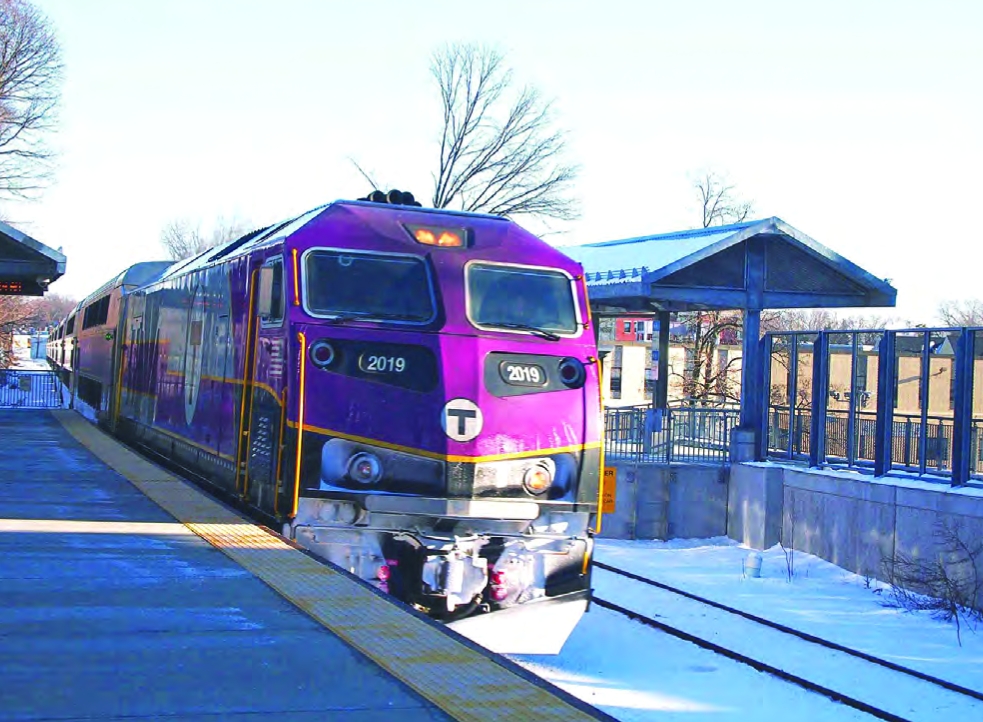
Fairmount Line trainThe MBTA board voted last week to increase the frequency of trains on the Fairmount Line to 20 minutes, effectively bringing rapid transit service to the commuter rail line serving Roxbury, Dorchester, Mattapan and Hyde Park communities.
Currently, diesel trains serve the line at halfhour intervals. Under the MBTA’s plan, the system will be served by battery electric multiple unit trains — trains where each car has its own power, enabling them to accelerate and brake faster than diesel trains, where a locomotive pulls or pushes a train of passenger cars. The electrification will increase frequency from the current 30-minute wait between trains during peak times.
The plan is part of a $54 million pilot project being launched by the MBTA and Keolis, the firm contracted to run its commuter rail lines. The Battery Electric Multiple Unit pilot project is expected to be implemented by 2028. If the project succeeds in attracting more riders, MBTA officials may use the technology to electrify additional commuter lines.
State Rep. Christopher Worrell, whose district office sits across the street from the Four Corners stop on the Fairmount line, called the MBTA board vote a step in the right direction.
“It’s truly amazing that this is happening,” he said. “Electrifying the Fairmount Line will mean better service and less diesel emissions in our neighborhoods.”
Local
transit advocates, many of whom are now working under the banner of the
Fairmount Indigo Transit Coalition (FITC), have pushed for decades for
better service along the corridor, which runs through some of the most
public transit-dependent communities in the city. For years the line ran
with several stops in Hyde Park, one on Morton Street in Mattapan and
none in Dorchester or Roxbury.
Over
the last three decades, activists have advocated new stops, gaining
stations in Mattapan Square, Upham’s Corner, at Talbot Avenue and at
Washington Street near Four Corners and Geneva Avenue. Beginning 20
years ago, a coalition of neighborhood nonprofits advocated electrifying
the line to facilitate rapid transit service. In recent years, transit
advocates have pushed for electrification on multiple MBTA commuter rail
lines — a move many say would increase ridership and lead to less
traffic on Greater Boston area highways.
“This
is a long-awaited victory for the residents along the Fairmount
Corridor,” said Marilyn Forman, co-chair of the FITC. “It builds on the
success of the new stations and service improvements we’ve achieved over
the years. We are committed to ensuring that this pilot is just the
beginning of more transformative changes to come.”
Jarred
Johnson, the executive director of the Transit Matters advocacy group,
said he hopes the MBTA will replicate the faster, more frequent service
on the Fairmount Line on other commuter rail lines.
“If
commuter rail is able to transform into [a] regional rail, the rail
network will be much more useful, not just to commuters, but to
everyone,” he said.
Johnson
said it could take the MBTA 15 to 20 years to electrify more lines,
given the agency’s reliance on the Massachusetts Legislature
for funding. But the move could bring subway-like service to cities and
towns as far away as Lowell and Worcester and greatly reduce commute
times to Boston.
“It will have a real transformative impact on congestion and on the ability to build more housing,” he said.
Mela
Miles, co-chair of the FITC, said the electrification of the line will
improve the quality of life for those who live in the communities it
serves, including improving the air quality.
“Millions
of dollars of investment to electrify this line will serve to improve
the air quality and quality of life in our communities in so many ways,”
Miles said. “You just can’t put a price tag on that.”


