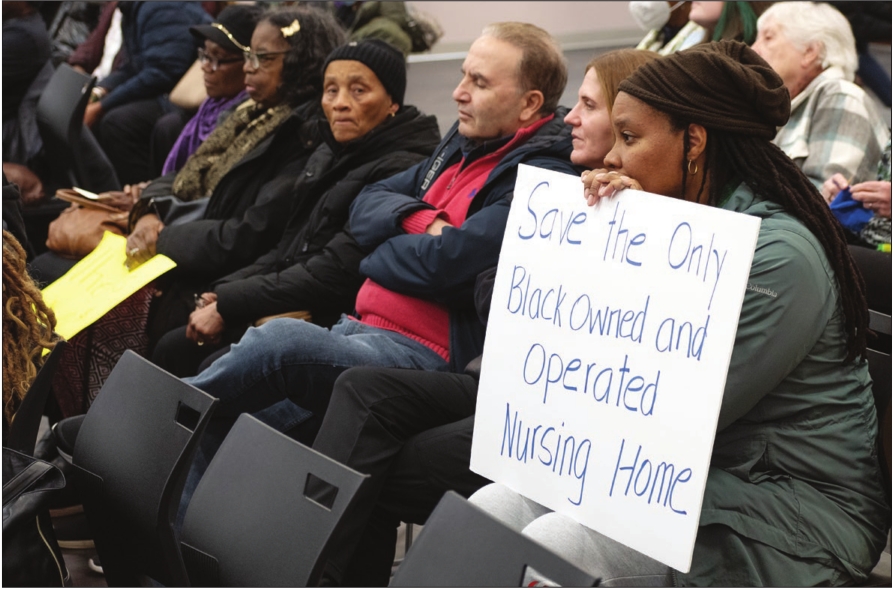
A supporter of the Edgar Benjamin Healthcare Center holds a sign calling for the facility to remain open at a Department of Public Health hearing on March 26.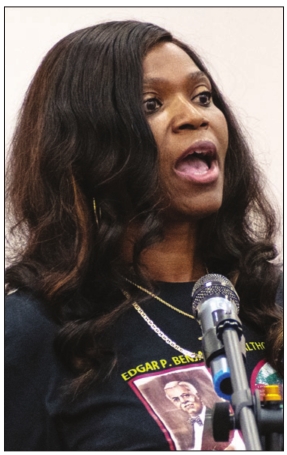
Leslie Henderson, director of admissions at the Edgar Benjamin Healthcare Center, speaks out at a public hearing on the pending closure of the facility.
As the Edgar Benjamin Healthcare Center faces a pending closure this summer, community members took matters into their own hands in an attempt to keep the facility open.
In a lawsuit filed March 28, two family members of residents at the historically Black nursing home officially pushed for receivership of the Mission Hill facility, after petitions for the attorney general’s office and the Department of Public Health — the two state entities designated to seek a receiver — did not initially lead to official action.
However, days before the case’s April 2 hearing, the attorney general’s office and DPH voiced their support for the action, following months of declining to petition the court for receivership. Receivership would lead to a state takeover and the ouster of the Edgar Benjamin’s controversial management team but not necessarily ensure the center’s survival.
The receivership case was heard in the Suffolk County Superior Court. At the civil hearing, Justice Katie Rayburn took the matter under advisement, saying she will get to it as soon as she can. Attorney Oren Sellstrom, who represented the two guardians of Edgar Benjamin residents, said he is confident that Rayburn recognized the urgency of the matter.
The suit for receivership comes after the Edgar Benjamin’s administration announced in February its intent to close the almost-100-year-old facility, which currently serves about 70 residents, most of whom are people of color.
Ahead of the hearing, former state Sen. Dianne Wilkerson said she was “delighted” the case is being heard in court. If approved, receivership would offer a chance for new leadership to try to get the facility back on track.
“The answer can’t be to throw the whole baby out,” Wilkerson said. “You’ve got to run some new bathwater.”
In a letter to families Feb. 13, Tony Francis, executive director of the center, said the closure was due to “insurmountable financial difficulties.”
Since Francis took over as director in 2014, his salary risen by more than four times to nearly $628,000 in 2021, according to financial records filed with the IRS.
If receivership of the facility is approved, the state would appoint someone from outside the facility to take over in an attempt to address issues at the center. In its history, the Edgar Benjamin has twice before been put under receivership, and both times, the change in leadership allowed the center to bounce back and continue operations.
“It’s critical that the person at the helm be someone who can manage finances properly and steer the institution in the right direction,” said Sellstrom, who serves as litigation director at Lawyers for Civil Rights.
In the filing, attorneys from Lawyers for Civil Rights pointed to inadequate supplies, staff shortages and center mismanagement in their lawsuit filed to ask the Massachusetts Superior Court to grant receivership.
Francis and the facility declined to comment.
According to the suit, residents at the Benjamin have faced declining care. As of 2020, the center had a doctor on site. Now the doctor comes in only on Saturdays and doesn’t meet with residents. The facility’s dietician doesn’t come in regularly and is allowed to work remotely. Risk assessment meetings with the doctor, dietitian and nursing staff, which are supposed to happen weekly, haven’t occurred since January, even as patients have experienced significant weight loss.
Affidavits from staff at the facility paint a picture of limited supplies and equipment. As of February, the center’s supply of colostomy bags ran out and staff had to wrap a resident in a towel before they could borrow some from another facility. About 10 call lights — used to signal when a resident is having an emergency or needs help — were nonfunctional.
In response to the allegations, during the hearing, the attorney representing the Edgar Benjamin pointed to an affidavit from Stephen Davis, director of the state’s Department of Facility Licensure and Certification, describing a visit to the center at which time, he found no shortages of supplies.
During the same visit, staff said that was not always the case. For instance, kitchen staff said they sometimes run out of food.
According to the affidavits, vendors who used to work with the facility have cut ties due to non-payment. This has left residents with broken wheelchairs and equipment, like the lifts used to help get heavier residents out of bed. Residents can’t be weighed correctly because the scales used are inaccurate and uncalibrated, and computers at the facility are left vulnerable to cyberattacks and hacking without updates.
The center’s van, used to transport residents to medical appointments, hasn’t been used in months because the insurance hasn’t been paid on it, said Leslie Henderson, director of admissions, in her affidavit.
Utilities, too, have gone unpaid, resulting in a past-due water bill of $175,000 and an electric bill of $339,000 as of February.
The facility failed to pay staff paychecks in November 2023 and again in December — with Francis citing financial issues both times. In December, staff also started receiving paper checks after the payroll provider stopped processing paychecks because of nonpayment. When several employees attempted to deposit their checks, the checks bounced.
Francis allegedly said he would pay for banking fees and late fees resulting from the bounced checks, said Kathy Blicker, who works in accounts receivable at the Edgar Benjamin, in her affidavit. To her knowledge, that hasn’t happened.
During periods when staff went unpaid, the center saw decreased staffing numbers as nurses called out of work. According to an affidavit from Marise Colsoul, the Edgar Benjamin’s director of nursing, understaffing often left each of the three units with one nurse only, and nurses sometimes had to work double shifts.
Blicker said that when the facility was especially understaffed, she and other office staff would go in on weekends to perform tasks that would normally be done by a certified nursing assistant.
Following the filing of the lawsuit, staff again went unpaid as checks bounced Friday. In response, two nurses called out from the Saturday night shift, leaving the facility understaffed.
During the hearing, an attorney for the state said the most recent round of bounced checks is what pushed both the DPH and the attorney general’s office to sign onto the petition for receivership.
If appointed, they said, the receiver could ensure payment of staff and care of residents while also determining if the closure plan should continue or if the facility could be kept open.
The lawsuit brings into question the financial hardship the nursing home is allegedly facing.
According to Blicker, the facility continues to receive significant income and revenue.
Monthly, it receives about $720,000 from sources like private and public insurance, as well as an additional $75,000 in rental income from Roxbury Prep’s Mission Hill Campus, which rents the building’s third floor. In 2021, the facility received over $1.6 million in Paycheck Protection Program support from the federal government, according to the federal Pandemic Oversight program.
Royal Bolling Jr., who previously served on the board of directors at the Edgar Benjamin until he was removed after questioning financial decisions at the facility, said that during his tenure at the organization, the center frequently faced financial challenges, but they were never insurmountable.
Sellstrom said there’s a series of red flags that indicate the need for a change in leadership, including a rapidly shrinking board that went from about 12 individuals prior to Francis’s tenure to three, as of March 21.
“For a nonprofit organization like the Benjamin, the board of directors are key to maintaining accountability and transparency,” Sellstrom said.
Staff at the Edgar Benjamin alleged that any board members who raised issues about management of the facility were removed, and that no board member, save for Francis, who serves as president, has set foot in the building.
Sellstrom also pointed to a “highly unorthodox” interchange of Francis’s personal money to pay for things like payroll with a 12% interest rate.
A series of request forms for checks cut by the facility in 2023 to reimburse Francis for personal money used to pay the Edgar Benjamin’s payroll and other expenses show a total of at least $660,000 given back to Francis, including interest.
Separately, bank statements obtained by the Banner show payments of large bills on an American Express card for Francis. In March 2023, the bill was $100,000. In July, it was $85,000.
Francis’ alleged financial mismanagement came under fire at a public hearing on March 26, held by the Department of Public Health.
“If we’re in such financial distress, and if we’re still able to pay a salary in excess of $625,000, maybe you are the financial distress,” said Henderson, the admissions director.
At that hearing on the closure process, which took place at the Thelma D. Burns Building in Roxbury, a crowd of residents, staff, guardians and community members voiced strong support for Francis to step down or be removed from his role, and for a receiver, if appointed, to figure out how to keep the facility running.
That public hearing is part of a process to inform the department’s response to the Edgar Benjamin’s closure plan. It has until April 9 to approve or provide comments on the plan.
Sellstrom said the community’s goal is to keep the facility open but that, once appointed, a receiver would be able to assess all options and determine if that is feasible.
“The community is strongly behind keeping the Benjamin as the premier institution that it is in the community,” Sellstrom said. “We believe that with the appointment of a receiver that will be the first order of business, to examine how to make that a reality.”
As part of the suit, Roxbury attorney Joseph Feaster was recommended to fill the role of receiver.
Feaster said he doesn’t know much about what the circumstances are at the Edgar Benjamin, but said he believes he could bring a sense of order to the process, given his career as an attorney, his longstanding community connections, and a previous five-year stint as a receiver at the Roxbury Comprehensive Community Health Center.
In 2013, Feaster was tapped by then-Attorney General Martha Coakley to take over the Roxbury health center and guide it through a tumultuous closure, helping to transition patients to other facilities and assess the financial situation that had led to that health center’s collapse.
Bolling said that if a receiver were appointed, that person would be one part of the puzzle but would have to turn to someone with nursing home administration expertise to keep the facility open long-term.
Feaster said he would want to be able to provide another set of eyes on the situation.
“You want to look at whether you can stabilize the organization such that it can continue,” he said “That’s the threshold determination, in my view.”