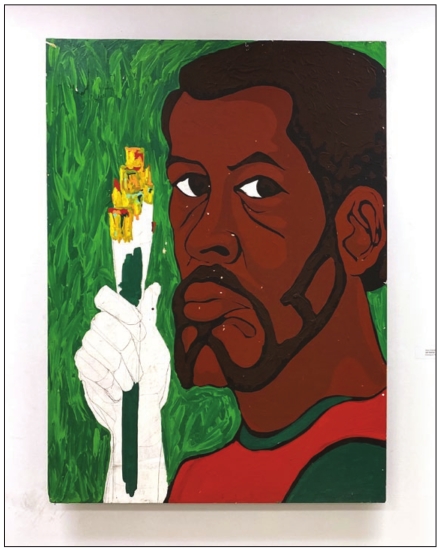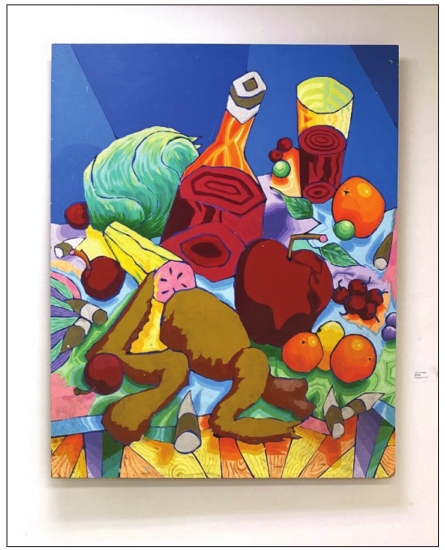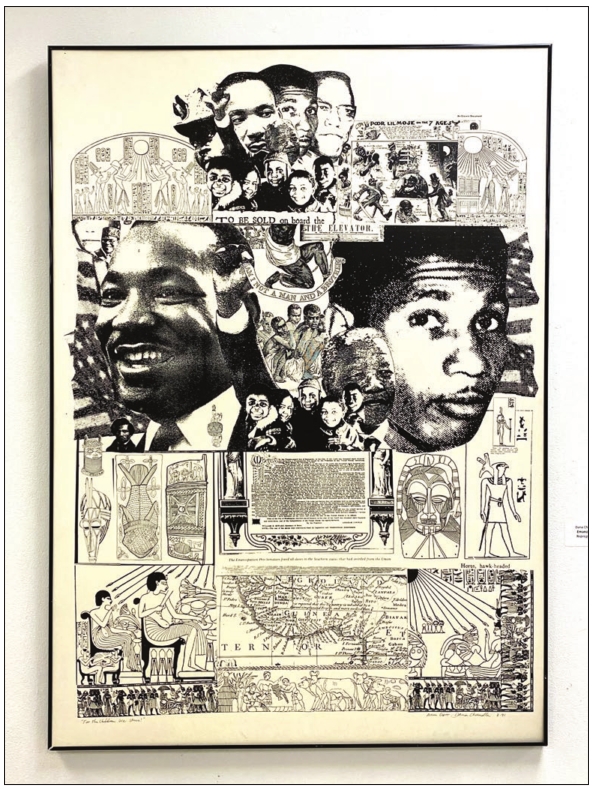
(above
left) “Self-portrait,” Dana C. Chandler Jr. (above right) “Still life,”
Dana C. Chandler Jr. (left) “Emancipation,”reprographic, Dana C.
Chandler Jr. BANNER PHOTOS 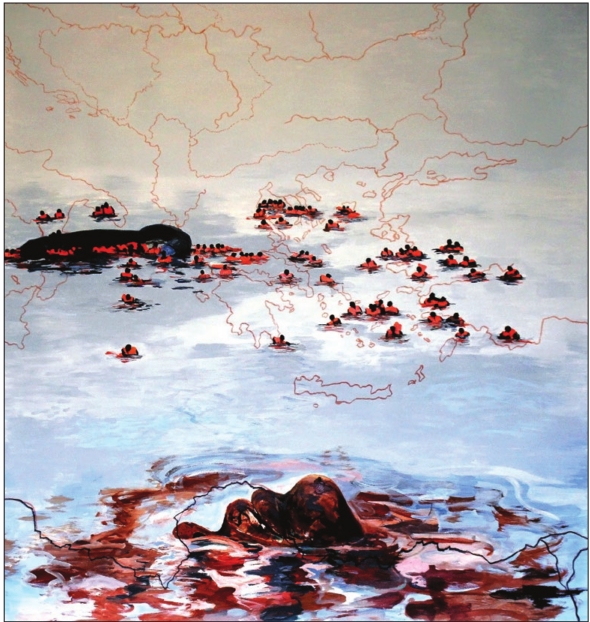
“THE MEDITERRANEAN PASSAGE 1,” Khalid Kodi
‘Reclamation’ features work of artist-activist Dana C. Chandler Jr. and others
Before finding its home in Jamaica Plain about two decades ago, the African American Master Artists-in-Residency Program was housed in a factory building on Leon Street and later moved to a space on Huntington Avenue. Through each move and passing decade, AAMARP has continued to provide artists with studio space and, most importantly, a supportive community.
Every few months, the program conceives a themed exhibit, displaying artworks from the various artists-in-residency. Currently showing at AAMARP is “Reclamation,” a mixed-media exhibit honoring the program’s founder, Dana C. Chandler Jr., an artist and activist who established AAMARP in the 1970s. The endeavor began simply as a gathering space for artists and subsequently became a Northeastern University-affiliated program.
“It’s important to recognize and acknowledge those who come before you,” said Reginald “Reggie” Jackson, a professor emeritus of communications at Simmons University and acting director of AAMARP. He added that honoring Chandler’s work was crucial because the founder “started something that’s not replicated anywhere that I’ve been” when he created AAMARP.
The program’s two-floor space in a building on Atherton Street is brimming with artwork. The Dana Chandler Gallery, the primary location of the section of the “Reclamation” exhibit honoring Chandler, holds a collection of selected works by the artist, some black and white, others bursting with vibrant colors.
In other parts of the building, entire hallways and walls are adorned with works by
AAMARP’s notable artists-in-residency: Gloretta Baynes, Jaypix Belmer,
Marlon Forester, Ricardo Gomez, L’Merchie Frazier, Kofi Kayiga, Khalid
Kodi, Bryan McFarlane, Hakim Raquib, Susan Thompson, Don West and Rene
Westbrook.
Beyond being a tribute to Chandler, “Reclamation” is a visual statement about racism, discrimination, disparity
and access. A dynamic mix of artworks — quilting, photography, painting,
wood-burning and more — bring it to life. The exhibit, which Jackson
called an “attempt to reclaim our history which we have been helped to
forget,” is on display at AAMARP until April 27.
Kodi,
a professor of the practice in the arts, media and design department at
Northeastern University, has been an artist-in-residence at AAMARP
since the 1990s.
“[AAMARP
is] important because it’s a venue for the community from these
neighborhoods to interact with the artists,” said Kodi. “This is a place
that always opens [its] doors for student groups. Different community
groups come and interact with the artists, learn from the artwork
exhibited and learn from the artists.”
For
the “Reclamation” exhibit, Kodi submitted art pieces and an
installation centering on the trip African youth make across the
Mediterranean Sea into Europe to flee hardship, many of them losing
their lives along the way — a story he said echoes the experiences in
the Middle Passage in some ways.
One
of the pieces, “THE MEDITERRANEAN PASSAGE 1,” is a large acrylic
painting depicting this harrowing journey. Against a blue background,
dozens of figures wearing recognizable bright-orange life jackets wade
in the waters between Africa and Europe, in a limbo between life and
death.
Currently, the
future of AAMARP hangs in the balance. Jackson said the program risks
losing its Jamaica Plain space, owned by Northeastern University.
“I feel so blessed and fortunate to be part of this program,” Jackson said, adding that losing the space would be “devastating.”
He
said he is hopeful that the energy within the community will keep
AAMARP going and help the program continue its work of “creating an
environment that is responsive to the needs of the community.”
ON THE WEB
Learn more at facebook.com/groups/AAMARP