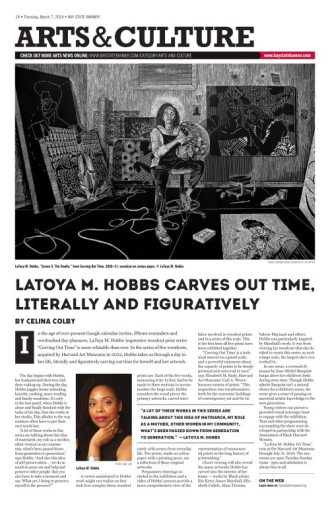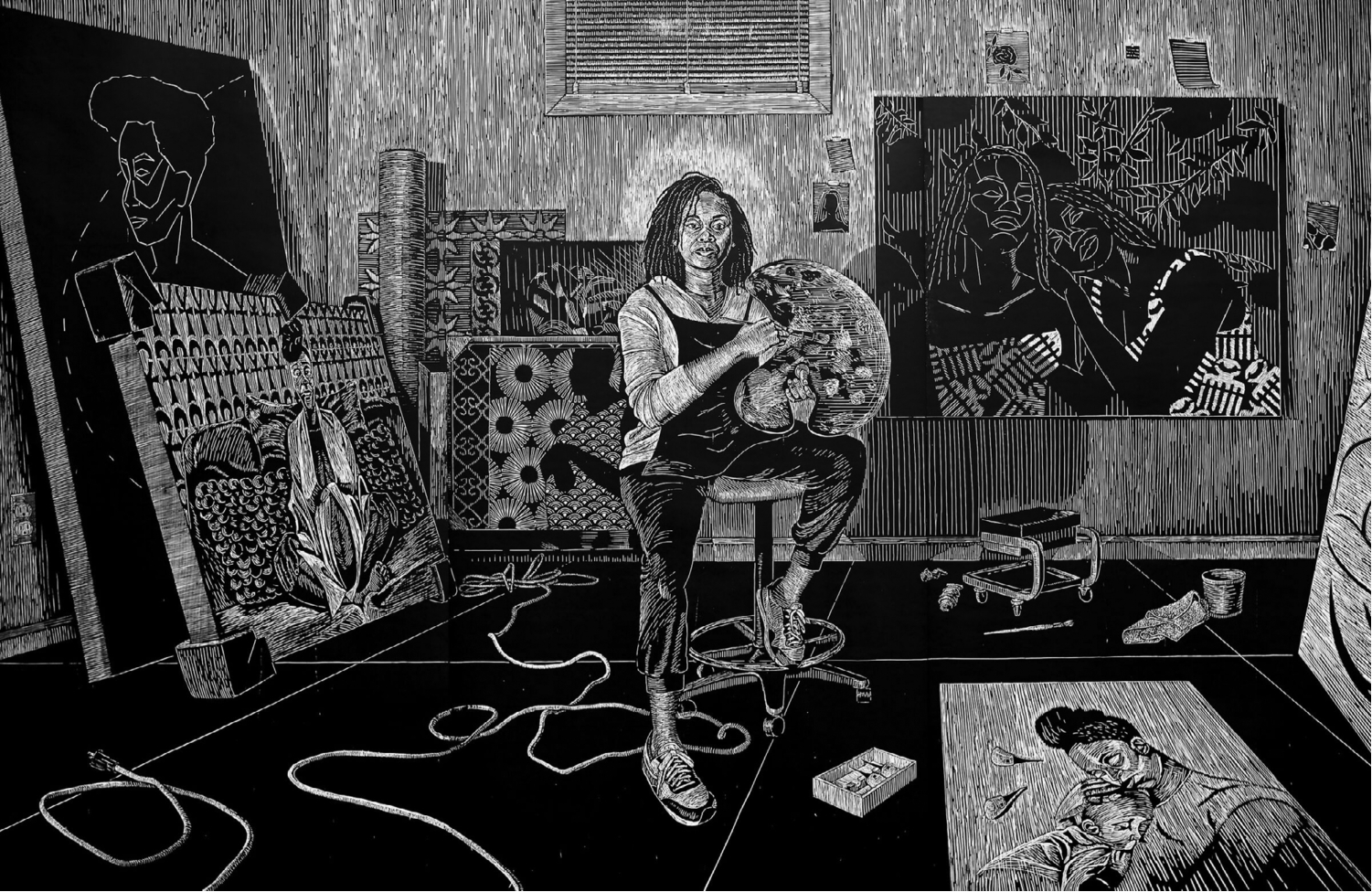
LaToya M. Hobbs, “Scene 5: The Studio,” from Carving Out Time, 2020–21, woodcut on cotton paper. © LaToya M. Hobbs
LaToya M. Hobbs
In the age of ever-present Google calendar invites, iPhone reminders and overbooked day-planners, LaToya M. Hobbs’ impressive woodcut print series “Carving Out Time” is more relatable than ever. In the series of five woodcuts, acquired by Harvard Art Museums in 2022, Hobbs takes us through a day in her life, literally and figuratively carving out time for herself and her artwork.
The day begins with Hobbs,
her husband and their two children waking up. During the day, Hobbs
juggles home-schooling, laundry, cooking, story-reading and family
mealtime. It’s only in the last panel, when Hobbs is alone and finally
finished with the tasks of the day, that she works in her studio. This
alludes to the way mothers often have to put their own needs last.
“A
lot of these works in this series are talking about this idea of
matriarch, my role as a mother, other women in my community, what’s been
passed down from generation to generation,” says Hobbs. “And also this
idea of self-preservation … we do so much to pour out and help and
preserve other people. But you also have to take a moment and say, ‘What
am I doing to preserve myself in the process?’”
A viewer uninitiated to Hobbs’ work might not realize on first look how complex these woodcut prints are. Each of the
five works, measuring 8-by-12 feet, had to be made in three sections to
accommodate the large scale. Hobbs considers the wood pieces the primary
artworks, carved intricately with scenes from everyday life. The
prints, made on cotton paper with a printing press, are a reflection of
those original artworks.
Preparatory
drawings included in the exhibition and a video of Hobbs’ process
provide a more comprehensive view of the labor involved in woodcut
prints and in a series of this scale. This is the first time all five
prints have been exhibited together.
“‘Carving
Out Time’ is a technical marvel on a grand scale, and a powerful
statement about the capacity of prints to be deeply personal and
universal at once,” says Elizabeth M. Rudy, Harvard Art Museums’ Carl A.
Weyerhaeuser curator of prints. “This acquisition was transformative,
both for the museums’ holdings of contemporary art and for its
representation of monumental prints in the long history of printmaking.”
Closer
viewing will also reveal the many artworks Hobbs has carved into the
interior of her home — works by Black artists like Kerry James Marshall,
Elizabeth Catlett, Alma Thomas, Valerie Maynard and others.
Hobbs was particularly inspired by Marshall’s work; it was from viewing
his woodcuts that she decided to create this series on such a large
scale, the largest she’s ever worked in.
In
one scene, a crowned dinosaur by Jean-Michel Basquiat hangs above her
children’s beds during story time. Though Hobbs admits Basquiat isn’t a
natural choice for a children’s room, the scene gives a sense of passing
on ancestral artistic knowledge to the next generation.
Young
visitors can pursue a provided visual scavenger hunt to engage with the
exhibition. That and other programming surrounding the show were
developed in partnership with the Association of Black Harvard Women.
“LaToya
M. Hobbs: It’s Time,” runs at the Harvard Art Museums through July 21,
2024. The museums are open Tuesday-Sunday 10am - 5pm and admission is
always free to all.
ON THE WEB
Learn more at: harvardartmuseums.org