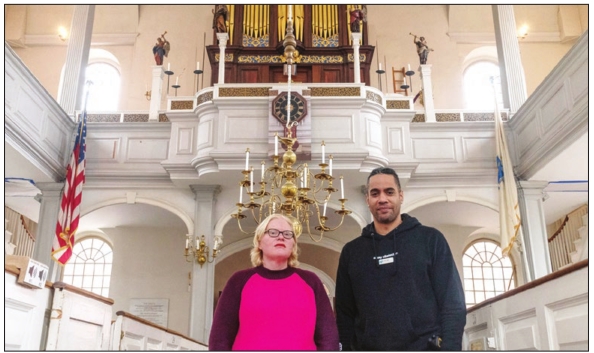
Nikki
Stewart (left), executive director of Old North Illuminated, and Julius
James, visitor experience manager at Old North Church and Historic
Site, pose for a photo in Old North Church, Feb. 23. To celebrate its
300th anniversary in 2023, the church installed a new permanent exhibit,
alongside a series of videos and an audio guide, exploring the church’s
history beyond its connection to Paul Revere, including its legacy with
slavery and people of color. In the front left corner of the hushed sanctuary in Old North Church sits a box pew lined in plush red velvet, as it might have looked centuries ago. That pew was once reserved for the use of a group of traders who donated a cargo-load of valuable logwood that the church sold to fund the construction of the steeple where two lanterns set off Paul Revere’s ride.
That logwood that paid for the steeple was felled by slave labor.
For years, that pew, called the Bay Pew, served as the location in the church where guides might discuss the church’s connection with slavery and race. That story has now been spread across the whole floor of the church sanctuary, following new research and educational efforts to broaden the site’s historical legacy in honor of its 300-year anniversary last year.
“When people come, they learn more about the one moment [of Paul Revere’s ride] which is so important in U.S. history, but there have been so many important moments in Old North’s history, and we felt that it was important to ensure that African and Indigenous peoples were also part of that story,” said Jaimie Crumley, the research fellow who led the work.
Crumley’s research focused on the period between its first worship services in 1723 and the lead-up to the Civil War in 1861.
During that time, the North End landmark was open to white, Black and Indigenous congregants — the church’s first rector Timothy Cutler, an enslaver, eagerly tried to baptize Black and Indigenous people into the congregation — but the space was long segregated by race and class. Congregants of color were forced to sit in the north gallery, above the sanctuary floor, where clear sight lines to the front of the space could often be blocked.
Incorporating the history
throughout the entire sanctuary space was a prominent goal for Old North
Illuminated, the historical museum arm of the church, which also hosts
an active congregation.
“We
try to be very intentional about not saying, ‘Okay, we’re going to talk
about Paul Revere and the lanterns in this space and then we’re going
to talk about slavery over here,’” said Nikki Stewart, executive
director of Old North Illuminated. “We’ve really tried to weave it all
together so that no matter what you’re experiencing here, you understand
both the signal lanterns and the connection to the revolution but also
that slavery was common in the North.”
In
the new exhibit, which was unveiled in August, informational placards
about people like Mary Crankey, a free Black woman who was part of three
generations of Black congregants documented in church records, sit
alongside signs telling the story of people like Newark Jackson, who
worked as a captain, merchant and shop owner and owned and traded
slaves.
In one pew, a
sign tells the story of Elizabeth Humphries, a free Black woman whose
eight children were baptized at Old North Church, while another
identifies Alexander Chamberlain, a white church member who indentured
three of Humphries children when their father died.
Crumley,
who now works as an assistant professor of ethnic studies and gender
studies at the University of Utah, said the history of non-white groups
is often siloed out from the rest of the story in U.S. history.
“Part
of what we’re trying to do at Old North as a public history site [is]
to break away from that and to show that our stories are actually really
integrated,” she said.
“The
white colonists could not have done what they did without Indigenous
peoples both collaborating with them and also resisting them. It’s the
same thing with the stories of African people.”
The
new information has been well-received by visitors, many of whom aren’t
expecting the breadth of stories when they arrive at the church through
the narrow streets and colonial brick architecture of the North End.
“The
general tourist who’s on the Freedom Trail, from other parts of the
country, is drawn because of the lanterns, the rest is like a welcome
surprise, like, ‘Wow, we didn’t know all this happened,’” said Julius
James, visitor experience manager at the Old North Church & Historic
Site.
Kim Burke, a
Michigan resident who visited the church Feb. 23, said going in she
didn’t know if the church would discuss its history with communities of
color but liked
seeing the history included. She said she was interested to learn how
the church both welcomed and separated members of color.
James
said the church has seen some visitation from people specifically
seeking out the exhibit while other stumble onto the new exhibit while
following the Freedom Trail, but he hopes to see more visitation from
communities of color, especially locally in the Boston area.
He encouraged local residents to come, even if they might be turned off by the neighborhood’s touristy reputation.
“The
stories of the free and the slave folks here are just like the real
stories that took place here in Boston in this place in this
neighborhood,” James said. “People should just come and visit.”
The
work done by Old North Illuminated comes as churches and other groups
across the city and the region research and grapple with their ties to
slavery. In 2023, the First Church of Roxbury released a report
detailing its history with slavery and people of color from its founding
to the American Revolution. A report released last month by the
community group Hidden Jamaica Plain investigated the neighborhood’s
ties to enslavement, including connections to local churches like the
First Church of Jamaica Plain.
Crumley
said that as churches and organizations examine and confront this
history, it provides an opportunity to inform discussions both around
financial reparations but also around general questions of equity, and
how to learn from the past to move forward.
“What
does it mean really to create equity in light of these histories?” she
asked. “What does it look like for us also to create more inclusive
futures?”