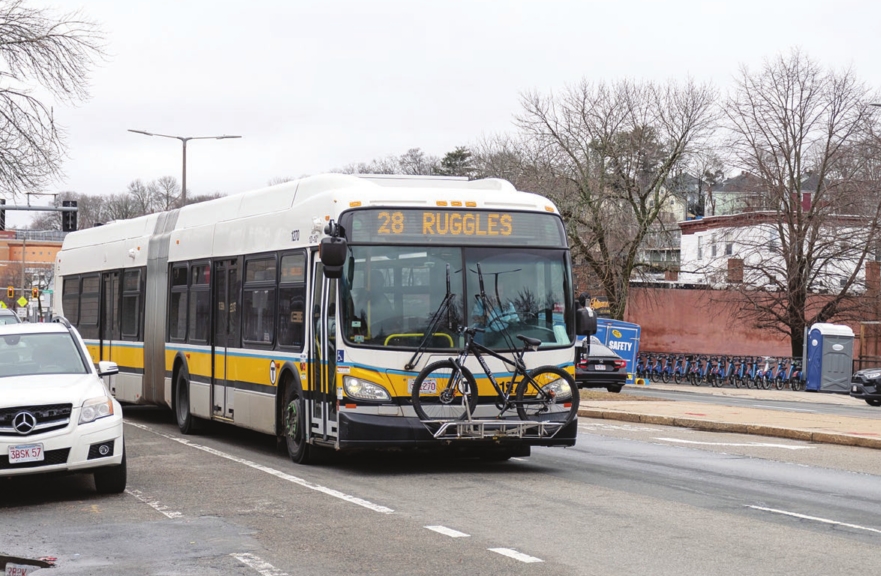
A
bus drives the 28 route on Blue Hill Avenue in Dorchester. A city plan,
announced Feb. 28, would create a center-running bus lane on Blue Hill
Avenue between Mattapan Square and Warren Street, a transit corridor
that serves more than 37,000 riders daily.City proposal would add center bus lane, maintenance and beautification efforts
On a misty morning in Mattapan Square, Fatima Ali-Salaam stops to submit a picture of a toppled steel trash can, its contents spilling out across the sidewalk, to Boston 311, the city’s problem-reporting app and hotline. Five minutes down Blue Hill Avenue, she reports a trash heap including a large, torn-up mattress. At Blue Hill Avenue and Morton Street, she keeps an eye on a crossing signal that doesn’t change for the nearly 15 minutes she waits.
The stops are part of an almostnine-mile walk from one end of Blue Hill Avenue to the other and back that Ali-Salaam, who heads the Greater Mattapan Neighborhood Council, does every Sunday morning to take the pulse on the roadway, which serves as a major artery for Mattapan, Dorchester and Roxbury toward the center of the city. Between piles of trash, uneven pavement and out-of-order crossing signals, her unofficial weekly audit tends not to come back empty-handed.
“We need change. I don’t think anybody would think that we don’t,” Ali-Salaam said.
The administration of Mayor Michelle Wu is planning to use federal funding for a $44 million overhaul of the roadway, with a focus on updated bus and pedestrian infrastructure. The work is slated to begin in 2026.
The
proposed transformation of the roadway would revolve around
center-running bus lanes from Mattapan Square to Warren Street that
could speed up travel times for the more than 37,000 riders who use bus
routes along Blue Hill Avenue daily, making it the travel corridor with
the highest ridership in the MBTA. That key piece of the project, and
one of the only specifics that has been so far announced, has received
mixed reviews from community members and leaders.
The
plan, announced Feb. 28, comes after two years of specific community
engagement efforts and more than a decade of conversations about how to
renovate the thoroughfare. City officials say they plan to target safety
and efficient transportation.
Specific
details around the work remain to be determined as the city continues
to engage the community to develop plans that could vary block by block.
Those efforts will last about two years, with a final plan slated to be
released at the end of 2025.
In
the short term, as the city develops concrete plans, it will start with
beautification and repair efforts to address long-term disinvestment in
the area.
Since
Ali-Salaam started her weekly walks almost five years ago, she said
conditions along the road have only declined, with no significant
maintenance or improvement efforts. The city’s work would include things
like repairing damaged sections of sidewalk and roadway, refreshing
crosswalk and road markings, improving streetlighting and installing
speed humps in nearby neighborhood roadways.
Louis
Elisa, president of the Garrison Trotter Neighborhood Association, said
that work to repair and maintain the area is long overdue, but doesn’t
see a benefit for residents of Boston, especially its Black communities.
“There’s
no reason they can’t fix up Blue Hill Avenue without putting in a
center bus line,” said Elisa, whose neighborhood association borders
Blue Hill Avenue between Warren Street and Seaver Street.
He
said he will be glad to see the better tree coverage the project
promises, along with curb cutouts and better access for disabled
community members, but worries the center-running bus lanes will cause
major disruption in the communities that line Blue Hill Avenue. That
change, he said, would complicate traffic and access to schools and
other locations. Business operations could be impacted if the project
takes away already limited parking spots — along the roadway, cars are
often double-parked and sometimes triple-parked. On Sunday mornings,
outside big churches like the Morning Star Baptist Church in Mattapan,
cars spill out from the parking lot, double-park a block in either
direction and sit on the cement median.
Elisa
said he sees the proposed work as a boon to communities south of the
city whose residents drive into Boston, as well as construction
industries, but not for the nearby neighborhoods themselves.
“It’s the spine, and you can’t clog up the spine without affecting the various veins and arteries,” he said.
But
the center bus lane also brings an opportunity to shift what is
primarily a car-focused roadway into a route that takes a more balanced
consideration of different modes of transportation, said Makayla Comas,
senior manager of community engagement at the transit advocacy group
Livable Streets.
“It’s
the manifestation of equalizing the road space,” said Comas, who helped
collect perspectives from bus riders along Blue Hill Avenue as the city
ran a two-year community engagement effort.
According
to the MBTA, bus riders on Blue Hill Avenue collectively lose an
estimated 3,000 hours in traffic, and across the system, Black bus
riders tend to spend 64 more hours on average on buses than their white
counterparts.
Emmanuell
De Barros, director of development and community engagement at the
Roxbury-based Alternatives for Community and Environment (ACE), said he
views the target audience of the Blue Hill Avenue work as transit
riders, who could see travel times drop by over 30 minutes, according to
city estimates. ACE runs the T Riders Union, which is dedicated to
improving service for public transit users, especially low-income riders
and riders of color.
Ed
Gaskin, who leads Greater Grove Hall Main Streets, said that in Grove
Hall, the project might present the new opportunities to expand green
space through improved medians.
“We
saw the green median as a piece of green infrastructure that can have a
lot of benefit to the community,” he said in an interview.
Greater
Grove Hall Main Streets has been engaged in trying to improve Blue Hill
Avenue medians in the commercial district for years. In the summer of
2017, the organization identified work that could be done to beautify
the space.
In Grove
Hall, the dividers that separate traffic have patchy grass and limited
landscaping, while the Seaport District has medians that are a lush
green and decorated with public art, Gaskin noted.
That
Greater Grove Hall Green Medians project, which started as an
initiative to beautify these spaces, would also cool and limit the urban
heat island effects in the summer and help manage stormwater if
implemented, Gaskin said.
Many
of these goals are included in the city’s proposed work, which would
include planting new trees to help address heat impacts and install
green infrastructure to help address storm flooding, absorb solar energy
and reduce carbon emissions in the area.
Gaskin
said he’s aware of community members’ objections to a center-running
bus lane, but his Main Streets organization didn’t want to get involved
with that conversation, opting instead to focus on how the Blue Hill
Avenue project can help bring better medians and green spaces.
The
center-running bus lane would be the second in Boston, after the city
installed a dedicated center bus lane along Columbus Avenue, where
red-marked lanes are set aside for buses only and platforms on either
side offer improved bus stops and shelters.
A
2023 report from the city found that the Columbus Avenue center bus
lane hastened travel times for bus riders by three or four minutes
during rush hour. As part of that report, a survey found that about 25%
of respondents rode the bus more frequently after the bus lanes were
installed.
According
that report, some nearby neighborhood streets have seen increases in
traffic — a concern Elisa has for the impact of the Blue Hill Avenue
project if implemented — but around Columbus Avenue, the city found that
the increase in neighborhood traffic varied widely.
For
Ali-Salaam, the work that needs to be done on Blue Hill Avenue goes
beyond adding a bus lane. She said the general maintenance and
beautification work the city is promising is key, but the area also
needs more economic revitalization. Much of that, she said, she didn’t
see come to Columbus Avenue when the center-running lane was installed.
“I
really hope we get more than what was done on Columbus Avenue,” she
said. “I really hope we get more than a red stripe on the road.”


