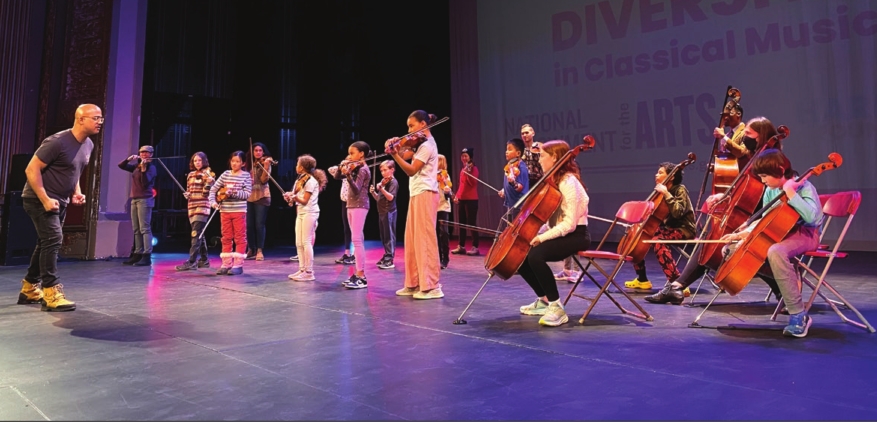
Daniel Bernard Roumain in rehearsal with elementary and middle school musicians. Acclaimed classical violinist and composer Daniel Bernard Roumain stood in front of a group of elementary and middle schoolers at the Strand Theater, framed by a gilded arch and burgundy curtains.
“Rhythm is everything, you dig?” he told the students, before guiding them through a series of spirited improvisational musical exercises.
The bright-eyed young musicians rocked their bows back and forth in step with Roumain, the symphonious sounds of their violins and cellos animating the dim auditorium.
The recent rehearsal was a sampling of a youth string concert that centered on the theme of diversity in classical music.
A first-time collaboration between Roumain and two community arts organizations, the Feb. 11 performance on the historic Dorchester stage featured a mix of works composed by Roumain and students from the Suzuki School of Newton, a community arts nonprofit, and Project STEP, an organization that supports young classical musicians from underrepresented communities.
“The hope was I could come in and work with their students and their parents and their community, our community,” Roumain said, “and create a work together that would represent their hopes and dreams and aspirations for our classical music.”
Collaboration is key for Roumain, who has worked with groups ranging from the Boston Pops to the New Jersey Symphony. He said this partnership with the Suzuki School of Newton and Project STEP could “serve as a model” for community engagement within classical music.
The concert aimed to continue “the work of making classical music a bridge towards equity,” according to the Suzuki School of Newton’s website. The hourlong performance culminated in a “community conversation” in which the 60 K-12 performers and the audience members shared stories about their backgrounds and relationship to music, an unconventional occurrence at a classical concert.
Black and Haitian American, Roumain is one of just 2.4% of U.S. orchestra musicians who are Black or African American, according to a 2023 report from the League of American Orchestras. The study found that Hispanic, Latinx, American Indian and Alaska Native musicians face the same lack of representation. More than three in four orchestra musicians are white.
“For many years, if you were a person of color, there was a bit of compartmentalizing who you were in order to learn Bach and Beethoven and Brahms,” said Ian Saunders, artistic director for Project STEP. “And so having students being able to fully embrace who they are and bring that to the table…it’s pretty essential for breaking down those particular barriers.”
Sachiko Ishihara, executive director of the Suzuki School of Newton, said she wanted to work with Roumain because of his activism and values, which align with the school’s mission to teach children “about the love of music and the love of learning” and to “teach them a sense of social responsibility.”
Beyond his status as a multihyphenate composer who plays over 30 instruments including the harp, djembe and flute, Roumain subverts the idea of who is allowed to occupy classical music spaces and what the genre is. He said he sees himself not as a first responder — an EMT or law enforcement official — but as a “fourth responder” with a “unique role and responsibility.”
“I have an opportunity to create work that speaks to this notion of, ‘In a time of division and great divide, how can the work of artists create community and spaces and places, locations of healing?’” he said.
Classical music has long been viewed as a “service as opposed to any sort of collaboration,” Saunders said. The “reciprocal nature” of the community conversation held following the performance at the Strand Theatre was necessary in cultivating a relationship between the community and its classical music institutions “to see how they can best help each other.”
The concert was the first large indoor performance for the Suzuki School of Newton since the start of the pandemic, so people were “really eager” to attend and “have the opportunity to share their stories,” Ishihara said. She also said asking the audience to “join the conversation” was valuable.