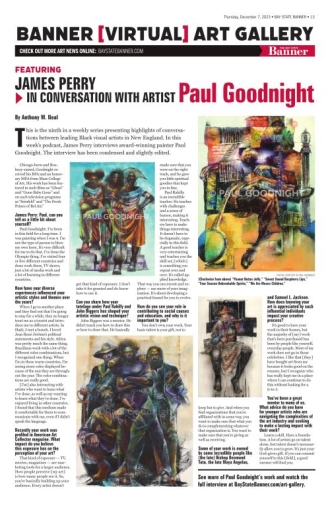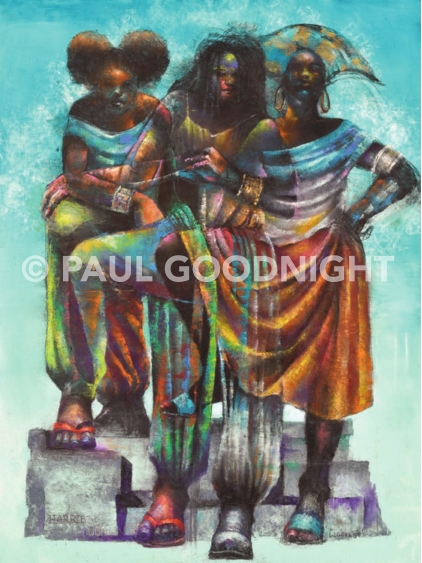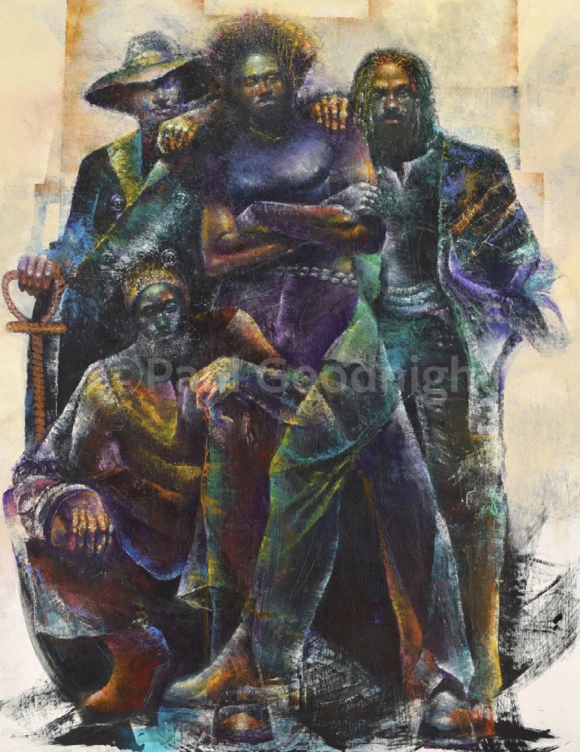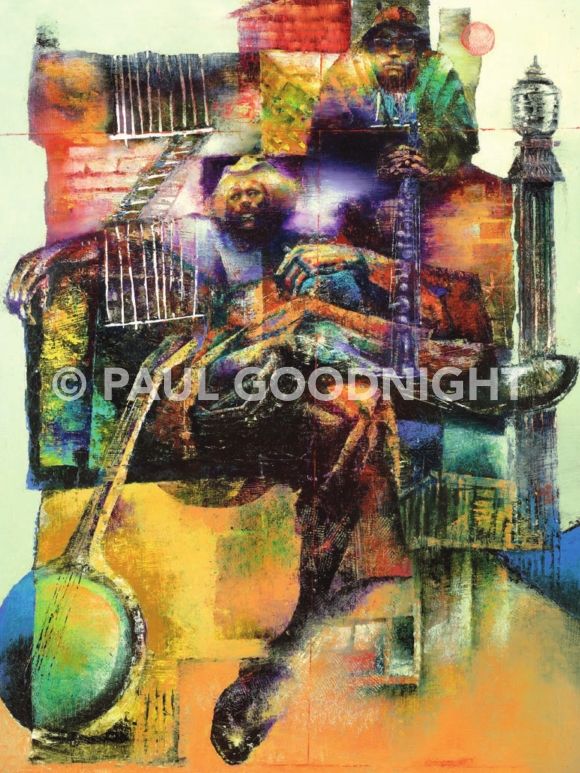
(Clockwise
from above) “Peanut Butter Jelly,” “Sweet Sound Raspberry Lips,” “Four
Season Unbreakable Spirits,” “We Are Moses Children.”

This is the ninth in a weekly series presenting highlights of conversations between leading Black visual artists in New England. In this week’s podcast, James Perry interviews award-winning painter Paul Goodnight. The interview has been condensed and slightly edited.
Chicago-born and
Roxbury-raised, Goodnight received his BFA and an honorary MFA from Mass
College of Art. His work has been featured in such films as “Ghost” and
“Gone Baby Gone” and on such television programs as “Seinfeld” and “The
Fresh Prince of Bel Air.”
James Perry: Paul, can you tell us a little bit about yourself?
Paul
Goodnight: I’ve been in this field for a long time. I was painting when
I was 4. I’m not the type of person to blow my own horn. It’s very
difficult for me to do that. I’ve done the Olympic thing. I’ve visited
four or five different countries and done work there, TV shows, just a
lot of media work and a lot of learning in different countries.
How have your diverse experiences influenced your artistic styles and themes over the years?
When
I go to another place and they find out that I’m going to stay for a
while, they no longer treat me as a tourist and introduce me to
different artists. In Haiti, I met a bunch. I loved Jean René Jérôme’s
political statements and his style. Africa was pretty much the same
thing. Brazilians work with a lot of the different color combinations,
but I recognized one thing: When I’m in these warm countries, I’m seeing
more color displayed because of the sun they see throughout the year.
The color combinations are really good.
[I’m]
also interacting with artists who want to learn what I’ve done, as well
as my wanting to learn what they’ve done. I’ve enjoyed living in other
countries. I found that this medium made it comfortable for them to
communicate with me, even if I didn’t speak the language.
Recently
your work was profiled in American Art Collector magazine. What impact
do you believe this exposure has on the perception of your art?
That kind of exposure — TV, movies, magazines — are marketing tools for a larger audience.
How
people perceive [my art] is how many people see it. So, you’re
basically building up your audience. Every artist doesn’t get that kind
of exposure. I don’t take it for granted and do know how to use it.
Can you share how your tutelage under Paul Rahilly and John Biggers has shaped your artistic vision and technique?
John
Biggers was a mentor. He didn’t teach you how to draw this or how to
draw that. He basically made sure that you were on the right track, and
he gave you little spiritual goodies that kept you in line.
Paul
Rahilly is an incredible teacher. He teaches with challenges and a
sense of humor, making it interesting. Teachers have to make things
interesting. It doesn’t have to be dogmatic, especially in this field.
A
good teacher is very entertaining and teaches you the skill set,
[which] is something you repeat over and over. It’s called applied
knowledge.
That way you can invent and explore — use more of your imagination. It’s about developing a practical funnel for you to evolve.
How do you see your role in contributing to social causes and education, and why is it important to you?
You don’t own your work. Your basic talent is your gift, not to keep but to give. And when
you find organizations that you’re affiliated with in some way, you want
to make sure that what you do is complementing whatever that
organization is. You want to make sure that you’re giving as well as
receiving.
Some of
your work is owned by some incredible people like [the late] Bishop
Desmond Tutu, the late Maya Angelou, and Samuel L. Jackson. How does
knowing your art is appreciated by such influential individuals impact
your creative process?
It’s
good to have your work in their homes, but the majority of [my] work
that’s been purchased has been by people like yourself, everyday people.
Most of my work does not go to those celebrities. I like that [they]
have bought art from me because it looks good on the resume, but I
recognize who has really kept me in a place where I can continue to do
this without looking for a 9-to-5.
You’ve been a great mentor to many of us.
What
advice do you have for younger artists who are navigating the
complexities of the art industry and seeking to make a lasting impact
with their work?
Learn
a skill. Have a foundation. A lot of artists go on talent alone, but
talent doesn’t necessarily allow you to grow. It’s just your God-given
gift. If you can commit yourself to this [field], a good mentor will
find you.
See more of Paul Goodnight’s work and watch the full interview at BayStateBanner.com/art-gallery.