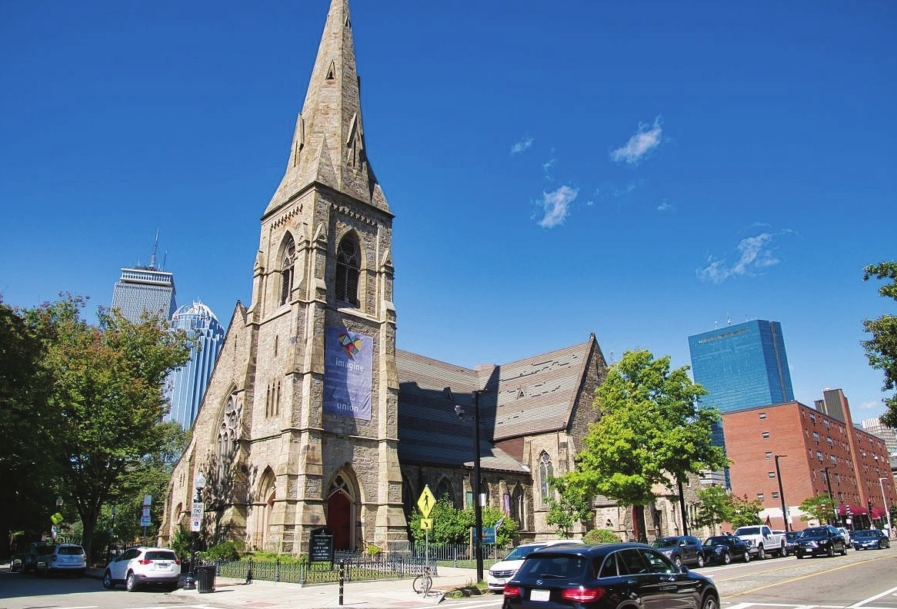
Union United Methodist ChurchSays residents could save close to $15 per month over Eversource
With utility prices soaring, Boston residents will now have a chance to pay lower electricity rates, thanks to a program initiated by City Hall.
The city of Boston announced new rates last month through the Boston Community Choice Electricity program and encouraged all customers to choose BCCE as their electricity supplier. The new rates will be locked in until December 2025, the city said.
Officials said the average resident who uses 600 kilowatt-hours of electricity per month on the BCCE standard option is expected to save nearly $15 per month compared to the Eversource basic service residential rate.
Choosing to get household electricity through BCCE is like casting a vote for more green energy infrastructure in the region, said John Rogers, a Boston-based senior energy analyst at the Union of Concerned Scientists.
“Every time you turn on the light, every time you turn on your dishwasher, you’ll have the power. Nothing changes with regard to that,” Rogers said. “What changes is the impact you’re having when you flick that light switch or when you look at your electricity consumption overall.”
The BCCE program, which launched in February 2021, procures electricity from the electric company on behalf of customers in order to negotiate cheaper rates. It also features higher proportions of renewable energy.
The
program’s standard rate offers recipients more green energy than is
required under state law, with the opportunity to opt out to a rate at
the state’s requirement or opt in to a 100% renewable electricity
supply.
When it announced the new rates, the city said the program aims to help support a transition to more renewable energy.
That
impact is possible because the city isn’t trying to make a profit, said
Mariama White-Hammond, the city’s chief of environment, energy and open
space.
“People are
actually acting as investors in the renewable energy economy,”
White-Hammond said. “We really look at how we can use these resources.
Because we’re not using them to pay executives and all these other
things, we then can use those resources to really invest in renewable
energy projects locally, as much as we possibly can.”
The
BCCE program supplies renewable energy through renewable energy
certificates, which are issued to renewable energy generators to help
track who is producing and who is using the green energy as it traverses
the electrical grid.
For
the Community Choice Electricity program, those are socalled Class I
certificates, which means the energy comes from generators within New
England.
Rogers said local generation of renewable energy is “not a given” in all programs.
“You’re
having an impact much closer to home than if you just bought wind
renewable energy credits from Iowa or Texas,” he said. “This is
something that’s happening here.”
The
BCCE program is being promoted as part of the city’s Green New Deal,
which White-Hammond said is ensuring that people don’t have to choose
between dealing with cli mate justice and economic justice issues.
“It’s
about recognizing that people are sometimes making the choice between
food and fuel,” she said. “Pushing as much as we can to bring in as much
renewable energy as we can, while making sure that people have what
they need to sustain themselves in what’s a little bit of a challenging
economic climate.”
She
said even details like the standard BCCE rate offering 39% renewable
energy rather than an even 40% is evidence of the considerations that
went in to balance economic concerns.
“We
really looked at every dollar that’s spent and made sure that people
got both savings and green at the same time, and that’s what the Green
New Deal is about,” she said.
Rogers
said increased use of renewable energy in household electricity needs
to happen more broadly to better address climate concerns.
“What
people are doing, but particularly when they vote for that 100%
offering, is saying ‘I want that faster.’ We need to pick up the pace,”
Rogers said.
He said
he would like to see efforts like Community Choice Electricity serving
as a precursor to other initiatives that provide 100% clean energy for
electricity across the state, like a bill currently moving through the
State House that would transition the state to that goal by 2035.
“We
need to be picking up the pace when it comes to our adoption of
zero-carbon electricity, and this is a piece of low-hanging fruit and an
easy way for people to help make that happen,” he said.


