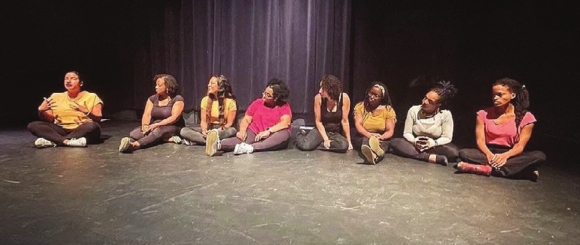
Members from the first cohort of PBT’s Drama Therapy Group. A group of 17 women gathers every Tuesday evening in Cambridge. For six weeks, the group is led by two facilitators, Jamila Batts Capitman and Paige Brooks-Cook, who invite them to play and process their feelings in nontraditional ways. These women are part of Performance Based Therapy (PBT), a drama therapy group founded by Batts Capitman and Brooks-Cook in the spring of 2022. The group for women of color is based out of the Central Square Theater.
PBT is currently working with its second cohort, and the session will culminate in a group performance on Dec. 16 at the Central Square Theater.
Drama therapy uses dramatic exercises like role-playing, improvisation, storytelling and theater games to explore a participant’s inner life and improve their interpersonal relationship skills, according to the North American Drama Therapy Association.
Over
Zoom one morning, Batts Capitman, who has a master’s degree in drama
therapy, walks the Banner through a typical twoand-a-half-hour session.
It begins with a grounding exercise where participants “enter the play
space,” co-creating a safe space and leaving distractions outside. From
there, the group sings and dances as a way to be present in their
bodies. A drama therapy exercise is introduced. When it’s finished,
group members discuss their thoughts and journal. Eventually the session
is closed by “leaving the play space,” transitioning members back to
the outside world.
Batts
Capitman says the program “deals a lot with the mindbody connection.”
She explains, “The vagus nerve strengths our voices, our bodies and our
breath in a gentle way that helps us respond to trauma and be more
resilient.”
The vagus
nerve is the longest nerve in the parasympathetic nervous system, the
calming portion of the nervous system. When stimulated, the vagus nerve
can improve the brain-gut connection and one’s mood.
While
Batts Capitman discusses mindfulness and breathing exercises,
Brooks-Cook mentions embodiment. Embodiment is the intentional use of
one’s body in a dramatic context. One such context is the “Heroine’s
Journey” exercise. Participants identify a role they play now, a role
they want to inhabit in the future, a role that helps them to grow and a
role that hinders their growth. Each group member gives these four
roles a name, a line and an action. Then they’re assigned to other group
members to act out.
“This
journey acknowledges the different roles that we can play for ourselves
in our own lives and asks people to think about the role they’re
playing that feels very dominant to them,” says Brooks-Cook.
The Banner did not have access to see a session, in order to protect the integrity of the group.
However,
a participant from the first cohort, Cherish Casey, spoke about her
experience. Her final performance incorporated pieces from the Heroine’s
Journey exercise, along with songs, dances and monologues created
during the six-week session.
Each cohort’s performance is uniquely their own, though, and this year’s performance won’t be like the last.
Casey
says she found the group therapeutic. After one exercise where she was
prompted to embody a character that gives her advice, she says, “By the
time I was done, I was like, ‘Oh my God, I have really worked through
something without even realizing it.’ It was really beautiful.”
Casey
would like to see additional mental health resources distributed at the
end of sessions for participants. She also hopes in the future there
will be multiple performances in various communities of color like
Dorchester and Roxbury.
Batts
Capitman says the most rewarding part of leading the groups is seeing
“Black women’s joy and sisterhood and reverence for our capacity to move
through.”
Casey says,
“It’s healing, and I think we need more of that. We need more time to
be able to play, and through artistic expression heal ourselves and the
collective.”
ON THE WEB
Learn more at performancebaseddramatherapy.com


