(top)
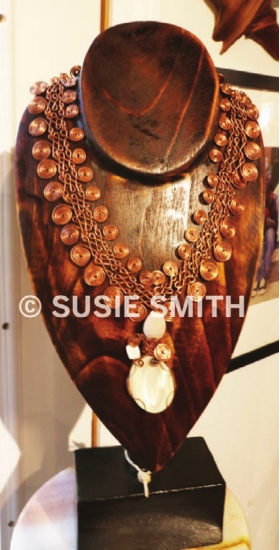
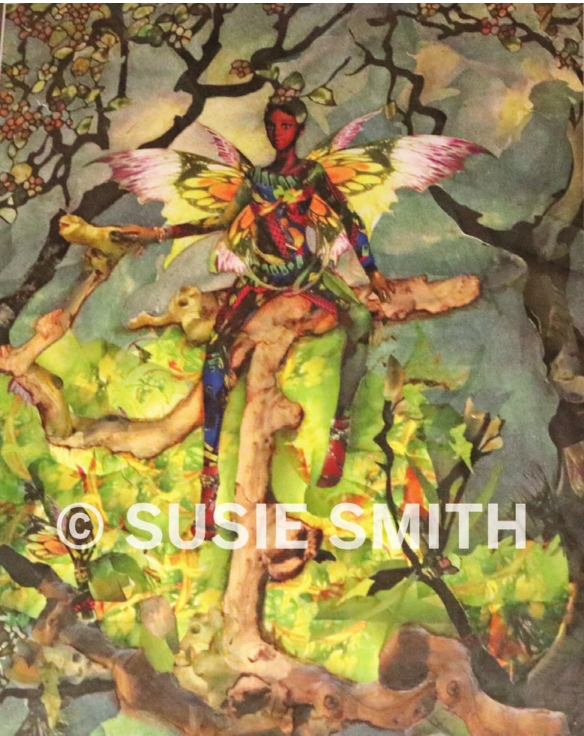
“Archangel Michael,” (above left) “Copper & Pearl Necklace,” (above
right) “Sky Goddess,” (far left) “Harmony” (part of the fairy collage
series) This is the eighth in a weekly series presenting highlights of conversations between leading Black visual artists in New England. In this week’s podcast, Larry Pierce interviews sculptor Susie Smith. The interview has been condensed and slightly edited.
Smith’s body of work spans
25 years of creativity in such diverse genres as sculpture, fashion
design, art-shade design and fabrication, jewelry design, and most
recently, original doll design and creation. Her current series,
“Susie’s Angels,” is a collection of magnificent and original-designed
sculptures of angels, elegantly attired and radiating love, virtue and
purpose.
Larry Pierce: All your friends call you Cookie. So, Cookie, give us a brief synopsis of yourself.
Susie
Smith: I’m from Selma, Alabama, and moved to Boston in ’65. I went to
Timilty [Middle School], Jeremiah Burke High School, the Vesper George
School of Art and, from there, Roxbury Community College because I took a
break. Then, I went to Mass College of Art.
You’re known for your beautiful Black angels and spiritual beings. How did your creative journey begin?
I
always was a dreamer as a kid in Alabama. I always loved dolls and made
cornhusk dolls. I thought about making dolls when I visited a Black
doll show in Roxbury one Sunday evening. Jane Bradbury, who makes
beautiful dolls, was the guest artist. She demonstrated how to make
[them] and passed out a brochure. So I called her and she invited me to
her studio in Quincy and gave me some tools — some clay, a knitting
needle that she made a tool out of, a set of eyes, printouts of the body
parts of dolls. She said, “Now go do it.” I went back to her [studio]
two days later with a doll. She said, “Oh, my goodness. You really did
it.”
Is it true that Minister Louis Farrakhan purchased one of your angels?
Yes. He bought an angel. It was wonderful.
You’re a jewelry designer who sometimes uses unconventional material. Talk a little bit about that.
I use glass and metals, a lot of copper. I do a lot of weaving, knitting and crocheting of metals.
You
also created a tribute to an elderly woman who had a lot of dynamic
qualities, including playing the saxophone in her younger years.
Describe the beautiful memorial sculpture that you created incorporating
the saxophone.
Miss
Betty Ellis was a senior at church who I took care of. She played the
saxophone. She would come to the gallery and loved to sit. She could
hardly blow the sax because she was 92. That piece is over here in the
corner — her saxophone. When she passed, I had to do something. So at
her funeral, I placed her sculpture at the head of her casket.
What advice would you give to young people who are considering a career in art?
I
would tell young people, if you have a passion for something, stay true
to yourself. Just keep working at it and believe in what you’re doing.
Not that you’re going to make a whole lot of money in the beginning,
though some people do. Young people should just go for their dreams.
Let’s talk about these fairies.
These
are my sky goddesses. In the body I wanted to reflect the sky, and her
hair is the all seats are $25 clouds. In today’s fairies, I think of
younger people — the way they dress and their tattoos, the dreadlocked
hair, the different colors of hair.
You found this motorcycle and built the rider to scale to fit it, right?
Yes.
I found the motorcycle in a flea market in Selma, Alabama. I’ve had it
for a while. I made [the rider] an angel on the run and decided to
[give] her a Grace Jones hairstyle.
Tell me a little bit about this beautiful lamp you’ve created and when you started making lamps.
I
created the shade from a placemat that I found at Pier 1. I took a
wooden bowl, and I shaped it. It’s kind of rigged together. I started
making lamps when I worked for Appleton’s Antiques in Brookline. They
were getting lamp shades from England. I saw them and said, “I can do
that.” I went home, taught myself and started covering shades for them. I
decided
that I was tired of covering shades and wanted to build a shade. That’s
how I got into making lamp shades — for Appleton’s Antiques. Once I
started building the shades, I wanted to build a lamp. So I started
making a lamp for the shade. I learned welding from a neighbor, Mr.
Coleman, who had a trucking stop, repaired flat tires and welded parts.
What visions do you have of projects you might work on in the future?
Spiritually,
I don’t know how I’m going to be led. I don’t have a plan. It just
comes when it comes, sometimes in dreams. I do my best work when I roll
out of bed in the morning.
See more of Susie Smith’s work and watch the full interview at BayStateBanner.com/art-gallery.