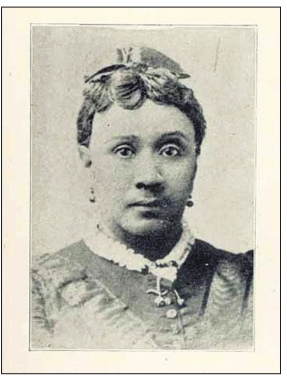
Susan Paul The members of Harambee Singers walked to the front of the African Meeting House and delivered a jubilant performance. The audience stood, swaying from side to side and clapping along to the beat.
Echoes of the song “Let it Shine” are heard throughout the church.
“When you can get people to sing and move and clap together, they can feel the love that’s being sent their way,” said Linda Brown-San Martin, the choir’s director.
The song was part of a celebration of the life of Susan Paul, a member of Boston’s Black abolitionist community in the 1800s.
Paul was the first African American woman to become a lifetime member of the New England Anti-Slavery Society. As an educator, she helped to cultivate a new generation of abolitionists, and led the Juvenile Choir of Boston, which performed at anti-slavery meetings and held concerts to raise money for anti-racism and anti-slavery causes, according to the National Park Service’s website.
Paul’s 1835 publication, “Memoir of James Jackson,” made her the first author of an African American biography, according to documents about her.
More than 30 people gathered to honor her legacy Oct 14 for a concert titled “Let the Children Sing! A tribute to Susan Paul” at the African Meeting House, where the funeral services for Paul, barely into her 30s when she died, were held.
The concert featured performances by the Harambee Singers, Eastern Mass. Children’s Choir and City Strings United Cello Choir. The Beacon Hill Civic Association, the Museum of African American History and Crescendo Productions hosted the celebration.
“There is something special about being in the African Meeting House, the very space where Susan Paul once sang, worshiped, and was commemorated on her passing in 1841,” said Christian Walkes, the museum’s director of education, at the event.
Paul was active in both the abolitionist and temperance movements in Boston, the National Park Service’s website said.
In addition to being a member of the New England Anti-Slavery Society, Paul later joined the Boston Female Anti-Slavery Society, holding officer positions, assisting in the annual anti-slavery fairs and representing the society in national anti-slavery meetings in New York and Philadelphia, the website said.
Paul was also a leader in burgeoning temperance organizations, including the local Ladies Temperance Society and the New England Temperance Society of People of Color, the website said.
But she struggled with personal and family tragedy. After her sister Anne died in 1835, she became responsible for her aging mother as well as her sister’s four children. Her fiancé died of tuberculosis five years later, and Paul herself contracted the disease and died from consumption in the spring of 1841 at the age of 32, the park’s services website said.
“My heart is sad when I think of the loss which our cause sustains in the death of Susan Paul. Many are abolitionists from the mere force of circumstances. Not so with Miss Paul,” wrote abolitionist Benjamin Bacon, according to the website. “The simple fact that oppression existed was enough to call forth her most self-denying efforts for its overthrow. Not but the willful perversion of her mental constitution could have made her otherwise than the uncompromising enemy of slavery in every form.
Peace to her memory.”
During the musical tribute to Paul, Noelle Trent, president and chief executive officer of the Museum of American History, urged the audience to sing along, dance and get on their feet.
“If you like what you hear, you can say ‘Amen,’” Trent said. “This is not Carnegie Hall.”
Noting US and global conflicts, she said each voice raised “disrupts the silence in a world of hate as wars are breaking out all over.” She urged participants to use the space as “an act of joyful resistance.”
In addition to Paul, the concert honored social activists and included songs that speak out against prejudice, racism and anti-Semitism.
“That’s part of what we sing about, that’s how Susan Paul led her life,” Brown-San Martin said.
The concert also highlighted the importance of youth choirs and music groups, and their long traditions. Children performing music in such an emotional and historically significant setting “made sense,” given that Paul once led a young choir, said Michael Maler, founder of Crescendo Productions.
“These types of spaces, looking back at the history [of people] like Susan Paul, should bring people together,” Maler said.
“Using songs, language and direct instruction helps teach young people to become a ‘healing agent’ in society,” added Regie Gibson, a literary performer and lecturer at Clark University.
Dorothy Clark, historian and preservationist, said landmarks, such as the African Meeting House, represent a critical “sense of place” in history.
“It is up to us to ensure the protection and continued use of these places,” she added.
Patricia Tully, executive director of the Beacon Hill Civic Association, said the concert exceeded expectations and brought people from the neighborhood closer.
“It’s about community,” Tully said. “When you have community, you can do anything.”
The music and the subject of the tribute were also inspiring, added Patricia Bass, an audience member and violinist in the Cambridge Symphony Orchestra.
“I like history,” Bass said. “I am very interested in Black history in Boston … so whenever I hear about something like this, I like to come see what it is about.”


