
Tanisha Sullivan, president of the Boston NAACP, addresses attendees at a press conference launching a day of service July 22 ahead of the national NAACP convention.
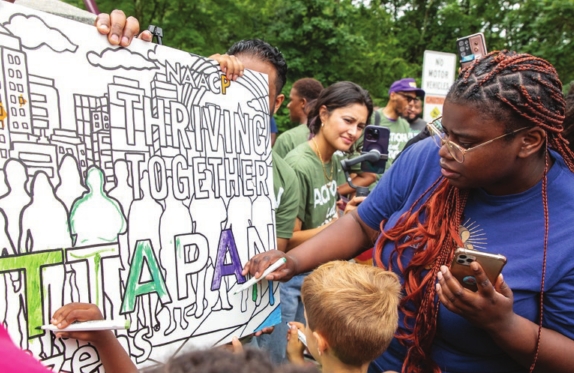
Volunteers gather for NAACP Day of Service.
V.P. Harris to speak at 114th annual event
In 2020, plans to bring the national NAACP convention back to Boston for the first time in almost 40 years were scrapped due to the COVID-19 pandemic.
Now, as the city prepares to host the 114th annual NAACP convention, local leaders within the organization are excited to pick up where they left off three years ago.
Tanisha Sullivan, president of the Boston NAACP, called the path to this gathering a “four-or-fiveyear journey.”
“We could not be more honored, as a branch within the association, to be serving as host to this historic convention at such an important time in our nation’s history,” Sullivan said.
The event, which runs from July 28 through Aug. 1, will host speakers like Vice President Kamala Harris and former Secretary of State Hillary Clinton. Harris will speak July 29 at the event’s opening public meeting, Clinton at a ticketed dinner Aug. 1.
The rest of the roster of speakers — altogether 62 individuals, according to the NAACP convention website — includes a mix of academics, Black business owners, government officials and local organizers. U.S. Rep. Ayanna Pressley will make remarks at a ticketed dinner July 31.
The convention will also feature a handful of events open to the public, like the Hub, a marketplace hosting Black-owned businesses.
Sullivan said this year will mark the first time the convention has had a space like the Hub.
“One
hundred fourteen years and we’re trying a few things out new, and this
is one of them,” Sullivan said. “Being very intentional about that
experience, Friday, Saturday and Sunday being free open to the public —
open to everybody, not just Black people, everybody — and really
centering the Black experience, which is really important. That’s what
we’re about as an association.”
Sullivan
said she is looking forward to a forum about economic opportunity and
another about fighting hate and white supremacy as well as a civic
engagement bootcamp for organizers across the country.
“The
agenda is full, it is rich, it’s substantive, and it’s really designed
to help after the convention to propel us forward,” Sullivan said.
For
Sullivan, the success of the convention won’t be measured by what
happens at the event, but what lasting impact comes out of it. That’s
why the Boston NAACP kicked off the convention with a day of service on
July 22.
“It does us
no good if people show up, they take pictures, they make speeches, and
nothing changes,” Sullivan said. “So, it is my hope and belief that this
convention will be measured by what happens when it’s over. What
happens when the cameras go home, when the eyes of the nation are not
thrust upon us? How are elected officials and policymakers doing things
differently after this convention to help ensure that all of us can live
work and thrive in this Commonwealth?”
Ken
Reeves, president of the Cambridge branch of the NAACP, said he sees
this convention as a chance to advance policy on a variety of issues,
such as affirmative action, abortion rights and LGBTQ protections.
“This
convention … [offers] up an opportunity for what I call the ‘Black
brain trust’ to come together and discuss the important issues of our
day and come up with policy resolutions which get adopted by the
national body,” Reeves said.
The convention also offers Boston the opportunity to reintroduce itself to the rest of Black America, Sullivan said.
“The
perception of Boston across the nation as the most racist city in
America not only holds us back nationally, but it holds us back here
locally,” Sullivan said. “And the only way we can change that perception
is by doing things differently, by working to ensure that we are
advancing public policy that is not regressive, but actually continues
to move us forward.”
Hilina
Ajakaiye, executive vice president of Meet Boston, said this moment is a
chance to show that Boston has moved forward since 1982, the last time
the city hosted the NAACP convention.
“We
want to show them that Boston has changed,” she said. “There’s an
incredible tapestry of Black leaders and Black organizations and Black
joy in the city of Boston, and we’re ready to receive [the national
NAACP].”
The convention is also expected to bring major economic impact to the city.
As
of Friday, Meet Boston — formerly known as the Greater Boston
Convention & Visitors Bureau — said there were over 6,200 people
registered for the event, 17,663 room nights booked and an estimated
$12.5 million in economic impact.
“There’s
such an exciting momentum around not only the overall city, but how
we’re going to be able to really impact residents and small businesses
in 23 different neighborhoods, to really feel the magnitude of having
6,200-plus delegates converge onto the city of Boston,” Ajakaiye said.
“This is an economic impact that everyone will feel, from restaurants to
tourist attractions to hotels.”
Through intentional planning, Ajakaiye hopes much of that economic impact will benefit Blackand brown-owned businesses.
RoseMark
Production, a Blackand woman-owned business, was hired to help build
out the Hub and organize other events. Davis Systems, a social impact
events business, was contracted to run the July 22 Day of Service. A
morethan-$277,000 contract went to Privé Parking, a Black-owned
business, to manage transportation for the convention.
“I
think that those are the things we should all be proud of,” Ajakaiye
said. “This convention has been intentionally funneled to make sure that
Black- and brownowned businesses — and specifically Black-owned
businesses — see the economic impact.”
Sullivan
said this is an opportunity to demonstrate that Black- and women-owned
businesses deserve access to government contracts.
“What
we’re trying to demonstrate is that there are capable experienced
women-owned, Blackowned, BIPOC-owned businesses that deserve the
opportunity to help, to participate in events like this,” Sullivan said,
“and deserve the opportunity to have access to contracts, be they
government contracts or even contracts from some of our some of our
businesses in the private sector.”
NAACP Resolutions
Delegates
to the 114th convention in Boston are scheduled to vote next week on
nearly 50 draft resolutions on policy issues. The resolutions will guide
the positions and activities of the civil rights organization’s more
than 2,000 local branches. Here are 10 of the resolutions:
• Endorse debt-free college solutions
• Call for a federal ethics law for Supreme Court justices
• Reaffirm support for anti-racism education in K-12 schools
• Condemn anti-Black efforts to distort and redefine the specific term “woke”
• Call for restricting federal funding to jurisdictions that erode voting rights
• Threaten lawsuits against bans on diversity, equity and inclusion programs
• Urge monitoring of disproportionate disciplinary action against Black police officers
• Threaten lawsuits against makers of hair relaxers associated with uterine cancer
• Support continuing Deferred Action for Childhood Arrivals (DACA)
• Pledge to fight discrimination against the LGBTQ+ community


