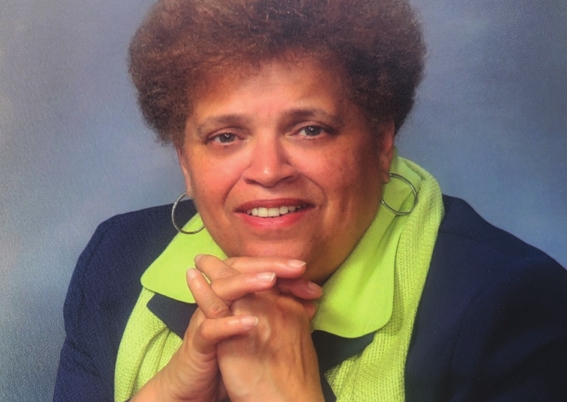
Saundra Graham
Former state rep was fierce housing advocate
Harvard was conducting its sedate commencement exercises in 1970 when a young community activist from a nearby section of Cambridge mounted the stage, bullhorn in hand, with 20 other protesters.
“We are here to demand that Harvard University give to the residents of the Riverside area free land so that we can build low-income housing for the poor people of Cambridgeport,” Saundra Graham, who was 28, declared to some applause. “We have been here longer than you’ll ever be here and we are not going to go because of you.”
Harvard President Nathan Pusey ordered the protesters to leave the stage. They refused. Black campus police offices declined to enforce the order.
The disruption lasted 15 minutes until a few Harvard officials agreed to meet the protesters elsewhere on campus to discuss the school’s acquisition of private homes in Riverside, displacing longtime residents of a historically Black neighborhood where white ethnics also lived.
The bold protest made worldwide news and catapulted Graham into politics. She was elected the first woman of color on the Cambridge City Council the next year and, in 1976, the first Black woman from the city in the state legislature. She held both offices simultaneously for about a dozen years.
Graham,
81, died from an undisclosed illness June 23 as she was returning to
her home, still in Riverside, from a hospital, her sister Sheila Headley
Burwell said.
After
more than a half century, Burwell said the Harvard protest remains her
favorite story about her older sister, whose impact was outsized
compared to her stature.
“She’s only four-eleven, and here she comes with a bullhorn and captured their attention,” Burwell said. “A four-eleven giant.”
Riverside
residents had unsuccessfully sought a meeting with members the
governing corporation, but the negotiations prompted by the protest led
to concrete results. Harvard agreed to build elderly housing on one site
and halt its eastward expansion along the Charles River at Putnam
Street.
“They would never have otherwise talked to us — the snobs,” Graham told the Harvard Crimson, the student newspaper, in 1995.
On the council and in the Massachusetts House, Graham continued her advocacy for
affordable housing for low-income people. She pushed for rent control in
the city and chaired the council’s Housing and Land Use Committee for
more than a decade, bringing in federal funding to rehabilitate and
modernize three public housing complexes.
In
the legislature, she became a member of the Joint Committee on Housing
and Urban Development. Graham also joined the handful of lawmakers in
what was then called the Massachusetts Black Legislative Caucus,
alongside Mel King, Bill Owens, Raymond Jordan and Doris Bunte, all of
whom have passed in the last two years.
Unlike other Caucus members, Graham represented a white majority district and was not from Boston or Springfield.
“Her priorities were similar to ours but had a unique Cambridge flavor to it, particularly around affordable housing and land
grabs that universities were involved in then, particularly Harvard,”
said former state representative Royal L. Bolling Jr., another Black
Caucus member at the time.
Graham also advocated for Harvard and MIT to offer more scholarships
to Black students and for the colleges, major employers in Cambridge,
to hire more Black people. “She was always pushing on that,” Bolling
said.
The former legislator from Mattapan said Graham joined other Black Caucus members in taking an expansionist view of their roles.
“Civil rights, anti-war, apartheid, freedom, democracy for everybody, not just the district you represent,” Bolling said.
Graham,
in keeping with her roots in progressive Cambridge, joined a movement
calling for a freeze on nuclear weapons and urged nuclear disarmament.
After losing her reelection bid in 1988 to Alvin Thompson, Graham left the legislature.
She retired from the Cambridge Council the following year.
Out of elected office, she worked on developing low-income housing in New Jersey and ran a drug rehab program.
Through
her politics and activism, Graham became friendly with civil and human
rights leaders of her time, including Shirley Chisholm, Angela Davis and
Jesse Jackson.
“These are the people she placed in our company,” Burwell said. “She didn’t bring them to us as dignitaries.”
The
Graham and Parks School, not far from the Harvard campus, is jointly
named after the former state representative and Rosa Parks, whose
refusal to give up her seat spawned the Montgomery, Alabama bus boycott
that Martin Luther King Jr. led in the 1950s.
The
second of 11 children, Graham was born in Cambridge on September 5,
1941, to Roberta Betts Postell and Charles B. Postell. In the late
1950s, Graham married Carl Graham Sr. The couple had five children
before divorcing.
In
the recent years of Graham’s retirement, Burwell said her sister was
devoted to bringing together her extended family, whose members —
descendants of the 11 siblings — number more than 125.
“She
constantly wanted her family around her,” Burwell said. “She softened
up in the family atmosphere. But when she was in a political atmosphere,
she was tough … I think it was the lion in her.”
Graham
is survived by her children, Carl J. Graham Jr., Rhonda L. Graham, Tina
M. Graham Everett, Darrell B. Graham and David A. Graham; sisters
Marlene Crawford, Cheryl Headley Moore, Sharon Freeman, Sheila Headley
Burwell and Sonja Scoby; brothers Shawn and Kevin Headley; twelve
grandchildren, eight great-grandchildren and one great-great-grandchild.
As of June 27, funeral arrangements were pending, and A. J. Spears Funeral Home in Cambridge had not established visiting hours.
Despite
her political career taking Graham into public arena and contact with
national figures, she maintained her home in Riverside and continued her
advocacy for its residents, convening meetings of volunteers into her
later years.
As recently as two weeks ago, Burwell said, Graham was working with her and a neighbor on a community concern.


