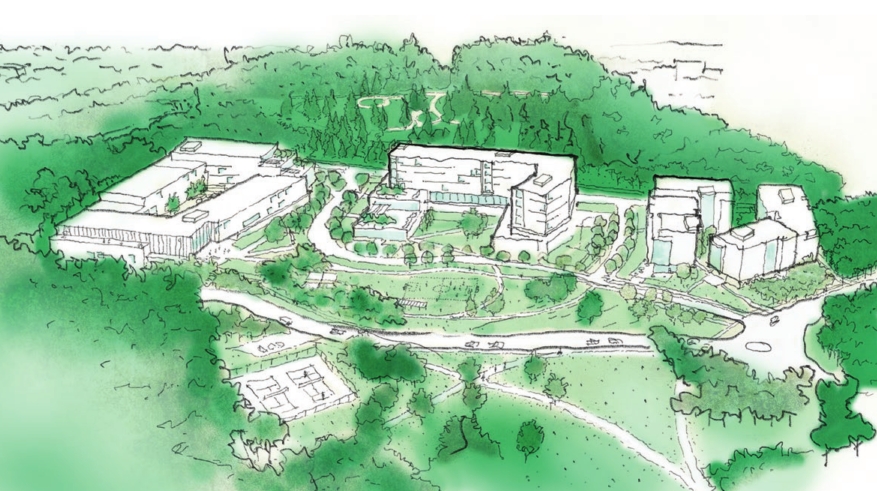
Architect’s rendering of the proposed building complex at the site of the Shattuck Hospital.
Will Franklin Park be the next Mass & Cass?
In what has become a daily ritual, Rory Coffey threads his way through the wooded trails between the Shattuck Hospital site and the Williams Street entrance to Franklin Park, looking for the hypodermic needles that litter the encampments in the area.
Calls to Boston’s 311 line to report discarded needles, open drug use, overdoses and encampments skyrocketed last year after the city removed tents and improvised shelters from the Massachusetts Avenue and Melnea Cass Boulevard area and erected temporary housing structures on the Shattuck grounds.
Now, with a consortium of nonprofit developers and service agencies pushing a proposal for 405 units of supportive housing for formerly homeless people, 326 beds for people being treated for substance abuse and 120 emergency shelter beds, Coffey and others who live in the vicinity of the park fear that with the drug use, litter and public disorder, Franklin Park will replace the Mass and Cass area as the locus of the state’s drug addiction crisis.
“I think this park is going to be destroyed,” said Coffey, a member of the Stony Brook Neighborhood Association in Jamaica Plain. “I think it will be bad for the community and bad for the people who are trying to recover.”
The state’s Division of Capital Asset Management and Maintenance last week gave provisional designation to the consortium, headed by Boston Medical Center, for the redevelopment of the Shattuck Hospital site. The nonprofits, which include the Pine Street Inn, Jamaica Plain Neighborhood Development Corporation and The Community Builders, plan to accommodate expanded outpatient treatment services on the site.
“Our
ambition is that we can create a much better form of care and treatment
for people who have mental health conditions and addiction and who are
probably experiencing homelessness or housing insecurity,” said Rob
Koenig, executive director of strategic programs at Boston Medical
Center.
Koenig, who
spoke with the Banner via Zoom, would not say whether BMC would continue
to offer suboxone and other supportive services in the Mass and Cass
area, but noted that the city will no longer be offering housing at the
Roundhouse Hotel there.
Koenig
noted that the BMC team’s proposal— the sole response to the request
for proposals for the site — includes medication-assisted treatment for
as many as 400 people, in addition to other services.
Roxbury
residents, who complain of an existing overconcentration of drug
treatment and recovery services in the neighborhood, say the transfer of
people and services into the park would place an undue burden on the
neighborhood.
“I believe in the research
that shows housing does support treatment of substance abuse,” said City
Councilor Tania Fernandes Anderson, who lives a quarter-mile from the
park. “I just wonder why there aren’t plans for this in other
neighborhoods.”
Last
year, when the city removed encampments from the Mass and Cass area,
Mayor Michelle Wu pledged that the city would identify low-threshold
housing units for people struggling with addiction in neighborhoods
throughout the city. A year-and-a-half later, the city has yet to
identify a single supportive housing site outside of the historic
boundaries of the neighborhood.
“I
think it’s racist,” said Louis Elisa, president of the Garrison Trotter
Neighborhood Association. “I can’t think of any other way to put it.
They just moving the situation out of the South End and putting it in
Roxbury.”
Elisa
notes that Roxbury has had drug treatment sites since the Third Nail
and First Academy opened in the late 1960s. But while those programs
catered to people from within the community centered in Roxbury,
the services currently centered at Mass and Cass cater to people from
across Massachusetts and other New England states.
“This is a greater number than the community can accommodate,” he said.
Elisa
said the 405 housing units, 326 treatment beds and 120 emergency
shelter beds could accommodate as many as 1,000 people in addition to
those being served by outpatient programs. That concentration would
likely draw in drug dealers, as many of those served by BMC services are not in recovery.
“You can’t cluster people who are trying to re-enter society like that,” he said. “It’s not smart thinking.”
Seeds of a crisis?
State
Rep. Christopher Worrell, who represents part of Dorchester, said he’s
done a walk-through of the park, viewing the encampments and litter in
the woods. He worries the plans to increase the population at the
Shattuck more than tenfold will overburden the surrounding
neighborhoods.
“Nearly
a decade ago, a well-intentioned but misinformed public policy decision
sowed the seeds for the crisis that exists today at Mass and Cass,” he
said. “It is imperative that this same mistake is not made again for
neighbors in Dorchester, Roxbury and Jamaica Plain.”
So
far, there are 28 temporary shelters and 30 additional beds being used
on the Shattuck site, in addition to outpatient services. Even with
those numbers, abutters say the impact on the park is noticeable. Last
year, there were tents on the playing fields and in the woods around the
Shattuck. In the encampments and on the stairs leading from Forest
Hills Avenue to Circuit Drive, the ground is littered with discarded
needles, saline packs, glass pipes and other paraphernalia users obtain
from harm reduction packs distributed at the Shattuck.
“We get a lot of complaints about needles, people living in the woods,” Worrell said.
The
city’s Health and Human Services department seems illequipped to keep
up with the litter and public nuisances that come with the population
currently in the park.
Pine
Street Inn Executive Director Lyndia Downie said her nonprofit will
ensure that the park and surrounding neighborhood are kept clean and
safe.
“We are
committed to the campus being a safe and welcoming environment and to
being a being a place that is part of and fits into Franklin Park,” she
said.
Coffey said he
has been in frequent contact with the Pine Street Inn about the
encampments, litter, needles, human waste and drug use in the park, with
little success.
“The problem is, they all deny anything’s happening in the park,” he said.
Worrell
says he’s pushing for city and state officials to listen to abutters
and better engage the communities around the Shattuck site.
“This
is a once-in-a-century opportunity to determine the future of the
Shattuck and Franklin Park, and it needs to be done right,” he said.


