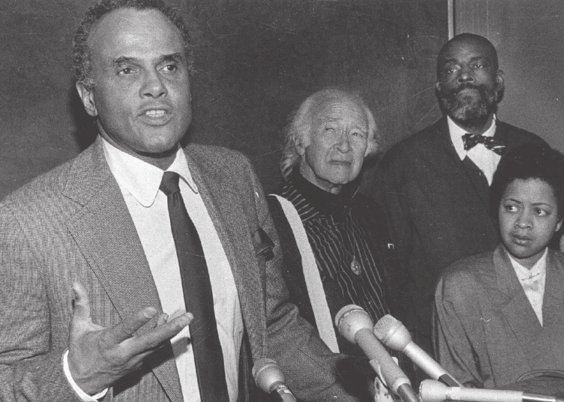
Harry Belafonte, George Wald, Mel King and Margaret Burnham.
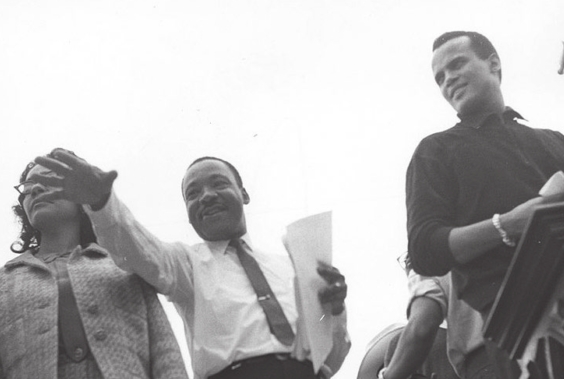
Martin Luther King, Jr. with Harry Belafonte in Montgomery, Ala., 1965.

Harry Belafonte and an 11-year-old Rwandan refugee girl, Akimane.
Powerful voice for change quieted at 96
Harry Belafonte, the son of West Indian immigrants who scaled artistic heights on concert stages and movie screens but was most devoted to human and civil rights advocacy, died last week at the age of 96 in his New York apartment.
The iconic singer and actor launched his career by bringing the sound of the Caribbean to American living rooms as the “King of Calypso” in the mid-1950s. His lithe grace, stunning smile and husky tenor voice soon landed him movie and television roles.
But the allure of public acclaim and the wealth afforded by performances on stage and screen mattered less to Belafonte than how he could leverage fame and money to serve the cause of equal rights and human dignity.
He put his career at risk by aligning himself closely with the civil rights movement in its nascent stages, making constant appearances at protests and quietly financing much of the organizational work led by his close friend Rev. Martin Luther King Jr., who often stayed at Belafonte’s West End Avenue flat on the Upper West Side of Manhattan.
Belafonte later became closely identified with the battle against apartheid in South Africa, a cause that brought him to Boston numerous times, including the triumphant 1990 appearance of Nelson Mandela in the city shortly after his release from prison, having been incarcerated for 27 years.
“I
wasn’t an artist who’d become an activist,” wrote Belafonte in his 2011
memoir, “My Song.” “I was an activist who’d become an artist. Ever
since my mother had drummed it into me, I’d felt the need to fight
injustice whenever I saw it, in whatever way I could. Somehow my mother
had made me feel it was my job, my obligation. So I’d spoken up, and
done some marching, and then found my power in songs of protest, and
sorrow, and hope.”
In
Boston, Belafonte found equally committed partners among members of the
Free South Africa Movement, who hosted political leaders living in exile
and led protests against Deak-Perera in the financial district for
selling Kruggerands, gold coins produced by the apartheid regime. He
made frequent appearances at New England Circle discussion gatherings in
the 1980s hosted by the Dunfey family, owners of the Parker House, and
accompanied Mandela on his trip to Boston.
By
then, Belafonte’s celebrity role as a champion of folk and
working-class ballads — like his first hit, “The Banana Boat Song,”
better known as “Day-O” — had receded in the public mind, replaced with
images of the tall and slender singer and actor, with his distinctive
high forehead, café-aulait complexion, widow’s peak and flashing eyes at
the head of protest marches and sit-ins.
“Fearless
is the word I would use to describe him,” said publicist Colette
Phillips, who helped organize Mandela’s Boston appearances. “He was one
of very few celebrities who was actually willing to put his conviction
on the line even if it meant he would be blacklisted.”
Belafonte’s
relationship with King began with a phone call in 1956. He attended the
landmark March on Washington in 1963 and raised money to support King’s
family after his assassination in 1968. His work brought him close to
the Kennedy family and other prominent liberals in politics and society.
In
1964, during Freedom Summer, Bob Moses of Boston called Belafonte to
ask for money to finance the waves of students spreading across the
Mississippi Delta to register voters. Belafonte offered to wire the
money, but Moses just laughed. “They’ll never let us use a bank,” he
said, according to accounts from the time.
“You’ll have to bring it yourself.”
The
singer called his friend, the late Sydney Poitier, who had acted with
him in the Negro Ensemble Company in New York City in the 1940s, and
they flew to a small rural airport, climbed into a car and barely
escaped a Klan posse that pursued them on narrow country roads.
Belafonte
frequently lamented that few artists, especially today, put their
careers on the line to stand up for their beliefs, whether challenging
the images of Blacks on the screen or policies hurting the poor and the
marginalized.
“Back in
1959,” he told the New York Times in an interview, “I fully believed in
the civil rights movement. I had a personal commitment to it, and I had
my personal breakthroughs — I produced the first Black TV special, I
was the first Black to perform at the Waldorf Astoria. I felt if we
could just turn the nation around, things would fall into place.”
Accusing
modern celebrities of turning “their back on social responsibility,” he
said, “There’s no evidence that artists are of the same passion and of
the same kind or commitment of the artists of my time. The absence of
Black artists is felt very strongly because the most visible oppression
is in the Black community.”
Malia
Lazu, a Boston businesswoman and activist who worked for Belafonte on
social activism and grassroots organizing efforts for five years, said
he “always held our feet to the fire.”
“When
I first started working for him,” she said, “he told me that within two
months we were going to have a gathering of the young – 30,000 gang
members to come to a convention to make a pledge to peace and criminal
justice reform.”
Asked
how they’d pull that off, Belafonte smiled and calmly said, “Nelson
Mandela filled Yankee Stadium on one day’s notice. We’ll do it.” He
reportedly said the same thing when asked how he would pull together an
all-star cast of artists to perform the song “We Are the World” to
benefit famine relief in Africa.
Lawrence
Watson, a Boston singer who organized a concert for Belafonte when he
received an honorary degree from the Berklee School of Music, grew up in
the Eleanor Roosevelt projects in the Bedford-Stuyvesant neighborhood
of Brooklyn worshiping the singer.
“He
had the courage to speak about the situation he faced as a Black man in
America,” said Watson. “He inspired me. I had him and Paul Robeson and
Berry Gordy as role models.”
Born
as Harold George Bellanfanti Jr. in Harlem in 1927 to a father from
Martinique and a mother from Jamaica, he moved to Jamaica at age 9 to
live with relatives before returning to the U.S. four years later. He
attended George Washington High School in New York but dropped out in
1944 to enlist in the Navy.
Back
in New York after loading munitions by day and studying books by W.E.B.
DuBois and others recommended by Black shipmates by night, he acted on
the stage and sang in clubs. His breakthrough album, “Calypso,” came out
in 1956 and stayed atop the Billboard charts for 31 weeks.
He
became a leading attraction on concert stages throughout the U.S. and
Europe and by 1959 was the most highly paid Black performer in history.
He
starred with Dorothy Dandridge in a 1954 production of “Carmen Jones,”
and in 1957, his screen role with Joan Fontaine in “Island in the Sun”
suggested a romance with his co-actor, provoking outrage from
segregationists.
Belafonte later produced and appeared in other films, including Spike Lee’s “Black KKKlansman.”
“About
my own life, I have no complaints,” wrote Belafonte in his 2016
autobiography. “Yet the problems faced by most Americans of color seem
as dire and entrenched as they were half a century ago.”
Belafonte’s
first marriage came in 1948 to Marguerite Boyd, whom he met while
stationed in Virginia. They had two children, Adrienne Biesemeyer and
Shari Belafonte, who both survive him. He later married Julie Robinson,
the only white member of the Katherine Dunham Dance Troupe, and is
survived by their two children, Gina and David Belafonte. His third
marriage was to Pamela Frank, a photographer, in 2008.