
Samantha Jane Williams as Hattie McDaniel,
Michelle Fenelon as Dottie and Stewart Evan Smith as Arthur in
“Boulevard of Bold Dreams“ by Greater Boston Stage Company.
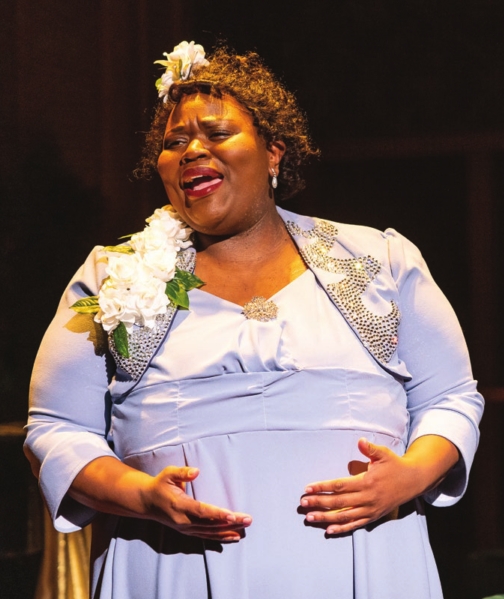
Samantha Jane Williams.
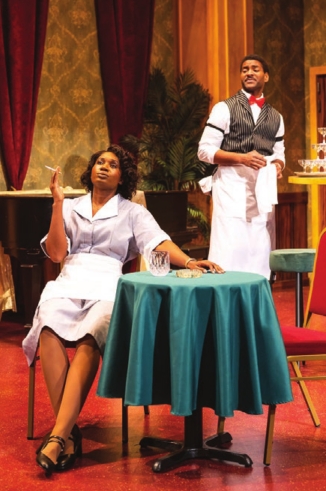
Michelle Fenelon and Stewart Evan
Smith.
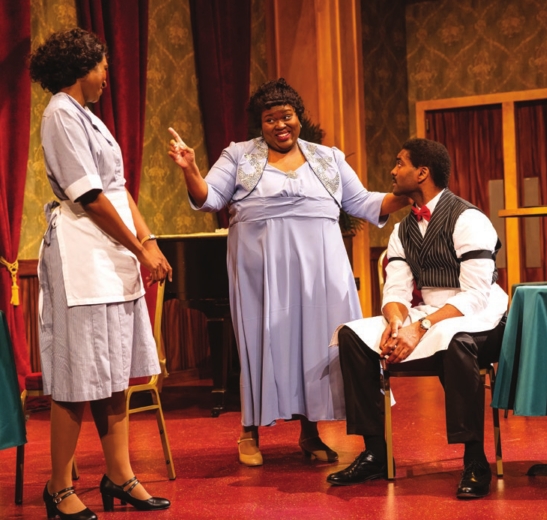
A scene from “Boulevard of Bold Dreams.”
Hattie McDaniel’s enduring legacy resonates in ‘Boulevard of Bold Dreams’
Seeing Samantha Jane Williams play Hattie McDaniel, who in 1940 became the first Black recipient of an Oscar for her role as Mammy in the classic film “Gone with the Wind,” is reason enough not to miss “Boulevard of Bold Dreams,” presented through March 19 by the Greater Boston Stage Company in its jewel box of a theater in Stoneham.
Written by LaDarrion Williams, the play concocts a fictional episode in which Hattie McDaniel takes refuge in a hotel bar just before the awards ceremony, uncertain as to whether she will attend the event. In her off-camera life, McDaniel’s struggles were as dramatic as her triumphs, as her rise coincided with an era of entrenched racial segregation. Even at the ceremony that might present her with an Oscar, she would be seated at a segregated table, and the Academy wrote her speech. While at the bar, the bartender and a hotel maid help Hattie to see that attending the Oscars would be a step forward for all Black Americans.
Directed by Taavon Gamble, the 90- minute, intermission-free production is captivating from start to finish. Its eloquent, artful staging intertwines the real and the imaginary, shifting between scenes in the barroom and scenes that express a character’s dreams.
The handsome set, an elegant artdeco barroom designed by Rachel Rose Burke and built by the Ogunquit Playhouse Scene Shop, includes a piano and a vintage television that in the play’s epilogue screens clips of McDaniel, as well as Black women who succeeded her as Oscar recipients giving their acceptance speeches.
Agile
lighting by Corey Whittemore and expressive costumes by Kiara Escalera
contribute to the alchemy, as does sound design by James Cannon and
music consultant David Freeman Coleman. A crashing vase sounds like a
gunshot (It’s the U.S.A.) and moments of live music ring with clarity.
In
a darkened theater, Williams, as Hattie, makes an unassuming entrance,
walking down an aisle and stepping up to the stage. She stands in a
spotlight, attired in a glittering blue cocktail dress. Her face is a
mesmerizing, motionless palette of emotions as the actress Mo’Nique,
accepting her 2010 Academy Award for Best Supporting Actress, says, “I
want to thank Miss Hattie McDaniel for enduring all that she had to, so
that I would not have to.”
The
scene shifts to the barroom on the day of the ceremony. Arthur, the
bartender, overwrought and endearing as played by Stewart Evan Smith,
frames the glassware he is polishing with his hands as if they are
elements of a scene in the movie he dreams of directing.
He
is soon joined by Dottie, his childhood friend, in a drab blue maid’s
uniform. The two left their small town in Alabama together to find new
lives in LA. Arthur has dreams big enough for both of them. In one
scene, Dottie is transformed into a torch singer in the noir film
hatching in his head.
In
contrast to Arthur’s exuberance, Michelle Fenelon as Dottie is more
attuned to her character’s cynicism than to her vulnerability. But when
Williams is in the room, her empathy encompasses them. As their rapport
grows, Williams, who, like the actress she portrays, is a singer and
pianist, uses music to help Dottie heal her hurts. The healing is
mutual.
As Hattie
departs, Dottie and Arthur tenderly bedeck her with a garland of
gardenias, her favorite flower, pulled from a hotel display. In the
poignant last scene, Williams is again alone in the spotlight. Her back
to the audience, she opens the barroom’s grand door and faces her
future.
ON THE WEB
For more information, see www.greaterbostonstage.org/shows-tickets/mainstage/boulevard-of-bold-dreams


