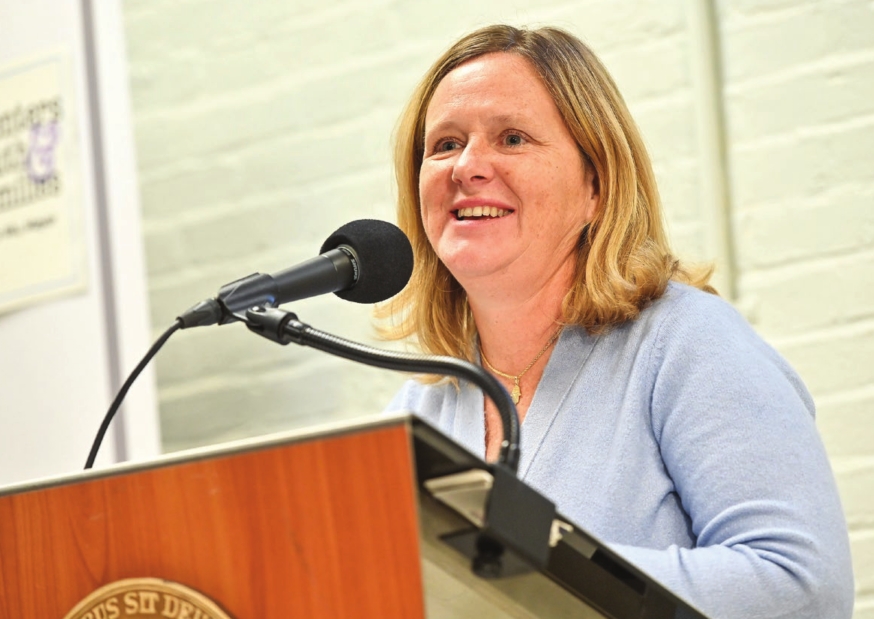
City Councilor Erin Murphy.
Experts say tactic would not reduce crime
A letter signed by four Boston City Council members calling for more police officers and “non-invasive” measures like metal detectors in Boston Public Schools is drawing criticism from advocates who are striving to reduce police and law enforcement presence in schools.
The letter, penned by at-large City Councilor Erin Murphy, urges Mayor Michelle Wu and Boston Public Schools Superintendent Mary Skipper to act quickly to address what Murphy characterizes as a rash of violent and otherwise troubling incidents in Boston schools by, among other things, reinstating Boston police officers in school buildings.
Boston police officers were removed from all Boston Public Schools in 2021, under former BPS Superintendent Brenda Cassellius, partly due to a change in state laws that required school officers undergo extra training. The officers were replaced by non-police “school safety specialists.”
Boston Mayor Michelle Wu has meanwhile repeatedly resisted calls to reinstate school police officers.
The four City Council members’ letter calls on Boston officials to, essentially, reverse the 2021 decision. Besides Murphy, who serves as vice chair of the City Council’s Committee on Education, the letter is signed by Councilors Frank Baker and Michael Flaherty and Council President Ed Flynn.
“There
should be no question among City and State Education Officials about
returning non-invasive technology such as metal detectors, and having
police officers present in our schools,” the letter reads. “We hope you
will agree that we need School Police to be reinstated into our Boston
Public Schools buildings for the safety of our students, our staff and
all of our BPS families.”
The
letter cites an apparent uptick in school reports of bullying and
unsubstantiated numbers of “sexual assaults” in the 2021- 2022 school
year, as well as anecdotal evidence, also unsubstantiated by data, of
“many disturbing incidents at our schools and on our school buses this
year,” including “stabbings, gun shots, bullying, physical attacks,
loaded guns and sexual assaults [that] have been happening across our
city” — including one incident of an alleged attack that took place
outside a school building.
In
September and October, there were two shootings involving students on
the streets around the Jeremiah E. Burke High School in Grove Hall. Last
week, a BPS teacher and student were assaulted by three girls outside
of the Young Achievers Science and Math Pilot School in Mattapan.
The letter bears no signatures by any of the Council’s members of color, including Education Committee chair Julia Mejia.
Requests by the Banner for comment were not returned by Murphy, Mejia, Wu nor Boston Public Schools.
Advocates
against police presence and a law enforcement-based approach to
discipline in schools, meanwhile, are assailing the Council members’
letter as misguided or worse.
“It
feels like we’re going backwards,” with calls for increased policing in
schools, said Ruby Reyes, executive director of the Boston Education
Justice Alliance.
“We
know that the results of police being in schools are not good for
students,” said Reyes. “These mitigation strategies have shown that they
don’t they don’t work. Research has shown that they don’t work.
[Research by] Boston Public Schools have shown that they don’t work,”
noting reforms implemented after a notorious 2018 incident in which a
BPS student was deported after communication between school police and
federal immigration officials.
“What
we know does work is school communities is really being able to have
the sources of funding, resources, professional development support —
all these things that create healthy school environments and healthy
school climates.”
Leon
Smith, executive director for Citizens for Juvenile Justice, says
research in Massachusetts and nationally has failed to show that a
police presence in schools keeps them safer.
“When
you look at peer-reviewed research, there is little convincing evidence
that the presence of an armed police officer has much effect on school
safety at all,” says Smith.
Meanwhile,
“There’s considerable evidence that the presence of a police officer
increases schoolbased arrests around low-level nonviolent behaviors that
have traditionally been within the purview of school administrators,”
notes Smith, citing a report, co-authored by his organization, that
found that school police presence in Massachusetts schools was linked to
increased disparities in how students of color, in particular, were
disciplined.
“The
Massachusetts data is clear that Black and brown kids, and kids with
disabilities, are disproportionately impacted by the school to prison
pipeline. So, for example, Black and brown students are 29% of students,
[but] 67% of school-based arrests,” said Smith.
Interventions
like school police officers and even metal detectors, Smith said,
create an illusion of safety that isn’t backed up by the data.
“It
may give that feeling of safety, but in actuality is not increasing
safety, but is increasing negative outcomes for your students.”
Jakira Rogers, of Massachusetts Advocates for Children, agreed.
“If
we treat children like criminals, they will internalize that … There is
no data that shows that that is an effective strategy,” Rogers said.
“And also, it’s not ‘noninvasive.’”
But
beyond questioning the effectiveness of police-based and law
enforcement-based approaches to school safety, Rogers — like several of
the advocates who spoke with the Banner — also questions the context in
which the four City Council members are pushing on the city
administration and BPS.
“I
see a trend, a trend of no community engagement with those directly
impacted, a trend of ‘white savior complex’ and a trend of
anti-Blackness, one of the most dangerous forms of racism,” Rogers said.
“I don’t think it’s a coincidence that only white city councilors
signed off on this letter. There is no coincidence that the city
councilor who is the chair of [the Council’s Education Committee] did
not sign this letter. It is not a coincidence that no people of color on
City Council signed on to this letter.”
“Who
is the ‘all’ that these four white city councilors are representing? I
have questions about who they’re trying to serve and what their intent
is,” said Rogers. “City Council’s racial divide is showing. We need to
be talking about that.”


