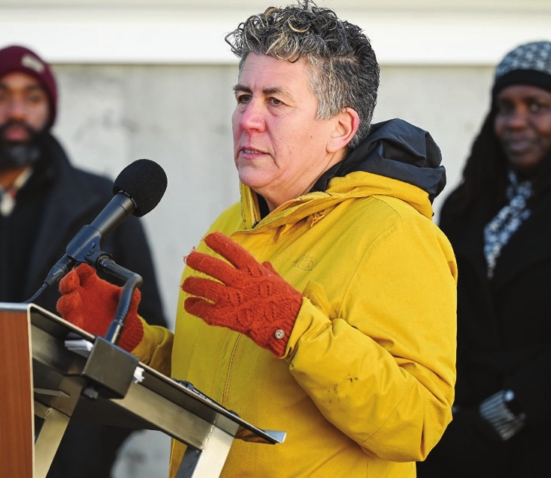
Boston Housing Authority Director Kate Bennett.
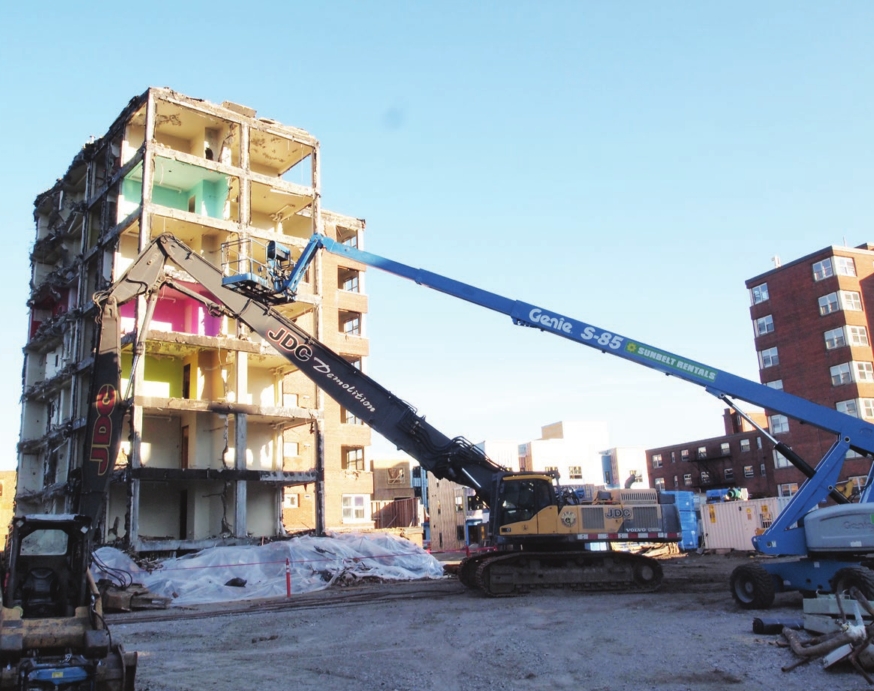
Construction
equipment on site for the demolition of the old Whittier Street complex
in 2018. New replacement units have been constructed with funding from
the HUD Choice Communities program.
Agency relying largely on local funding, partnerships for repairs
When the first rehabbed units in the Mission Main public housing development came online in 1999, it was the culmination of a seven-year, nearly $100 million process during which the 1940 brick-and-concrete development was razed and rebuilt as a community of three-story woodframe buildings.
Back then, city officials and HUD, which supplied $50 million through its HOPE VI redevelopment program, struggled with $187,000-per-unit construction costs. But HUD was there for the Mission Main, Orchard Gardens, Maverick, Old Colony and Franklin Hill developments, providing funding for long-delayed renovations. Fast-forward 23 years, and HOPE VI is a distant memory. So too are the days when HUD would reach deep into the federal coffers to bail out local housing agencies beset with maintenance backlogs.
For the Boston Housing Authority’s most recent efforts at redevelopment, the agency is leaning heavily on local nonprofit and for-profit developers to renovate its portfolio of housing developments.
Back in 2014, the BHA issued a request for qualifications from developers, seeking ideas on how to leverage the developments’ high-value real estate to renovate and preserve the stock of existing BHA units. Now, 17 of the BHA’s properties are undergoing redevelopment projects using a variety of funding sources, ranging from a $30 million HUD Choice Neighborhoods grant for a tear-down and rebuilding of a mixed-income development at Whittier Street to the transfer of 149 units in South End row houses to the nonprofit Inquilinos Boricuas en Acción community development corporation.
The multifaceted approach is made necessary by the nationwide lack of federal dollars available for maintenance of public housing. As the federal government has backed away from funding public housing, the BHA has had to become increasingly resourceful, noted Kate Bennett, the agency’s director.
“It became increasingly clear that the federal dollars were just not going to set us up for the future,” Bennett said. “As we used to say over and over again, the money is gone, and it’s not coming back. That era was really when we first started to realize we’re kind of on our own here. How are we going to move forward and preserve this precious resource? At the same time, housing prices were just beginning to really skyrocket.”
Now facing construction costs upwards of $500,000 per unit, the public/private partnerships have been a lifeline for the BHA. At Mildred Hailey Apartments in Jackson Square, the BHA
partnered with Jamaica Plain Neighborhood Development Corporation, the
Urban Edge CDC and The Community Builders, a nonprofit that specializes
in affordable housing development.
That
partnership, with the aid of an unprecedented $50 million investment
from the city, has renovated 253 existing units and will build 420 new
units of affordable housing.
Most
of the partnerships are part of HUDs Rental Assistance Demonstration
(RAD) program, which encourages housing authorities to partner with
developers to tackle backlogs. While most BHA developments were built by
HUD, the agency no longer provides the funding necessary to make major
repairs to buildings, such as replacement of roofs and heating systems.
HUD
estimates a $35 billion nationwide backlog of public housing capital
needs. Under the RAD program, public housing authorities can partner
with nonprofit or for-profit developers to renovate or rebuild public
housing. In many cases, market-rate units or new retail spaces
constructed on public housing land can help subsidize existing public
housing units under the program.
The
main requirements the BHA has for such partnerships is that any
redevelopment maintain the current number of affordable units in a
project, and that developers work closely with residents to determine
what gets built and how it gets built. The agency received over 50
proposals from developers for the 30 sites
it had listed and the 4,000 BHA units in the pipeline to receive needed
renovations or reconstruction.
“It
led us to a variety of preservation strategies,” Bennett said. “It
really multiplied the approaches that we were taking compared to that
those earlier Hope VI days. We launched projects that were mixed-income,
we launched 100%-affordable projects, we launched new construction, we
launched comprehensive renovation. We launched projects where BHA
remained the owner and developer, about two-thirds of the sites.”
Among the major projects the BHA has undertaken are:
Bunker
Hill in Charlestown, where a team including the BHA, Joseph Corcoran
Company and Leggat McCall Properties will renovate and replace the 1,100
units currently in the 26-acre development and create an additional
2,600 new mixed-income housing units. The project calls for the
demolition of 45 existing buildings and the construction of 15 new
towers. Market-rate rents in the new development will help subsidize the
existing affordable units.
Mary
Ellen McCormack in South Boston. Winn Companies and the BHA are
preserving the 1,016 existing units and constructing an additional 2,299
mixed-income units, with market-rate units subsidizing the affordable
units, funded with City of Boston capital funds and state dollars.
Lenox/Camden in Lower
Roxbury, where Beacon Communities will renovate the 357 existing units
with funding from a state public housing capital grant.
The
Amory Street elderly housing development in Jamaica Plan. The
development’s 199 existing units are being renovated while 266 new
affordable units are being constructed by Jamaica Plain Neighborhood
Development Corporation, the Urban Edge CDC and The Community Builders.
With
projects in various stages of planning and construction across the
city, BHA officials are staying busy. Bennett says the agency has
learned from the developers who stepped forward with plans to preserve
and redevelop public housing.
“The
RFQ identified motivated for-profit and nonprofit partners who are in
the community and who have been aware of BHA properties and were willing
to come to the table with really interesting suggestions for how to
preserve the long-term affordability of BHA sites,” Bennett said.


