Mayor Michelle Wu joins city councilors and administration officials to sign an executive order speeding approvals on affordable housing during a press conference in City Hall.
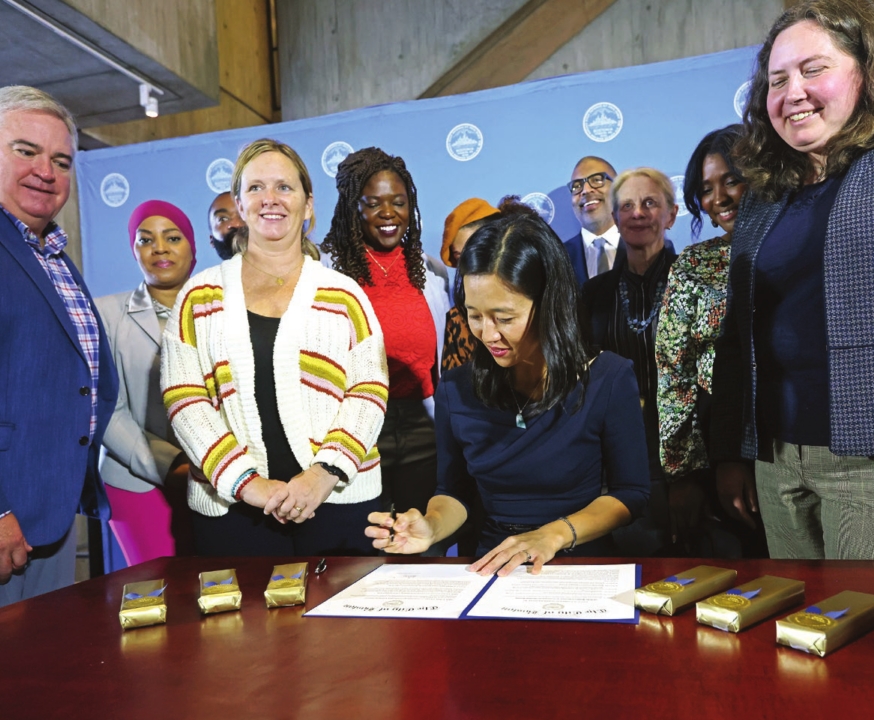
Mayor Michelle Wu signs the executive order speeding approvals on affordable housing during a press conference in City Hall.
Aims to cut affordable housing time in half
Mayor Michelle Wu last week signed an executive order overhauling the approval process for new income-restricted residential development projects.
The order, initially announced during a speech to the Greater Boston Chamber of Commerce at their annual Government Affairs Forum last month, aims to cut the approval process time in half, using a combination of departmental streamlining and study of current practices and procedures.
According to Wu’s office, the current process to approve affordable housing can take as long as 337 days.
“This executive order calls on departments to come together and find ways, in conversation with each other, to eliminate redundancies and streamline this process,” Wu said Thursday.
Her order, which will impact policies across nine city agencies, including the Boston Planning and
Development Agency (BPDA), creates a new, separate path for affordable
housing project review and approval and asks BPDA to prioritize those
projects.
Wu is
looking to the BPDA to specifically reform the Article 80 process that
dictates meetings and review steps projects must take before being
approved. The new process, her office says, will still include community
engagement and thorough agency review, but will cut down on an excess
of meetings that interested parties are expected to attend.
Specifically,
she’s calling for a policy where officials can skip review steps for
projects on cityor BPDA-owned land that is proposed for affordable
housing development when community feedback sessions have previously
been held.
Leslie
Reid, CEO of Madison Park Development Corporation, an affordable housing
developer in the city, said, “While current community processes and
design standards ensure that affordable housing in Boston meets the
highest quality standards, uncoordinated inputs and approvals from city
agencies have resulted in challenges, time delays and increased costs,
which we can ill afford at this really critical moment.”
The
mayor’s office said Wu is still looking at what, precisely,
implementation will look like in coming months, including an
interdepartmental governance structure and more in-depth procedural
recommendations. In the meantime, she has tasked the BPDA with studying
zoning challenges to affordable housing development and issuing a report
on potential zoning code changes that would incentivize affordable
housing creation while “minimizing the need for variances or other
permitting burdens.”
Chief
of Planning Arthur Jemison said in a statement, “The BPDA is looking
forward to creating a process that streamlines review and approval of
affordable housing developments. These projects are critical to boosting
our city’s housing supply and making Boston more affordable — one of
the BPDA’s top three priorities, along with resilience and equity.”
The
mayor has additionally promised the creation of an Affordable Housing
Development Review Advisory Committee sometime in the next three months
to study the work being done.
This
executive order is the latest in Wu’s push for affordable housing in
the city as she makes good on campaign promises to make the city more
equitable. Earlier this year, Wu allocated $380 million for housing
affordability efforts as part of the city’s budget. She told GBH News
that ideally, she would eventually like 30% of Boston’s future housing
development to be affordable.
“Over
the last few years as we’ve experienced this incredible building boom,
prior to the pandemic, the city had been surpassing all of the
benchmarks laid out for numbers of units,” Wu said Thursday. “Our
approach is to be much more specific, even outside of this executive
order, what types of units those have to be.”
She
went on to say that if the city continues down the same path, “We’re
perpetuating the same injustices and the same displacement that are
already at crisis levels across our neighborhoods.”
The city’s chief of housing, Sheila Dillon, who has been a strong voice supporting the mayor’s efforts, echoed the sentiment.
“We
know that access to affordable housing helps stabilize the lives of
those who receive it — giving them predictability in budgeting and
allowing them to put down roots in our neighborhoods,” Dillon said.
“This prioritization is the right thing to do.”