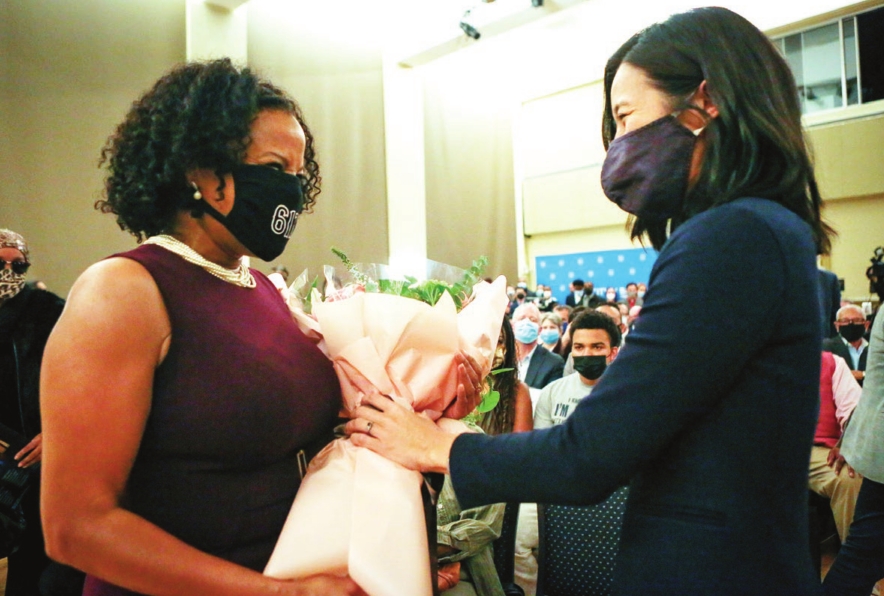
Boston Mayor-elect Michelle Wu, right, presents acting Boston Mayor Kim Janey with a bouquet following her farewell address at Hibernian Hall in Nubian Square on November 10.
Calls for just $60 million in funds for minority businesses
With both the Massachusetts House of Representatives and the state Senate having passed their spending plans for federal American Rescue Plan (ARPA) funds, advocates are left disappointed in the lack of investment into Blackowned and other minority-owned businesses in the wake of coronavirus economic fallout.
Leading up to the rollout of lawmakers’ plans, members of the Coalition for an Equitable Economy, which includes more than 60 statewide organizations, local community-based organizations, business associations and other individual small business supporters, came together to ask lawmakers to include $1.1 billion to support Black, Indigenous and people of color (BIPOC)-owned and women-owned small businesses through grants, lower-cost loans from community lenders and banks, equity investments and expanded technical assistance.
The amounts included in each body’s
plans don’t come close to that figure. The House plan includes $60
million in targeted spending aimed at women, minorities or veterans and
businesses that are focused on “underserved markets,” while the Senate
plan includes $50 million for “socially and economically disadvantaged
and historically underrepresented” markets and “diverse businesses owned
by underrepresented groups.” Additionally, all the spending is in the
form of grants; the other tenets of the proposal did not make the cut.
An amendment was proposed in the Senate last week to up the funding to $100 million, but it did not pass.
“We’re
disappointed that the … amendment did not pass, despite having a number
of co-sponsors,” said Joe Kriesberg of the Massachusetts Association of
Community Development Corporations (MACDC), a member of the coalition.
Kriesberg said the group would now turn its focus to advocating for the House plan.
Segun
Idowu, president and CEO of the Black Economic Council of Massachusetts
(BECMA), another coalition group, said the small amount of money won’t
be much assistance to the groups it aims to help.
“Unfortunately
we’re getting $50 million … not just for people of color, but women,
veterans, LGBTQ — which all are laudable groups to make investments in,
but it’s diluted,” Idowu said. “And it ensures that a very small piece
of $5.3 billion is going to businesses owned by people of color.”
According
to a study the Coalition for an Equitable Economy released in
partnership with the Boston Foundation and MassINC, the rate of Black
and Latino business ownership in Massachusetts remains half that of
whites. Additionally, the group claims in its study that entrepreneurs
of color in Massachusetts have unmet capital demand on the order of
approximately $574 million annually.
“We’re making the case that we need hundreds of millions of dollars to fill the capital gap that minority and small
businesses are facing,” Kriesberg said, “both to stay in business, given
all the challenges they face currently, but also to help change the
reality that we have this massive disparity between Black and Latino
businesses versus white businesses.”
Kriesberg also expressed disappointment that the non-grant aspects of the coalition proposal did not make it.
“We
think you need all four of those kinds of investments to really achieve
the transformational change we’re seeking in the business environment.
Grants can only get you so far at a certain point,” he said. “You need
access to loans, you need access to equity — and we propose some
programs that would leverage more private capital and create more
long-term solutions.”
He
added, “And then on the technical assistance, we feel like businesses
need to get the support, the coaching, the financial analysis, the legal
analysis. A lot goes into running a business, especially in the current
environment.”
In
addition to the targeted funding, both the House and Senate have
included a $500 million “premium pay program.” The program aims to put
money directly into the pockets of any low-income essential workers who
continued their jobs throughout the pandemic. Each worker would receive
between $500 and $2,000, depending on how many people are eligible.
They’ve also both agreed to a more than $500 million unemployment fund
to offset charges to employers.
Both
spending plans allot less than the total funds available to the state
for aid. Idowu and Kriesberg are hopeful that lawmakers might consider
using a portion of the almost $2.5 million in leftover cash or find
money in the regular budget to support Blackand other minority-owned
small businesses.
“We’re
going to keep doing what we’ve been doing,” Idowu said. “ARPA was just
one piece of the advocacy, but there are still other opportunities to
make investments in our businesses.”
Just
last week, a hearing was held for an additional piece of legislation,
S. 270, to support small businesses of color. However, that support is
still a ways off.
As
for ARPA funding, a joint committee began meeting to pass a final
spending plan on Monday. However, with both bodies in recess after Nov.
17, it’s unclear when it will be finalized.


