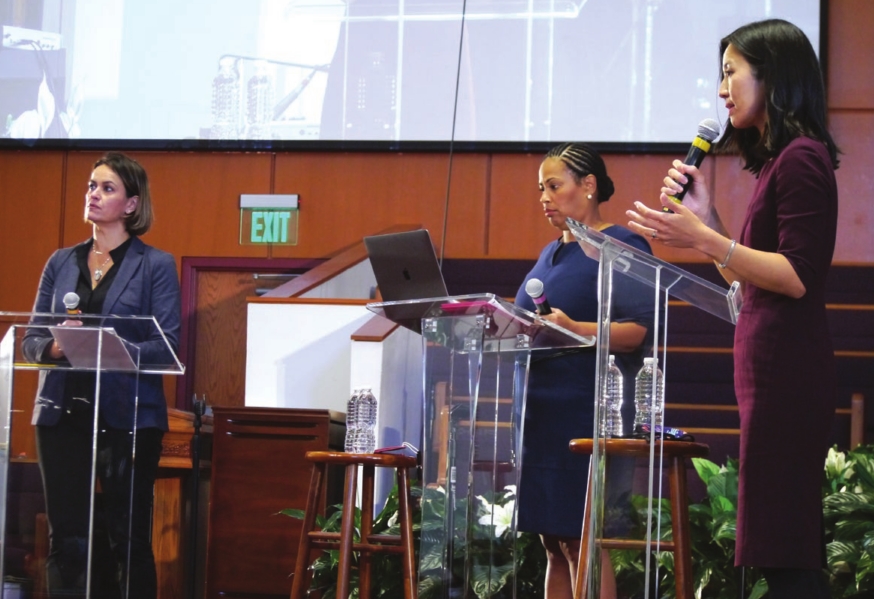
Mayoral candidates Annissa Essaibi George and Michelle Wu respond to questions presented by NAACP Boston Branch President Tanisha Sullivan.
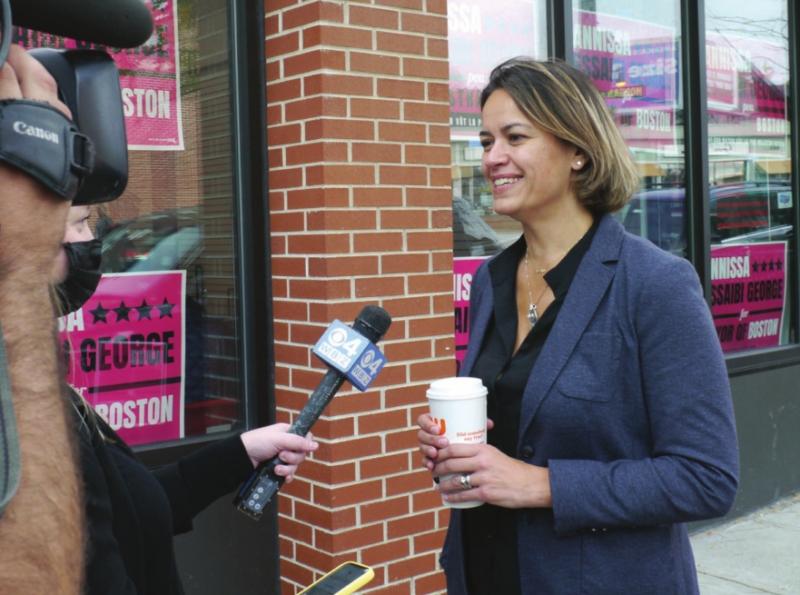
Annissa Essaibi George talks with reporters outside her Grove Hall campaign office.
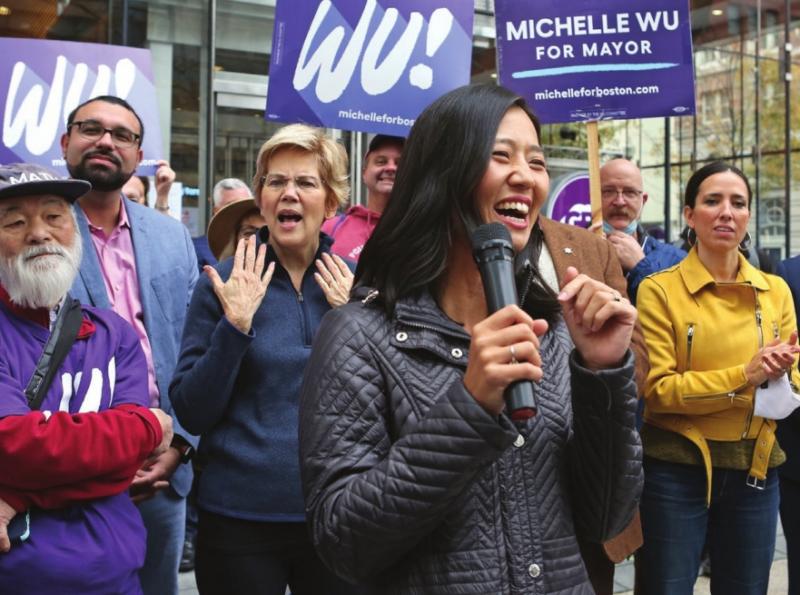
Flanked by Boston City Councilor Ricardo Arroyo, U.S. Sen. Elizabeth
Warren, Sen. Sonia Chang-Diaz and other supporters, Boston City
Councilor and mayoral candidate Michelle Wu speaks during an event to
kick-off the first day of early voting outside the Boston Public Library
in Copley Square last Friday. Forum probes candidates on issues pertinent to Blacks
Mayoral candidate Michelle Wu says her administration would dedicate $200 million in American Rescue Plan Act funds to affordable housing production and homeownership opportunities to help keep Black people in Boston.
Annissa Essaibi George has rolled out a $100 million commitment of ARPA funding that her administration would invest in Black-owned businesses as well as job training programs, and that would ensure Black workers achieve salary parity with whites in the city government’s 18,000- person workforce.
The promises and policy prescriptions articulated during a forum Saturday convened by state Rep. Russell Holmes, the NAACP Boston Branch and members of the Black clergy were detailed, as requested by Holmes, who kicked off the event asking for specific, measurable, achievable, timebased goals.
Speaking at the start of the forum, held at the Morningstar Baptist Church in Mattapan, Holmes cited the NAACP’s report card — first deployed in 2017 to assess the administration of Martin Walsh’s progress on racial equity
issues — as a benchmark for the new mayoral administration. The next
mayor will be assessed against the promises made on the campaign trail,
he added.
Asked how
her administration would ensure Black people have well-paying jobs, Wu
said she would leverage the city’s purchasing power to help businesses
owned by people of color.
“We
need to have a clear purchasing plan for the city of Boston so that we
will centralize and have accountability for how our dollars are spent,”
she said.
Wu said her
administration would also push local nonprofits such as universities and
hospitals to spend more of their contracting dollars with businesses
owned by people of color.
Essaibi
George, when asked how she would increase housing stability for the
city’s Black residents, said she is committed to dedicating $200 million
to housing creation, supporting first-time homebuyer programs.
“When
we think about that $200 million investment in particular, it’s about
creating a large volume of housing opportunities across our city. It’s
also about making sure that we have diversity in the housing that’s
available for single-parent families, for single person households, for
families just starting out, and for growing families, and for our
seniors,” she said.
Wu,
who supports a rent stabilization plan that would cap rent increases,
said renters must be taken into consideration in any housing plan.
“Two
thirds of Boston residents are renters, right, so if you don’t have a
plan for renters, we’re really not talking about housing and housing
stability at all in Boston,” she said. “Out of our renters, nearly a
third of folks who are renting their homes, pay more than 50% of their
income every year, unsustainable impossible choices that our families
are being put under.”
On
the topic of city contract dollars, Essaibi George said she would break
apart large contracts so that small businesses owned by people of color
could more easily bid on them, a strategy employed in state government
that the city has not yet implemented.
Wu said she would create a central office to oversee diversity in contracting.
“The
decision-making power has traditionally sat with department heads, not
centrally,” she said. “They’re not thinking ahead to how we ensure that
the next time this contract comes up, we have a long list of bidders
that include Black- or brown-owned businesses from the community.”
In response, Essaibi George said she, too, would have an office of equity that would oversee contracting.
The candidates agreed on several issues.
Asked
by NAACP Boston Branch President Tanisha Sullivan, who moderated the
forum, whether they would support creating a commission on reparations,
both candidates said they would.
Both
also said they would commit to implementing all elements of the Police
Reform Task Force Report issued last year. Both said they would create a
diversity, equity and inclusion unit within the Boston Police
Department.
Essaibi George said her administration, including the police department, would be diverse and reflective of the city.
Wu
said the command structure of the police department reflects years of
discriminatory practices in hiring, discipline and promotions. She said
she would empower the next police commissioner to make promotions using a
broader array of factors than exam scores and allow deputy
superintendents to command precincts, a position only captains currently
serve in.
Asked what
she would do to address the substance abuse crisis in the Massachusetts
Avenue and Melnea Cass Boulevard area, Wu said she would create a
cabinet-level position and work collaboratively with other
municipalities to better provide services.
Essaibi
George said she would work to decentralize services for people
experiencing homelessness and addiction and commit $30 million to
rebuilding the bridge to the Long Island shelter and treatment programs.
The
candidates differed on whether the School Committee should be elected
or appointed. Essaibi George said she is in favor of a body whose
members would be appointed by the mayor and City Council.
“I
believe in an appointed body, so that I’m held responsible for the
success and failures of what we do for and with our children and their
families,” she said.
Wu
said she is in favor of a hybrid School Committee with both popularly
elected members and members appointed by the mayor, to ensure
accountability for the mayor and also ensure that the body has diversity
in race and geographical representation.
The
forum, one of several held over the weekend, took place as early
balloting started. On Sunday, Holmes, along with members of the clergy
and U.S. Rep. Ayanna Pressley, joined Wu, at-large Councilor Julia Mejia
and other elected officials for a “Souls to the Polls” get-out-the-vote
rally at the Charles Street AME Church.
Early voting takes place through Friday, Oct. 29. The election will be held Nov. 2.


