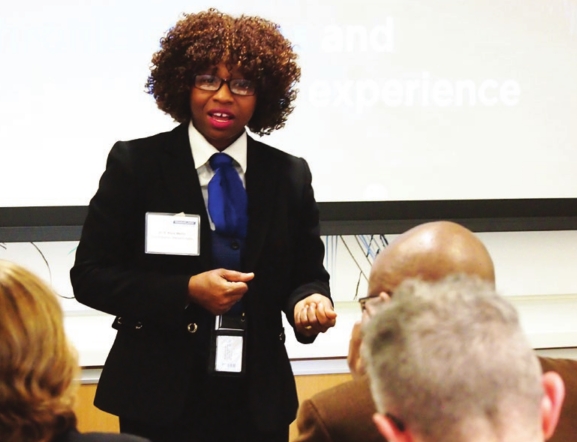
Atyia Martin
Study finds they have little influence on behavior
Even before the murder of George Floyd at the hands of the Minneapolis police officer pushed issues of racial inequities to the forefront, corporate diversity, equity and inclusion (DEI) consulting was an $8 billion industry.
With the racial reckoning that came from the Black Lives Matter protests — and with the racial violence and animosity that accompanied Donald Trump’s four years in office — DEI consulting is more in demand than ever.
But does it actually work? According to a 2020 review of more than 400 studies of anti-prejudice trainings and interventions, a team of social scientists found most interventions have no measurable effect on biased attitudes and behaviors.
“We only found two studies that lay claim to any effectiveness,” said Betsy Levy Paluck, a professor in the Psychology department and at the School of Public and International Affairs at Princeton University. “We found there’s an enormous absence of evidence.”
In their study, published in the journal Annual Review of Psychology, Paluck and researchers from Columbia University and Hebrew University in Jerusalem examined 418 studies of diversity initiatives in countries around the world.
The study’s conclusion — that companies, government entities and nonprofits are potentially spending
billions of dollars on questionable efforts to increase diversity and
equity — calls into question the efficacy of the entire field.
Paluck
says that 76% of interventions implemented by employers that her study
evaluated are what she calls “light touch” — trainings and workshops
that are relatively inexpensive and easy to implement. Trainings in
which individuals in the corporations are forced to confront their own
biases may lead to short-term changes in attitudes, but do not produce
short-term or long-term changes in behavior, Paluck said.
One
such training, an hourlong online session that a Fortune 500 company
offered to 10,000 of its employees, showed a modest short-term change in
employees’ attitudes. But when the same employees were encouraged to
take part in a mentoring program, whites who went through the training
were no more likely to mentor junior employees who were women or people
of color.
It’s the whole system
Atyia
Martin, who served as chief resiliency officer for the City of Boston
under former Mayor Martin Walsh and now runs her own diversity
consulting firm, says she only works with organizations that are
committed to systemwide change.
“If
the leadership of an organization doesn’t actually change the way it
does things, whether it’s structure or processes, the organization
itself stands in the way of change,” she said.
Yet,
Martin said, her firm is an outlier in a field full of trainers who are
willing to conduct the sort of one-time interventions Paluck and her
colleagues say are mostly ineffective.
“The field is flooded with people who haven’t done enough studying to understand what it is they’re trying to do,” she said.
Paluck,
who consults with organizations on diversity, says she stresses the
importance of systemwide strategies over one-time interventions.
“Urging
people to think about more structural solutions, using different
levers, rather than trying to build social change
individual-by-individual,” she said. “Don’t use a training to make sure
you have pay equity. Go through your payroll and make sure there’s
equity.”
Former Boston City Councilor Tito Jackson, who has offered diversity trainings and interventions at the corporate level, agrees.
When the efforts are limited to workshops offered by human resources departments, the initiatives go nowhere.
“The most important aspect of DEI initiatives is the buy-in of the leadership — the C-level people,” he said.
Martin
echoed Jackson’s point. “Human resources doesn’t always have employees’
interests at heart,” she said. “It’s often more of a risk mitigation
mindset that’s very much about protecting the organizations, versus
supporting employees. It becomes more about individual behavior and not
about the organization’s role.”
Among
the short-term interventions diversity trainers have employed in recent
years is implicit bias training. The assumption behind such trainings
is that people are influenced by attitudes that they hold
subconsciously, and once made aware of them, will act differently.
Donald
Green, a researcher who worked on the report, says that while many
police departments use implicit bias training in an attempt to weed out
discriminatory behavior among officers, many officers are open about
their prejudicial beliefs.
“It
may not be implicit prejudice that’s driving behavior,” said Green, a
professor in the Political Science Department at Columbia University.
“It may be explicit.”
What has worked?
Among
the organizations that have had the best success at integrating and
reducing bias, Green cites the U.S. Army, which was integrated by an
executive order issued by President Harry Truman in 1948.
“It used to be an explicitly racially hierarchical institution,” Green noted. “They changed their norms.”
Boston
NAACP Branch President Tanisha Sullivan points to the City of Boston,
which saw an increase in diversity under the eight years of former Mayor
Martin Walsh’s administration.
“The
city was focused on it,” Sullivan said. “Walsh knew it was something he
had to do. During the 2013 campaign, it was a top issue for folks.”
Although
the police and fire departments have long been resistant to change,
other city departments were better able to diversify. The Walsh
administration employed a public diversity dashboard on which
demographic data for each department is displayed.
“What really works is leadership from the top holding people accountable for getting the work done,” Sullivan said.
Sports and soap operas
In
addition to probing workplace discrimination, the study Paluck and the
other researchers conducted examined efforts to ameliorate hatred and
bias in parts of the world with religious and ethnic conflict, such as
Iraq, Israel and Rwanda.
One
approach to changing attitudes that researchers have found promising,
Green notes, are efforts to shift perspective. In Canada, Christians who
watched the Toronto-based “Little Mosque on the Prairie” sitcom were
seen to have more positive attitudes toward Muslims. Similarly, Hutus
and Tutsis who watched a Rwandan soap opera with a Romeo and Juliet love
story plot showed a similar lessening in negative attitudes toward each
other.
While such
efforts have been shown to generate some change in behaviors, those
initiatives have been small in scale and, as is the case with most
anti-bias initiatives, the majority of them have not been studied.
But Green says he takes heart in knowing that there’s a growing body of evidence of what does work.
“I’m
optimistic,” Green said. “The message of this paper is that if we want
to take this seriously, we have to get more serious about the
interventions.”


