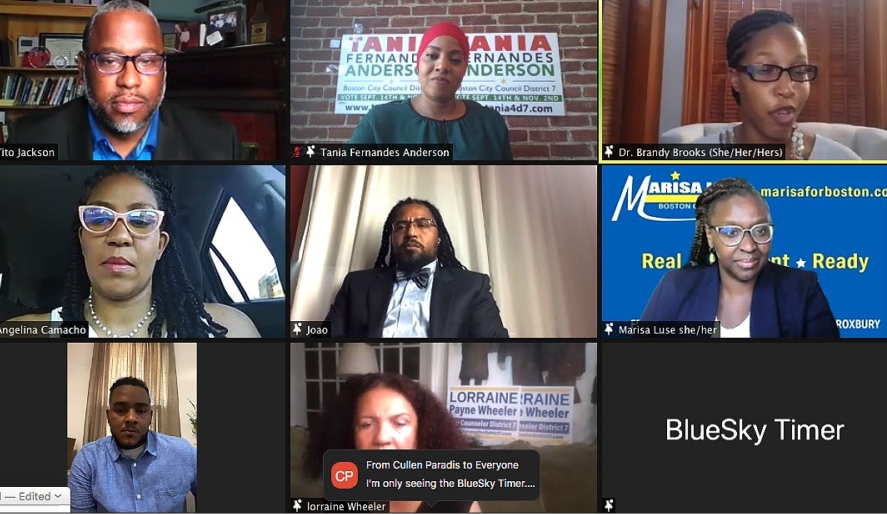
Seven candidates for the District 7 City Council seat discussed housing, the opiod crisis, public safety and other municipal issues during an online forum hosted by local ward committees and civic groups last week.
Former District 7 Councilor Tito Jackson moderated the panel. The following are summaries of the candidates’ positions on issues raised by the organizers.
Tania Anderson Fernandes
The former head of the Upham’s Corner Mainstreets organization stressed her experience as a Cape Verde-born immigrant who moved to the United States at age 10 and helped raise her two younger siblings while living in public housing.
“I am a small business owner and an artist, I faced deportation and experienced homelessness by the age of 23,” she said during her opening remarks. “I’m a mother of two and a foster mother to 17 children.”
Asked how she would help District 7 residents facing eviction, she advocated for the city stepping in to help tenants catch up on their rent arrearages.
“If you work 40 hours in this district and pay more than 30% of your income on rent, the city should pay the difference,” she said.
Asked about her approach to police reform, she said he would work to increase diversity in the police force, provide mental health support for officers and increase the number of social workers responding to emergency calls.
Anderson stressed her experience facing adversity in the district, including what she says was the wrongful conviction and incarceration of her husband.
“I am running for Boston City Council to apply for policies that will create equitable solutions, affordable housing and quality public education,” she said.
Brandy Brooks
Mental health advocate Brandy Brooks emphasized her experience working with families in crisis.
“As an educator and a mental health advocate, I’ve supported English language learners and those obtaining their high school certification, as well as working on public health issues ranging from suicide prevention, older adult falls prevention, intimate partner violence, youth violence prevention and providing safe spaces for lesbian, gay, bisexual, transgender, queer and questioning asexual, intersex and allied young people,” she said. “I’ve done it at the city level, at the state and national level as well.”
Asked what she would do to help residents facing eviction, Brooks said she would work to reinstate the state eviction moratorium that was put in place last year and review the city’s budget to find funds to help landlords and tenants with rents and mortgages.
Asked what she would do to re-imagine public safety, Brooks said she would work to shift funding from the police budget to social services.
“What we spend our money on is what we value,” she said. “We spend close to $90 million on police overtime.”
She said she would also work to make sure the new Office of Police Accountability and Transparency operates independently of the police department and work to diversify the police department.
On improving the situation in the Mass and Cass area, Brooks said the city should take a public health approach, rather than relying on policing. She advocated working with the state to help people find services in the communities where they live.
“We have 1,500 people coming into that area every day who are from other areas,” she said.
Brooks said the city should reopen the Long Island shelter and treatment facilities and use a ferry service to bring people there.
Angelina Camacho
Parent organizer Angelina Camacho emphasized growing inequality in her opening remarks.
“I’m running because there’s a disconnect between community and opportunity,” she said. “The haves are taking more than their fair share, the have-nots cannot connect to resources and those in the middle are left scratching their heads.”
Asked about residents facing eviction, Camacho spoke about increasing linkage fees developers pay to support the creation of affordable housing. She said the key to helping families stay in their homes is providing workforce development so that families can increase their incomes.
“We need to put more income into the hands of our residents,” she said.
Asked about reimagining public safety in Boston, Camacho said she would work to improve diversity in the police department.
Joao DePina
Community activist Joao DePina stressed his experience in the Roxbury community working on equity issues.
“I’ve
been here 20 years in the heart of Grove Hall, ensuring that this
community stays safe,” he said. “I’ve taken many measures in this
community and other communities to ensure that things are being done
correctly and holding our people in public office accountable and making
sure that our community is being treated equally.”
DePina
said he would work to reinstate the eviction moratorium and seek
funding to help people facing eviction from the private sector. He also
stressed the importance of neighborhood residents receiving financial
literacy education.
Asked
what he would do to reimagine public safety, DePina said he will
continue to highlight systemic racism in the Boston Police Department.
On Mass and Cass, DePina said he is opposed to state-run safe injection sites, but stressed a need for more services.
“I want to get people wraparound services,” he said.
Marissa Luse
Marisa
Luse, on leave from her job as campus engagement and collaborations
manager at Northeastern University, said she is a Roxbury native who has
raised children and run businesses and nonprofits in the neighborhood.
“I’m
running because I want to bring consistency transparency to uplift and
resolve reoccurring issues that continue to impact our quality of life,”
she said.
Asked about
how to help tenants facing eviction, Luse said the city should expand
its affordable housing and create community land trusts, entities where
homes can be deeded permanently affordable.
Asked about how best to reform public safety, she said the city has to face up to systemic racism.
“We
have to work on acknowledging that there is a systemic racism issue,”
she said. “We have to address that in every city department.”
Leon Rivera
Community
organizer Leon Rivera cited his tutelage under the late Chuck Turner,
who he says taught him how to work to improve his neighborhood and cited
his work in the Mass and Cass area.
“From
a young age I’ve been tackling quality of life issues from poor
conditions at our schools to pedestrian safety,” he said in his opening
remarks. “I’m one of the leading voices on the opioid crisis here in
Boston, and I’m looking to be your next district city councilor because
our district is in tough shape.”
On
helping residents facing eviction, Rivera said he would reinstate the
eviction moratorium and work to increase affordable housing in Boston.
He advocated increasing the share of affordable units developers are
required to build from 13% to 40%.
Rivera
said he would advocate for reallocating funds from the police
department and hiring more mental health workers and substance abuse
outreach workers.
Asked about improving the Mass and Cass area, he cited his work over the last five years cleaning used needles from parks there.
He said the city should increase outreach efforts in the area.
Lorraine Payne Wheeler
Attorney
Lorraine Payne Wheeler cited her work as a founder of the Roxbury Path
Forward neighborhood organization and helping abutters negotiate with
real estate developers in the area.
“For
the last 10 years I have been organizing a neighborhood association in
the Moreland Street Historic District and during that 10 years we’ve
really come across, almost all of the issues that affect district
seven,” she said.
Asked
about helping tenants facing eviction, she said the city should use the
federal COVID recovery funding to help stabilize families and small
property owners.
Asked
about reforming public safety, she said her experience losing her
grandfather and father to violence has sensitized her to the needs of
families who experience such losses.
On
improving the situation at Mass and Cass, she said she favors reopening
the Long Island shelter and spreading services to other communities.
“We have to look to suburban communities to offer services,” she said.
Lightning round
Asked
whether they would support an elected, appointed or hybrid school
committee, Luse, Brooks, Anderson and Rivera said the supported a
fully-elected body. DePina, Camacho and Wheeler said the supported a
hybrid elected/appointed body.
Asked
whether they supported the School Committee’s decision to change the
admissions process to the city’s exam schools, using a census
tract-based system, Camacho, Rivera, Brooks, Luse and Wheeler said yes,
DePina and Anderson said no.
All candidates agreed that police officers should not work in Boston schools.
Asked
whether they supported non-citizens being allowed to vote in municipal
elections, Rivera, Luse and Anderson said yes. Camacho, Wheeler, DePina
and Brooks said no. All agreed that 16 and 17-year-olds should have the
right to vote.
Brooks,
Wheeler, Rivera and Luse said they support restoring rent control in
Boston. Anderson, Camacho and DePina said they were against.
All opposed safe consumption sites for people addicted to opiods.
The field will be whittled down to two finalists after the Sept. 14 preliminary election. The final election is Nov. 2.


