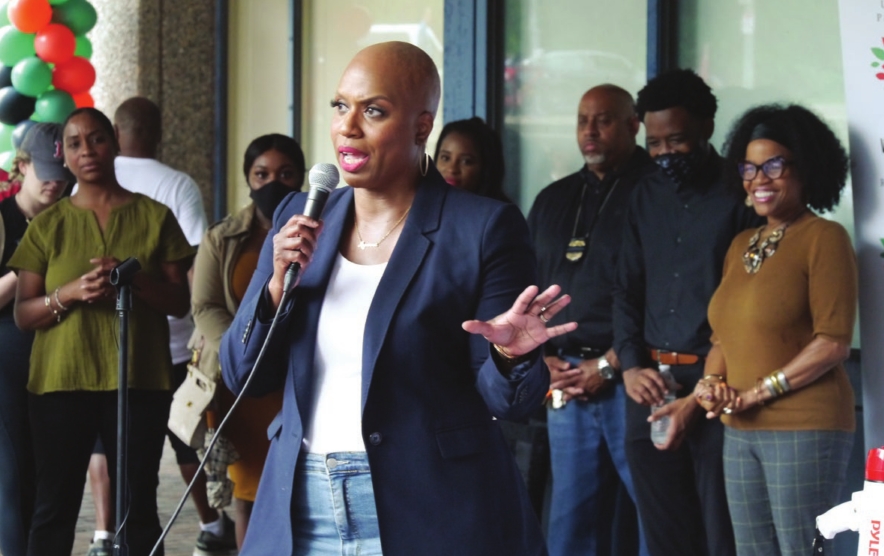
U.S. Rep. Ayanna Pressley addresses a gathering at Madison Park High School during the kick off for the Roxbury Unity Parade Sunday (story page 3).
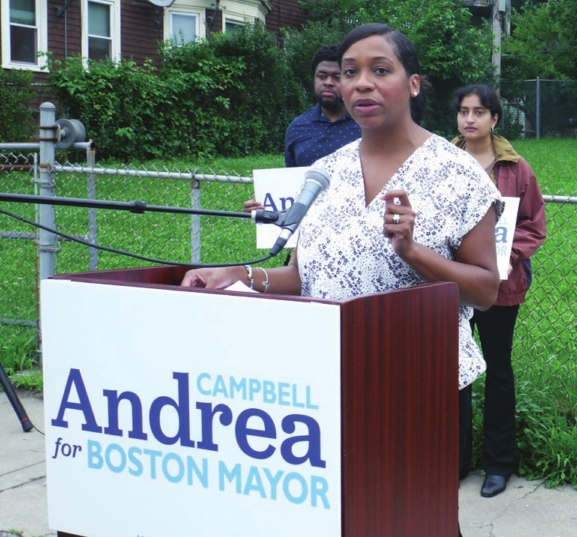
Mayoral candidate Andrea Campbell outlines a plan to develop vacant city-owned lots.
Most oppose rent control, support transfer tax
Andrea Campbell announced in a press conference last Wednesday that, if elected mayor, she plans to take action to develop more affordable housing in Boston, including selling 100 vacant lots owned by the city in her first 100 days in office.
The developed lots would promote affordable housing for local residents, Campbell said. She said her work in housing is also about closing the racial wealth gap and creating jobs.
“I would make sure these lots are used for housing and mixeduse development that will be affordable for those who live here, create local jobs and provide ownership opportunities for residents,” Campbell said.
The plan builds off work she has previously done as District 4 city councilor. She started a vacant lot initiative two years ago, in which she worked with architects, local universities, students, community members and civic leaders to develop plans to build on the city’s vacant lots, which she says are concentrated in Roxbury, Mattapan and Dorchester.
Her plan comes among a slate of candidates’ proposed policies focused on increasing affordable housing in Boston that look at topics from taxing the sale of luxury property to shifting the structure of the Boston Planning and Development Agency (BPDA).
Housing
is also a prominent issue for Boston citizens. In a June poll from
Suffolk University and The Boston Globe, respondents selected housing as
the most important issue that would affect their vote for mayor more
than any other issue.
Like
Campbell, John Barros proposes using city-owned land for the creation
of new affordable housing, including land around community centers and
libraries to create access to amenities that will draw people to
neighborhoods.
Taylor
Connolly, communications director for the Barros campaign, said his plan
is “more of a comprehensive neighborhood development approach.”
Also
in discussion among the candidates is a real estate transfer tax that
would be paid after a property is sold. According to their responses to a
Progressive Massachusetts’ 2021 Boston Mayoral Candidate Questionnaire,
all candidates support a transfer tax, with most candidates proposing a
$2 million threshold for the transfer tax, exempting sales of
properties under that value.
In
the questionnaire, Michelle Wu, Annissa Essaibi George and Campbell
specifically voiced support for the 2019 home rule petition proposed by
city councilors Lydia Edwards and Kim Janey that would create a transfer
tax of up to 6% on sales over $2 million. The fee would be split
between the seller and buyer of the property.
In
their responses to the Progressive Mass questionnaire, candidates tend
not to support rent control, which was ended in Massachusetts by a
ballot question in 1994. Three of the candidates — Campbell, Essaibi
George and Barros — do not support allowing rent control, while Wu
supports overturning the state-wide ban on rent control. Janey left the
question blank.
“I
support lifting the statewide ban so municipalities can employ more
tools to stabilize communities while creating more affordable housing,”
Wu said in her questionnaire response.
In
an April poll sponsored by WBUR, the Dorchester Reporter, and The
Boston Foundation about 75% of respondents voiced support for rent
control, and more than half of the total respondents strongly supported
the policy.
Among the
debated policies is the fate of the BPDA, with some candidates proposing
an independent public office of planning to take over some or all of
the current organization’s roles. Candidates Campbell, Essaibi George
and Wu take various stances in supporting the policy while Barros is
opposed. Janey left the question blank.
For
Essaibi George, an independent planning agency would exist separate
from the current BPDA. According to her campaign website it would be
“dedicated to the forward-thinking and inclusive development of our
city.” Meanwhile, Campbell proposes a comprehensive reform of the
existing agency.
Wu,
on the other hand, proposes abolishing the BPDA completely. In a 2019
report produced as chair of the City Council’s Committee On Planning,
Development & Transportation, Wu outlined a plan transitioning
resources and responsibilities to the city government before legally
abolishing the agency through a home rule petition.
Barros,
who oversaw the BPDA as Chief of Economic Development for the City of
Boston, would seek to shift how the agency is structured.
“Instead
of creating a new separate agency … he is proposing to really transform
the way that the BPDA currently operates,” said Connolly, for the
Barros campaign.
That
transformation, Connolly said, would have the planning arm of the
agency oversee everything and dictate needs and resources to the
development branch.
Also
discussed by candidates in the Progressive Massachusetts questionnaire
was shifting the percentage of affordable units in new developments
under Boston’s Inclusionary Development Policy. Currently, for any
development with more than units, the policy requires 13% of those units
to be income-restricted to provide for more affordable housing.
Apart
from Janey, who left the question blank, all candidates supported
raising the percentage of the developers’ obligation to create
income-restricted units. Barros proposed raising it to between 15% and
20%. Essaibi George suggested raising it to 20%. Wu and Campbell
proposed looking to raise it above 20%.


