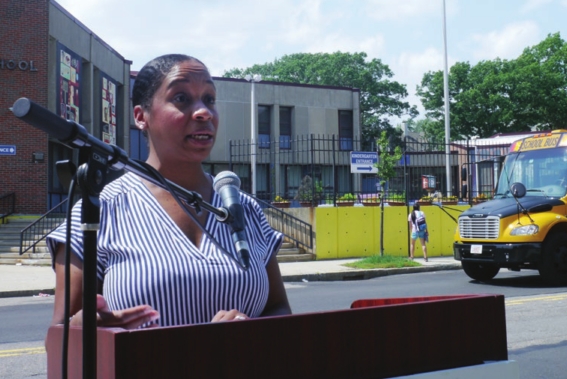
City Councilor Andrea Campbell addresses reporters in front of the Trotter school in Roxbury.
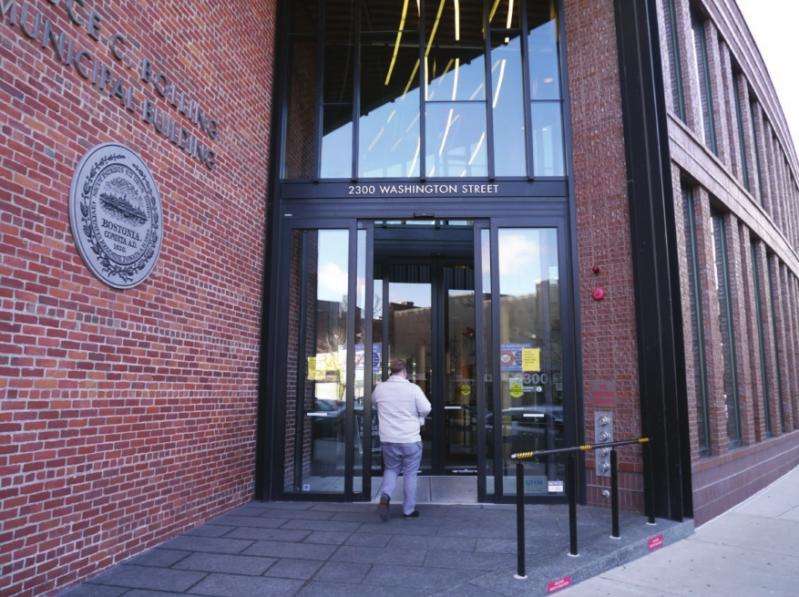
The Boston Public Schools central office at the Bruce Bolling Building in Roxbury.
Campbell: District should put money to use now
Citing wait lists for summer programs and school buildings with no air conditioning, District 4 City Councilor Andrea Campbell held a press conference last Wednesday calling on the Boston Public Schools to accelerate their release of millions of dollars in federal COVID relief funding.
Boston is slated to receive more than $400 million in Elementary and Secondary School Emergency Relief (ESSER) funding. While district officials are in the midst of a series of meetings with parents, students, school staff and other members of the public, soliciting input they hope will inform their priorities for spending, Campbell says there are urgent needs in the city’s schools that are not being met.
“We’ve known about this funding since March, and there is still no public plan, no timeline, no strategy from the administration or the district on how the city intends to use these once-in-a-generation funds,” Campbell told reporters. “While I appreciate the community process that BPS is launching to engage families, and how these dollars could be spent, this process should have started months ago, and been completed, frankly, by now.”
On Friday, BPS Superintendent Brenda Cassellius released a draft spending plan for a $123 million portion of the funding, targeting instructional
materials for students learning reading and for English language
learners, compensatory services for students with disabilities, and
students supports, including social workers in every school and
mentoring and tutoring services.
The draft report also calls for spending on air conditioning and clean drinking water.
“The
more than $400 million in funding we anticipate receiving will provide
Boston Public Schools with additional funding to address some of the
long-standing challenges we — Team BPS and our community — have together
identified as priorities,” Cassellius writes in the report summary.
A
BPS spokesperson said in a statement sent to the Banner, “Boston Public
Schools developed a thorough and transparent stakeholder engagement
process to discuss investment of federal relief funding and has
established an oversight office to ensure we are holding ourselves
accountable and are good stewards of the public trust.”
The
spokesperson said the district has so far held 33 meetings with 1,200
stakeholders. A Return, Recover, Reimagine Commission set up by the
district has held seven community meetings. There will be a public
comment period on the current proposal through July 30, after which a
final copy of the plan will be issued.
The
report currently out covers ESSER II funding, a pot of $123 million in
federal funds the district has received. The district already received
$55 million in ESSER I funds and will receive an additional $276 million
in ESSER III funds.
Campbell
said the district should have invested in air conditioning and HVAC
system upgrades before students began summer school and enrichment
programs in BPS buildings. Of the 63 BPS school buildings being used for
summer learning, only 29 have air conditioning.
The
lack of mechanical ventilation in BPS school buildings became an issue
over the last school year, as state officials pushed for students to
return to in-school learning. Because the coronavirus is spread
primarily through respiratory droplets and aerosols, classrooms without
mechanical ventilation systems are thought to put students at greater
risk of infection.
The
pandemic spotlight on the lack of ventilation in BPS buildings led to
calls for buildings to be retrofitted with HVAC systems.
Campbell
noted that she pressed the district to come up with a plan for
ventilation upgrades during a City Council hearing in April. Since then,
with nine days of temperatures above 90 degrees in June alone, students
and staff in the district’s older buildings have been forced to sweat
it out.
“Educators,
teachers, students, staff were saying the infrastructure of our school
buildings is a problem,” she said. “We’ve known it for years. They’ve
only gotten worse since COVID.”
Campbell
held her press conference in front of the Trotter school in Roxbury, a
building that lacks air conditioning and that the district’s BuildBPS
report found has “poor” ventilation and air quality.
Beyond ESSER
The
$2.6 billion in ESSER federal education funding coming into
Massachusetts can be spent between March of this year and the year 2024.
The portion of funding districts receive is weighted toward those with
higher numbers of economically disadvantaged students.
In
addition to the building upgrades Campbell and others are pushing for,
the funding can be used for the academic, social-emotional and mental
health needs of students.
In
addition to the ESSER funding, Boston and other school districts are
expecting to receive increased state funding under the Student
Opportunity Act, including a $219 million increase for the 2022 fiscal
year.
Some advocates
are calling on the district to hire more students support staff, such as
mental health counselors and literacy coaches, arguing that the
increased state funding will allow the district to continue paying for
such positions after the ESSER funds run out.