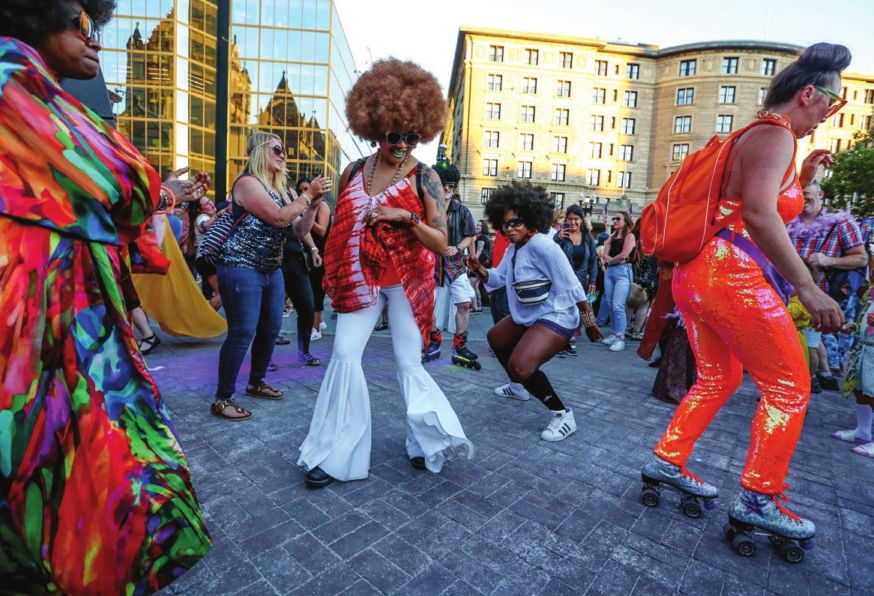
A crowd dances during the Donna Summer Disco Party in Boston’s Copley Square Saturday.
Majority of councilors indicate they’ll vote it down
City councilors clashed with acting Mayor Kim Janey over the city budget last week, with a majority of the body signaling they are not ready to pass the $3.76 billion proposal by the June 30 fiscal year end date.
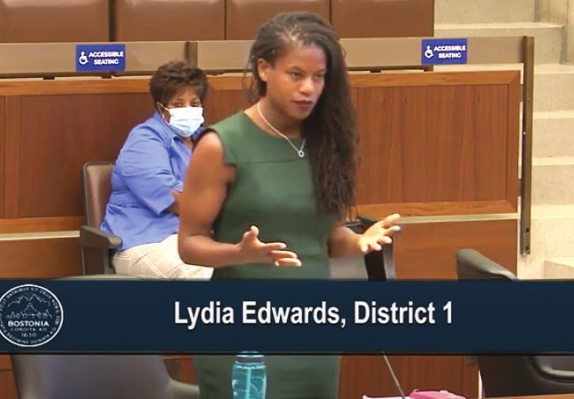
During the City Council meeting on Wednesday, June 23, District 1 Councilor Lydia Edwards said Janey did not provide the needed leadership to move the budget forward. She appeared to imply that Janey was not leading the budget process well.
“When the mayor is no longer here, than we as the elected body, collectively should be running, moving and be guiding the moral compass for this city,” Edwards said.
In response to the councilors’ complaints, which have appeared in local news media, Janey said she has been working closely with the council on the budget.
“I can’t speak to their criticisms, only to my willingness to continue to engage and work with the Boston City Council as we not only pass this budget but implement the
budget,” she said of her council colleagues, speaking to reporters
Thursday. “All 12 were invited for a face-to-face. Eleven of the 12 took
up that invitation. The invitations remain open.”
District 4 Councilor Andrea Campbell told reporters she has not yet had a chance to meet with Janey on the budget.
Janey said she expects to continue working with the council on spending priorities, even after the budget is signed.
While
only two councilors said they would vote “yes” on the new Fiscal Year
2022 operating budget, every other councilor expressed disappointment
with the current proposal. Objections range from a lack of communication
to insufficient cuts to the police budget.
Janey,
however, says she has met in-person with the 11 councilors who
responded to the invitation to meet. She says members of her
administration have participated in 30 hearings that the council held on
the budget.
With
three of the 12 people currently serving on the council running against
Janey for mayor, this year’s budget deliberations have taken on a
politically charged tone. Campbell, who is one of those candidates, held
a press conference Tuesday, blasting Janey’s budget for what she said
were inadequate cuts to the police budget.
At-large
Councilor Annissa Essaibi George, also running for mayor, said the
budget lacked proper housing support. Others said it didn’t prioritize
the homelessness and substance abuse crisis at Massachusetts Avenue and
Melnea Cass Boulevard.
District 5 Councilor Ricardo Arroyo, who supports Janey’s candidacy for mayor, said he will vote in support of the budget.
Each
year, the operating budget includes money allocated for all city
departments, funded by annual recurring revenues. The largest source of
revenue is the city’s property tax, followed by state aid.
Under
the current system, the mayor has exclusive power to make
appropriations. The council cannot add or remove items in the budget,
nor can councilors adjust dollar amounts. The body’s sole power, other
than holding hearings, is a “yes” or “no” vote on the budget.
In her remarks last Wednesday, Edwards suggested the council should take leadership on this year’s budget.
“I
do invite the acting mayor to pass the council’s budget,” she said. “A
budget that is reflective of the real needs and meeting the moment of
this time.”
District 8
Councilor Kenzie Bok, who is chair of the council’s Ways and Means
Committee, also suggested the body lead the budgetary process, although
she also said she would vote in support of Janey’s budget June 30.
“If
the acting mayor isn’t getting us there, it may be that this council
needs to take it into our hands and think about what are the
supplemental appropriations that get this council to ... provide this
city with an operating budget before the fiscal year begins July 1,” Bok
said.
This year’s
battle bears little resemblance to last year’s battle, when Janey and
four other councilors of color voted against former Mayor Martin Walsh’s
budget, calling for deeper cuts to the police department’s then-$414
million projected budget. In that battle, Edwards was the sole Black
councilor to vote in support of Walsh’s budget and authored an op-ed in
support of police.
Janey’s
$399 million police budget reflects a 5% cut in funding over the
projected $420 million in costs for the 2022 fiscal year and the police
overtime budget has been cut from $65 million to $45 million. A similar
cut Walsh made to overtime last year did not result in savings, as
police routinely overspend their overtime budget.
Noting that Janey voted “no” on Walsh’s budget last year, Campbell pushed for deeper cuts to police funding.
“A
full year later, the council is being asked to consider a police budget
that does not look a whole lot different,” she said at her appearance.
Campbell wants to reduce police overtime by $50 million, or 75%.
Edwards told the Banner that the biggest difference this year is leadership.
“We
do not have a mayor with a mandate. That’s a massive difference. So
what that means is it comes from us as a body,” she said. With the
budget in her view funding most departments at the same level and
anything extra coming from federal aid, she said, “That is not agenda
setting.”