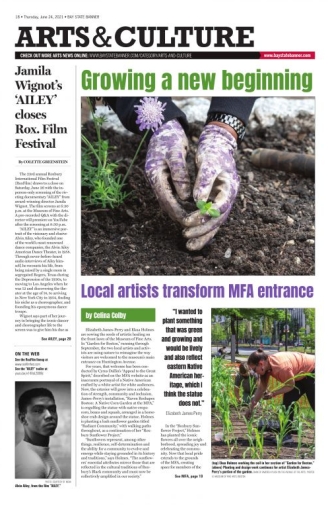
Planting and design work continues for artist Elizabeth James- Perry’s portion of the garden.

Ekua Holmes working the soil in her section of “Garden for Boston.”

Artist Elizabeth James-Perry.

Artist Ekua Holmes.

The installation “Garden for Boston” in progress at the Museum of Fine ArtsLocal artists transform MFA entrance
Elizabeth James-Perry and Ekua Holmes are sowing the seeds of artistic healing on the front lawn of the Museum of Fine Arts. In “Garden for Boston,” running through September, the two local artists and activists are using nature to reimagine the way visitors are welcomed to the museum’s main entrance on Huntington Avenue.
For years, that welcome has been conducted by Cyrus Dallin’s “Appeal to the Great Spirit,” described on the MFA website as an inaccurate portrayal of a Native American crafted by a white artist for white audiences. Now, the exterior will grow into a celebration of strength, community and inclusion.
James-Perry’s installation, “Raven Reshapes Boston: A Native Corn Garden at the MFA,” is engulfing the statue with native crops: corn, beans and squash, arranged in a horseshoe crab design around the statue. Holmes is planting a lush sunflower garden titled “Radiant Community,” with walking paths throughout, as a continuation of her “Roxbury Sunflower Project.”
“Sunflowers represent, among other things, resilience, self-determination and the ability for a community to evolve and emerge while staying grounded in its history and traditions,” says Holmes. “The sunflowers’ essential attributes mirror those that are reflected in the cultural traditions of Roxbury’s Black community and must now be collectively amplified in our society.”
In the “Roxbury Sunflower Project,” Holmes has planted the iconic flowers all over the neighborhood, spreading joy and celebrating the community. Now that local pride extends to the grounds of the MFA, creating space for members of the community in a historically exclusionary institution.
For
James-Perry, the installation is an opportunity to bring natural
growing space back into a city that has become a concrete jungle. “I
wanted to plant something that was green and growing and would be lively
and also reflect eastern Native American heritage, which I think the
statue does not,” says James-Perry. “I thought I would center also the
work of women in gardening, as well as the connection between the ocean
and Wampanoag tribal members in the New England area.”
The
Dallin statue utilizes symbols from various different Midwestern and
Southwestern Native tribes, and James-Perry says she was never drawn to
the piece. In “Raven Reshapes Boston” she has centered the local Native
community, using crushed shells around the garden in allusion to the
rich fishing and whaling history of the area and planting with
traditional techniques of the Indigenous population. When the corn has
grown fully, it will engulf the Dallin statue, centering authentic
Native experience. James-Perry plans to have local tribal members from
Aquinnah, Massachusetts harvest the corn with her in September and
either prepare it as is or dry it to make hominy.
“Garden
for Boston” is part of an ongoing effort by the Museum of Fine Arts to
re-contextualize and analyze its collection and behaviors. It’s an
acknowledgement of the misrepresentation of the Dallin sculpture and an
effort to make members of every local community feel welcome.
“For
me, it’s about cultural revival that is natural and authentic and from
native hands here in Boston,” says James-Perry. “I hope people get even
the tiniest glimpse of that. Even if it’s simply as they’re walking by.”
ON THE WEB
Learn more about the installations at www.mfa.org/exhibition/garden-for-boston