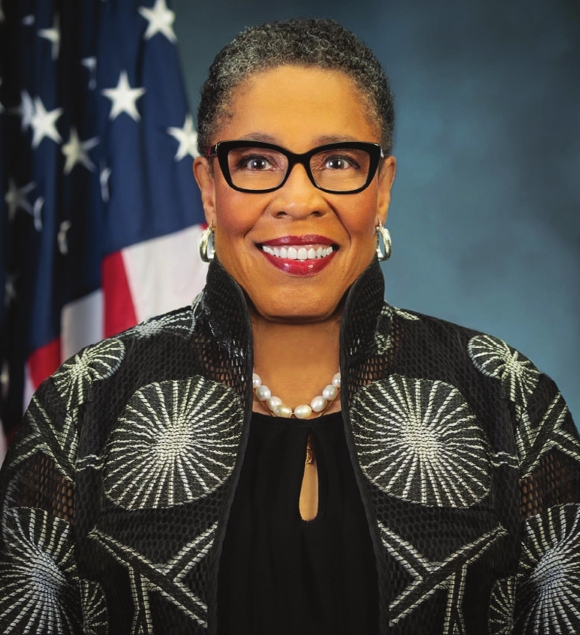
U.S. Housing and Urban Development (HUD) Secretary Marcia L. Fudge.
On May 26, U.S. Housing and Urban Development (HUD) Secretary Marcia L. Fudge toured Kansas City, Missouri to highlight how President Biden’s American Jobs Plan will address the nation’s affordable housing crisis and revitalize our nation’s housing infrastructure.
It is highly likely that many renters would prefer to own their own homes, but the combination of housing costs outpacing incomes remains a persistent obstacle. Additionally, and in a growing number of markets, rising rents leave many families with little or no funds to save for a home down payment.
“Our homes can serve as a bridge to greater opportunities and a better life,” said Fudge. “The American Jobs Plan is a historic, once-in-a-generation investment in our nation’s infrastructure — including our housing infrastructure. If we want the United States to remain the greatest nation in the world, then we must first take care of home — in the most literal sense. To pass an infrastructure plan that fails to expand affordable housing and to revitalize our communities would be akin to building a road that leads to nowhere.”
That same day, HUD named Camden, New Jersey; Cleveland, Ohio; Detroit, Michigan; Fort Myers, Florida; and Lewiston, Maine as 2021 recipients of a combined $160 million in funding through its Choice Neighborhoods initiative. The five awardees will benefit from nearly 2,700 new or renovated mixed-income housing units to help revitalize neighborhoods. The program’s requirement for a public-private partnership translates into one dollar of federal funding for every $10.60 generated from local public and private funds.
While the selected communities await expanded affordable housing in their respective locales, the rest of the nation awaits congressional action on President Biden’s goal of improving housing infrastructure as announced in his American Jobs Plan. The proposal includes $213 billion in direct funding, along with over $100 billion in new and expanded tax credits. If enacted as presented, an estimated 500,000 new and rehabilitated housing units will serve low-and-moderate income families. The Biden plan also requires related construction jobs to pay prevailing wages and $10 billion dedicated to federal enforcement agencies to ensure that participating employers comply with local hiring agreements, equal pay provisions, and workplaces free from discrimination, bias or harassment.
Sounds like a comprehensive plan scaled to broadly address real-life housing issues across demographics and locales. According to the White House, 11 million families now pay more than half their income on rent, and 3 million families with children under the age of six live in homes with lead-based paint.
But the key question becomes whether the plan can arrive soon enough to prevent evictions, overcrowding in existing dwellings, and a rise in homelessness. Studies show that even before the start of the pandemic, 25% of renters across the nation were paying more than 50% of their income in rent, leaving little for savings. This figure is even higher for Black and brown communities.
Further,
the barriers to expanding access to homeownership — particularly for
families of color — will remain an obstacle until or unless housing
down-payment assistance becomes more broadly available. According to a
new joint proposal by the National Fair Housing Alliance and the Center
for Responsible Lending (CRL), targeted down-payment assistance to
first-generation home buyers has the potential to increase homeownership
for 1.7 million Blacks and 1.32 Latino home buyers.
With
a highly partisan Congress unable or unwilling to enact basic voting
rights legislation, it’s reasonable to wonder whether housing programs
like the American Jobs Plan will attract bipartisan support.
This
spring, the National Association of Realtors (NAR) released a report
that updated housing market metrics. NAR found that the nation’s median
existing-home sales price in March rose by a record-breaking annual pace
of 17.2% to a historic high of $329,100, with all regions posting
double-digit price gains. The median existing-single-family home sales
price jumped 18.4% to $334,500, both historic highs.
Regionally,
median home prices were the highest in the West and Northeast. A
near-17% cost increase in the West since March 2020 translates into a
median cost of $493,300. In the Northeast, the corresponding cost was
$364,800 but represents a higher rate of increase, jumping 21.4% since
March 2020. Although median home prices in the South and Midwest were
respectively less costly, at $283,900 and $248,200, double-digit
increases in cost were also found: 15.6% in the South and 13.5% in the
Midwest.
“Consumers
are facing much higher home prices, rising mortgage rates and falling
affordability; however, buyers are still actively in the market,” said
Lawrence Yun, NAR’s chief economist.
Similarly,
Core Logic, a data analysis firm that draws key connections between
information intelligence and economic growth, also wrote about housing
affordability, harking back to the long-touted view of supply versus
demand. According to a December 2020 blog written by Selma Hepp, low
inventories are a major factor.
“[T]he
U.S. has had two decades of bleak housing construction — since 2000,
the U.S. has gained 46 million people and only 20 million housing units.
In the two decades prior, the country gained 45 million people and 35
million housing units. The imbalance has led to housing costs increasing
at a faster rate than incomes. Since 2000, home prices have increased
1.6 times the rate of real household incomes.”
Hepp’s
point is as sensible as it is central to today’s housing challenges:
Most consumers cannot keep up with the stark rise in homeownership
costs.
According to
HUD, the nation’s median family income in April 2020 was $78,500. The
long-standing measure of home affordability is measured by the ratio of
housing costs to income. By this measure, affordable housing costs 30%
or less of monthly income, while moderately cost-burdened households pay
between 30-50% of their income. Severely cost-burdened households are
those paying 50% or more on housing.
With NAR’s national median sales price of $334,500, housing affordability is vanishing across the country.
On
a state-by-state basis, even the nation’s highest median family income
of $113,300 in the District of Columbia causes an affordability strain,
with median home costs more than triple that income. Conversely, in
Mississippi where the lowest family median income is $59,400, the median
home price imposes affordability challenges as well.
The
mismatch between median incomes and housing costs only worsens when
racial disparities are added. The U.S. Senate’s Joint Economic Committee
report entitled “The Economic State of Black America in 2020,” reached
several startling conclusions:
• The wealth gap between Black and white households increases with education.
•
The typical Black households earns a fraction of white household income
— just 59 cents for every dollar. The gap between Black and white
annual household incomes is about $29,000 per year.
• Far less than half (42%) of Black families own their homes, compared to almost three-quarters (73%) of white families.
• Persistent segregation leads to large disparities in the quality of secondary education, leading to worse economic outcomes.
Further,
this report states, “Black households have never held more than 5% of
the nation’s total wealth, while white households held 85% in 2019,
despite Blacks making up around 13% of the population ... If these
trends persist, white median household wealth will increase while Black
and Hispanic household wealth continues to fall. At the current pace of
decline, median household wealth could reach zero by 2053 for Black
households and by 2073 for Hispanic households.”
As
CRL Executive Vice President Nikitra Bailey testified in March before
the Senate’s Committee on Banking, Housing, and Urban Affairs,
“President Biden has called for acknowledgment and redress of the
impacts of this long history of the nation’s and the federal
government’s housing discrimination, including the racial gap in
homeownership … Now is the time for bold solutions that center racial
justice in homeownership opportunity.”
Charlene Crowell is a senior fellow with the Center for Responsible Lending.


