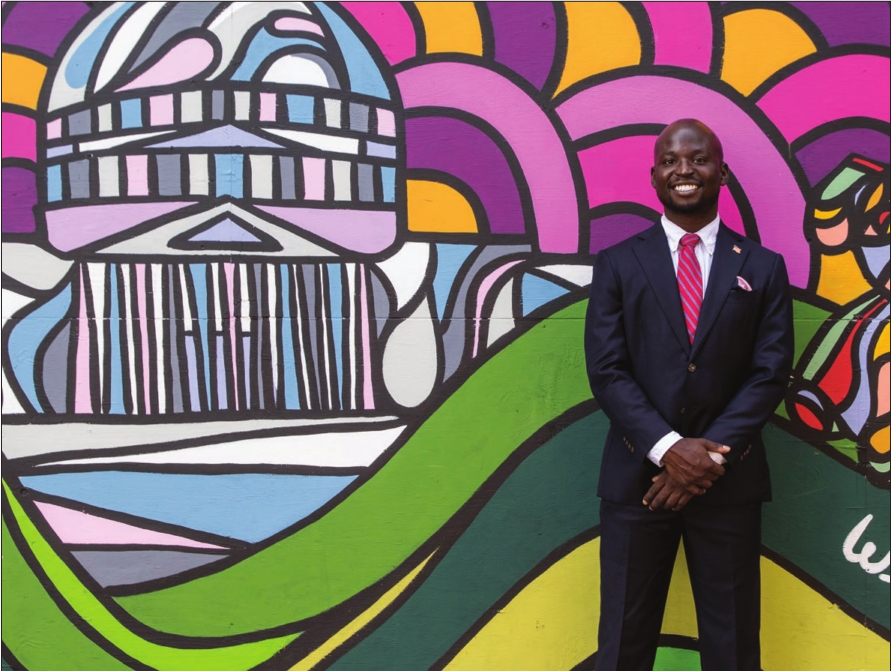
District of Columbia Congressional Rep. Oye Owolewa.
Roxbury native Oye Owolewa made history as the first Nigerian American elected as a shadow representative for the U.S. Congress. Now, he’s launched a campaign to spread awareness for D.C. statehood.
“Once I ran for this position, at first I was doing it to represent D.C. residents,” he said. “Right now, there’s 700,000-plus residents that don’t have a voice in Congress. But as I was getting further into the campaign trail, I realized it’s bigger than that.”
Owolewa said that his personal experiences have allowed him to empathize with a wide range of issues.
“Being a second-generation Nigerian American, being the first ever elected to federal office, being a health care worker, being a millennial, being a Black man living in an inner city, I felt like there were so many different perspectives I’d bring,” he said.
Growing up in Boston, Owolewa’s parents influenced his decision to get into politics. They were “natural leaders,” he said, both in the Nigerian community and Boston as a whole. As a child, he remembers reading through the Bay State Banner with his father.
“My dad used to bring those papers home, and we would just talk about things affecting our community,” he said. “So that kind of introduction into community-building is what got me into politics.”
Owolewa graduated from
Northeastern University’s pharmacy program in 2014 and moved to D.C.
days later. When Trump took office in 2016, Owolewa said that he
immediately noticed the growing racial tensions, as well as the momentum
building in protestors and politicians alike. Advocates were urging
others to speak to their representatives and fight back against sexism
and systemic racism. But as a D.C. resident, Owolewa didn’t have a
representative to call.
“I
realized that without a voting representative, without a voting
senator, we don’t have that. We don’t have a voice, we don’t have a say
on what’s going on nationally,” he said. “And that’s when I really got
inspired to talk about statehood and the importance of representation.”
America is the only westernized and industrialized country that denies its capital city residents representation, said Owolewa.
“I
believe we have something to provide for the country. We can voice our
opinion and vote on issues that affect climate change. We can really
discuss money in politics. We can really get into the fight to improve
our health care system. And there’s so many conversations that a vote
from D.C. can push our country into.”
D.C.’s
Black community makes up around 46% of the city’s population, compared
to less than 2% in Maine, Montana and Vermont. The city’s Black
population is larger than that of those three states combined — but
D.C.’s population still lacks federal representation.
“I think there’s a correlation between those demographics and a lack of civil rights,” said Owolewa.
He added that the fight is urgent.
“I
don’t want to wait until D.C. gets less of a minority population for us
to achieve statehood,” he said. “I believe the people who have fought
for statehood, people who live here for generations, deserve to benefit
from us being a state.”
Locally,
statehood would ensure protections for D.C. residents, said Owolewa. A
transition into statehood would also ensure broader LGBTQ+
representation, said Owolewa, since D.C. has the highest percentage of
LGBTQ+ individuals compared to other states.
As in Boston, the COVID-19 pandemic exposed inequities in D.C.
“At one point, [over] 75% of all Washingtonians who died from COVID were Black,” said Owolewa.
“And even in areas that weren’t as diverse, we were still seeing that
trend. Especially now, the rates of vaccines in the Black community are
lower. We’re very concerned that even as we get past COVID, [there will
be] remaining cases of deaths and hospitalizations in the Black
community.”
The Black
community suffered last year because D.C. isn’t allocated the same
federal funding as U.S. states. For instance, the federal government
passed the 2020 CARES Act to prevent economic downturns following the
pandemic. States with sparse populations were collecting billions of
dollars, but territories like D.C. received less than half the funds
states received.
“We
were limited in the way we could build health care infrastructure or be
able to basically maintain ourselves economically, [even though] we were
going through the pandemic like every other state,” said Owolewa.
Even
when the city began distributing vaccines, the residents of neighboring
states got early priority over D.C. locals. This created a paradox,
since D.C. locals were unable to travel to neighboring states to receive
their dose.
Owolewa expressed frustration over these health care barriers.
The
D.C. government has no control over the National Guard, either. On Jan.
6, destructive mobs of Trump supporters stormed the U.S. Capitol,
facing little resistance. Owolewa said another insurrection could be in
the near future.
“As
long as D.C. is not a state, and we don’t have control over our National
Guard, there isn’t really much stopping it from happening again,” he
said.
Advocates
arguing against statehood note that it is technically unconstitutional.
Congress doesn’t have the power to create a 51st state. Other residents
note that the state’s creation would be expensive and inefficient,
especially since the territory borders could be altered. This would
require a lot of compromise with both Maryland and Virginia. Statehood
could also cost millions of dollars annually, since D.C. officials would
have to run their own prisons and courts.
But for Owolewa, statehood is an opportunity to protect local residents.
“There are very big consequences of not having our own say and a final say over our own matters and resources,” he said.
Currently
D.C.’s powers are limited in several other ways. For example, federal
officials can veto bills proposed by D.C. politicians.
“We can’t finalize our own laws until Congress gives it the OK,” Owolewa said.
Furthermore,
residents have little control over their city budget. They cannot
properly enforce violations committed by Maryland or Virginia residents.
They cannot generate revenue from state tax.
“The
way to think about being a Washingtonian, is that we have the
responsibilities of a state, but we don’t have the rights and privileges
of being a state,” he said.
Owolewa said he won’t give up the fight any time soon.
“If
you want to get closer to a fairer society and fairer nation, then D.C.
statehood covers all bases and gets us closer to that,” he said.


