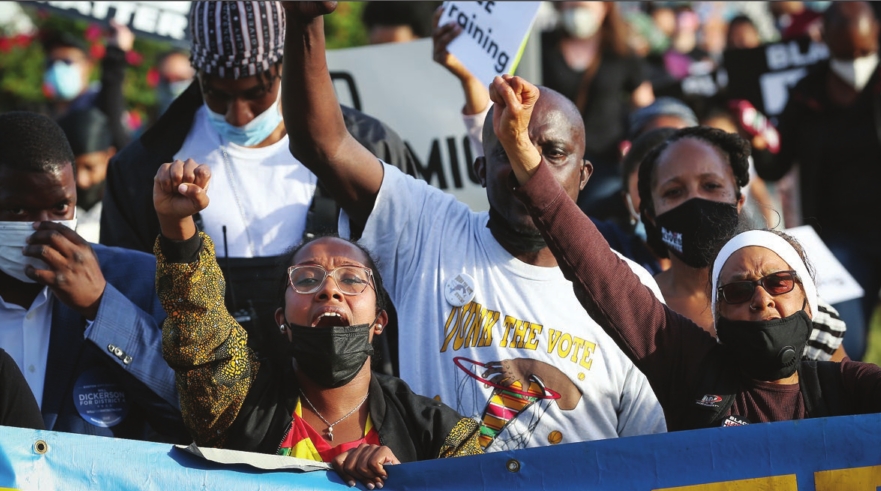
Hundreds participate in the March for George & Justice from Milton to Mattapan to commemorate the anniversary of the killing of George Floyd on May 25.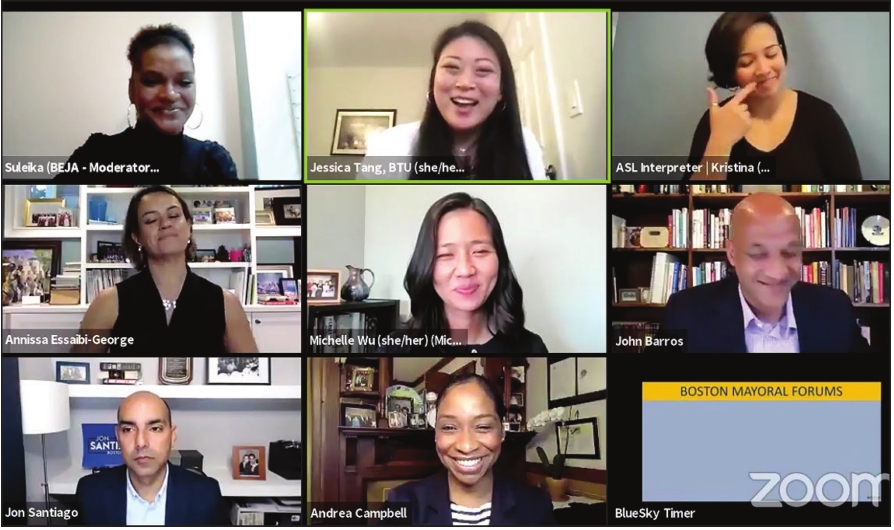
Wu, Janey round out top tier, others in single digits
A new poll shows at-large City Councilor Annissa Essaibi George leading in the mayoral race with support from 22% of likely voters, inching ahead of at-large Councilor Michelle Wu, who had support from 18% and acting Mayor Kim Janey, who had support from 16%.
The poll, which surveyed 550 people between May 25 and May 30, showed District 4 Councilor Andrea Campbell with 6% of the vote and state Rep. Jon Santiago and former City of Boston Economic Development Chief John Barros each with 5%. The greatest portion of likely voters — 29% — are still undecided.
The poll was conducted by a pair of political consulting firms — Poll Progressive and Emancipated Group — and queried likely voters
on mayoral preferences as well as on several key issues that have
emerged in this year’s municipal elections: reducing the police budget,
eliminating fares on the MBTA and lowering the voting age to 16. The
margin of error was 4.1%.
It
shows significant movement for Essaibi George, who in an April 28
Emerson College Polling survey came in with 14% of respondents’ support —
one point behind Janey and two behind Wu. That poll showed 36% of
voters undecided.
So
what’s changed in the last month? For one, the field is now set, nearly
two weeks past the May 18 deadline for nomination papers. Although much
of the debate in this year’s mayoral and at-large City Council races has
revolved around typically progressive issues such as reining in police
abuse, equity in city contracting and returning to an elected school
committee, Essaibi George seems to have cornered the moderate and
conservative vote, favoring an appointed school committee and opposing
calls to remove police officers from schools and shutter the
department’s controversial gang database.
Barros
and Santiago, who have taken similar positions to those held by Essaibi
George, may lack the name recognition she has earned through three
successful citywide races.
“She has won at-large races with a pragmatic progressive
approach, where she’ll go right on some issues and left on others,” said
David Fadul, a co-founder of Poll Progressive. “The other moderate
candidates have been quite weak.”
Essaibi
George may also benefit from having branded herself as the education
candidate, Fadul notes. Among voters who listed education as their top
concern, Essaibi, a former high school teacher, led the pack, with 32%
of their support.
While
the highest proportion of white voters in the survey — 27% — support
Essaibi George, Wu comes in second with 23% of white voters’ support.
Among Black voters, Janey leads with 34% of their support, but 35% of Black voters remain undecided in the race.
Issues for voters
A
near-majority of voters polled — 49% — said they would support reducing
the Boston Police Department budget and diverting the funds to violence
prevention programs, while 36% of voters were opposed to the idea and
15% were unsure. That question polled best with Black voters, 61% of
whom said they would support such a move. Nearly as many Latino voters,
60%, agreed, while 43% of whites said they favored cutting the police
budget and 45% of whites were opposed.
Asked
whether they would support a reduction of MBTA fares, 36% of voters
agreed, while 20% said they were in favor of abolishing fares for the T.
Thirty-five percent of voters said they favored no change to MBTA
fares.
A slim majority of voters polled — 55% — oppose calls to lower the voting age to 16.
“The opposition runs across all demographics except African Americans, who support it 47% to 37%,” Fadul notes.
Housing
led among issues voters are most concerned about, with 20% of
respondents listing it as their top concern. Education was second, with
16% of voters listing it as a top concern, followed by jobs, with 13%.
Among those who listed housing as their top concern, 25% supported Kim Janey and 22% supported Michelle Wu.
The
survey was conducted via text-message-to-web polling and interactive
voice response for land lines. While the number of Black, Latino and
Asian respondents to the poll were not proportionate to their share of
the voting population, their responses were weighted to reflect the
demographics of the city’s voters. Similar weighting was done for
educational attainment.
Where the candidates stand
In
a debate last week co-sponsored by the Boston Teachers Union and the
Boston Education Justice Alliance, Janey, Wu, Santiago and Campbell all
said they’re in favor of a hybrid elected/appointed school committee.
Barros, a former School Committee member, and Essaibi George said they
were in favor of the body remaining all-appointed.
Asked
whether they would support extending the grade and zipcode-based
admissions process for the city’s three selective high schools, Janey
and Wu said yes, while Barros, Campbell, Essaibi George and Santiago
said no.
Asked whether
they would support eliminating the MCAS exam as a Massachusetts
graduation requirement, all but Santiago and Campbell responded
affirmatively.
Santiago
and Essaibi George said they would not support removing police officers
from school buildings. Barros, Essaibi George and Santiago said they
would not support dismantling the Boston Police Department’s
controversial gang database.