
Mayor Martin Walsh addresses reporters in his final press conference Monday.
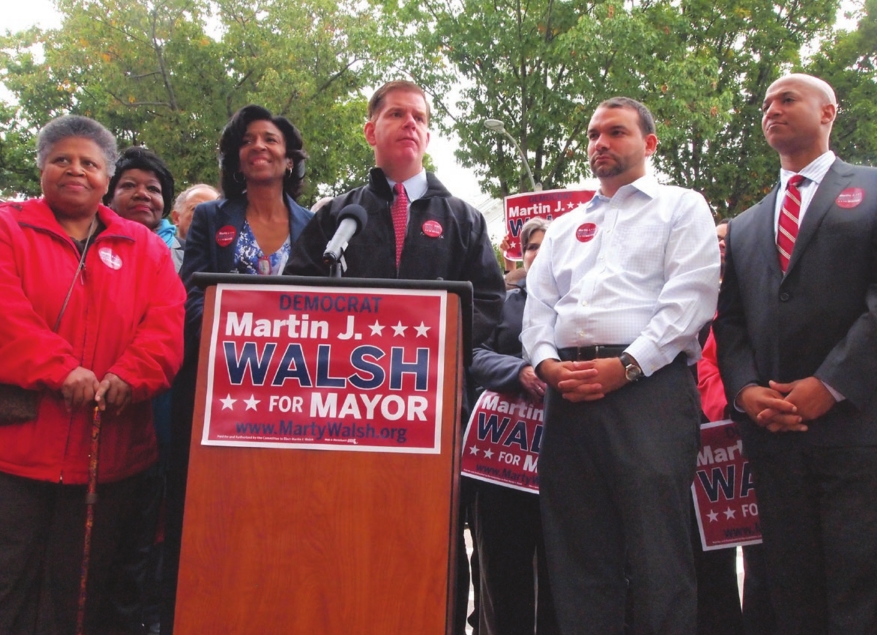
Then
state Rep. Martin Walsh is endorsed by elected officials and former
candidates including former state Rep. Gloria Fox, former state Rep. and
mayoral candidate Charlotte Golar Richie, former City Councilor Felix
G. Arroyo and former candidate John Barros.
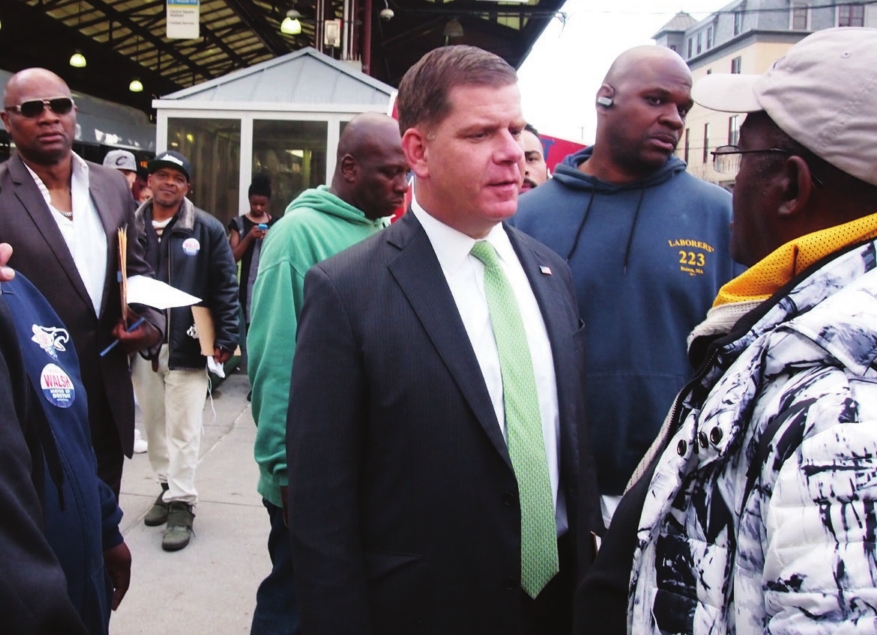
Mayor Martin Walsh collects signatures in Dudley Square during his 2017 campaign for re-election.
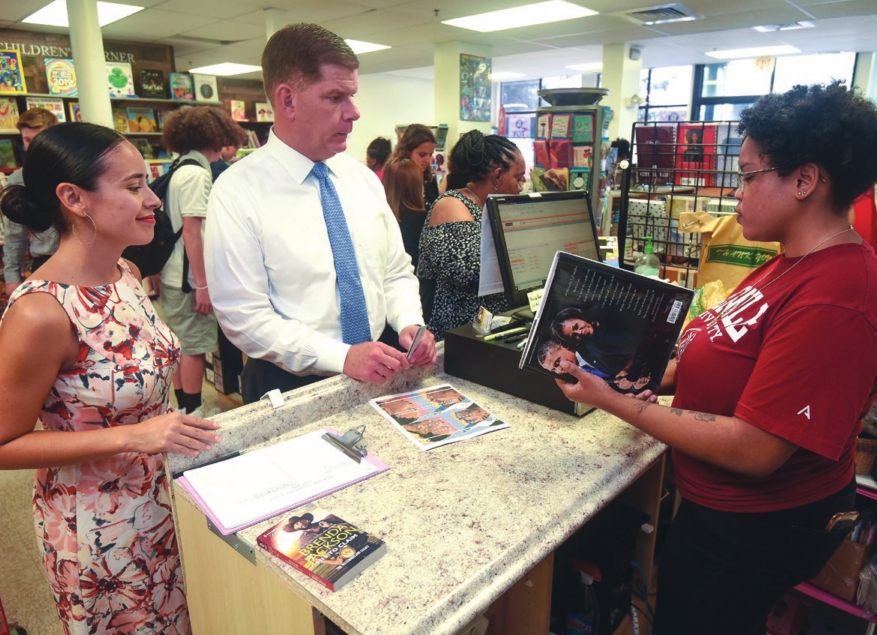
Mayor Martin Walsh visits Frugal Bookstore in Nubian Square in 2019.
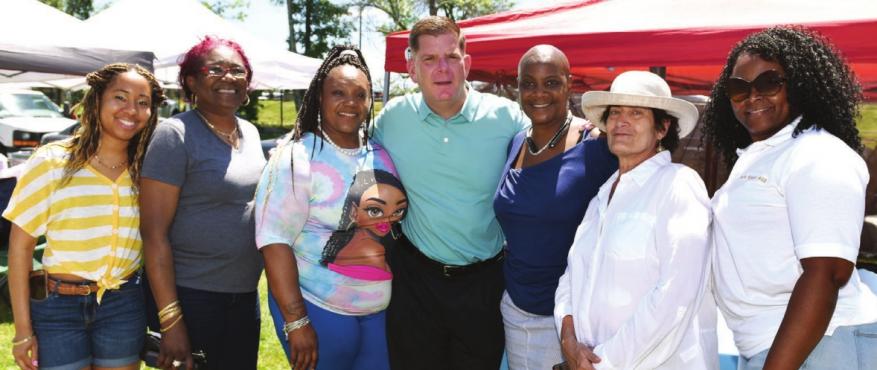
Mayor Martin Walsh attends the Roxbury Reunion in Franklin Park.
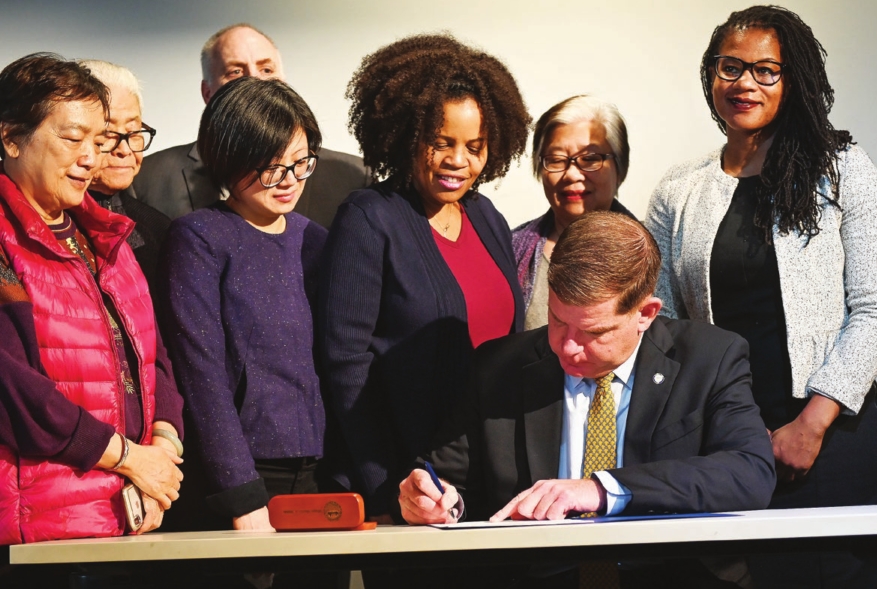
Walsh signs an ordinance authorizing a real estate transfer tax.

Walsh and elected officials cut the ribbon on the Dorchester Day parade in 2018.
Administration wrestled with racial inequality amid economic boom times
Back in September 2013, Martin Walsh wasn’t the top choice for Black and Latino voters, the majority of whom backed former Department of Neighborhood Development Director Charlotte Golar Richie and at-large councilors Felix G. Arroyo and John Connolly in the September preliminary.
But when the field narrowed and Walsh and Connolly faced off in November, Walsh scored a decisive victory, drawing a majority of the support from Black and Latino voters as well as white progressives and his conservative-leaning Dorchester/South Boston base.
While an odd coalition of voters secured Walsh a victory, when it came to representation in his administration, Blacks and Latinos faced a mixed bag. His original 17-member cabinet had just two people of color: Chief of Staff Daniel Koh, who is Korean and Lebanese, and Arroyo, who served as director of Health and Human services. His “kitchen cabinet” — the set of city officials he met with on a weekly basis — was all Irish American, with the exception of Koh.
While faces changed and Arroyo’s successor at Health and Human Services, Marty Martinez, secured a place in the kitchen cabinet, the general pattern of whites in top hiring and decision-making positions held throughout Walsh’s years in City Hall.
Despite the often-contentious relations between his administration and civil rights groups, Walsh did make several notable appointments. In 2018, William Gross became the first African American to head the Boston Police Department. In 2015, Tommy Chang’s appointment as Boston Public Schools superintendent marked the first time an Asian American held that position. In 2019, Walsh tapped then-Election Department Commissioner Dion Irish, who is Black, to head the Inspectional Services Department.
The policies and practices handed down by Walsh and his administration often opened with promises and pronouncements that did not always lead substantive change in a city that for decades has resisted progressive reforms on race.
As he prepares to head to Washington, Walsh leaves a complex legacy in city politics marked by moments of progress and stubborn challenges his administration often failed to meet head-on.
The changing face of Boston politics
Walsh’s rise to power in Boston politics came at the beginning of an era of unprecedented progress for Black, Latino and Asian elected officials. But the mayor more
often than not found himself in opposition to candidates of color,
endorsing white candidates over them in multiple electoral cycles until
his 2019 endorsement of at-large City Council candidate Alejandra St.
Guillen, who lost by one vote to Julia Mejia.
Walsh’s
time in office saw councilors Ayanna Pressley and Michelle Wu garner
the most votes in at-large races, as well as the historic upset
victories of Pressley in the 7th Congressional district race and Rachael
Rollins in the race for the Suffolk County District Attorney’s seat.
With the 2019 election, the Boston City Council became majority women and majority people of color.
Walsh,
who has largely enjoyed cordial relations with the city’s councilors
and State House delegation, clashed last year with the majority of the
council’s Black, Latino and Asian members over the Boston Police
Department budget. The councilors of color backed calls from community
activists to cut the department’s total budget by 10% and invest the
savings in crime prevention and social service programs. Walsh instead
opted for a smaller cut from the police overtime budget, which the
department routinely overspends and the city always replenishes. In the
end, five of the city council’s 13 members voted against the budget.
As
Walsh prepares to leave, three declared mayoral candidates — city
councilors Michelle Wu, Andrea Campbell and Annissa Essaibi George — are
women of color. Also in the race are Walsh’s Economic Development Chief
John Barros and state Rep. Jon Santiago. This year could be the first
mayoral election in which no white men are contenders — a far cry from
the 2013 election, where two white men bested a diverse field of 12 to
advance to the general election.
Real estate development
Walsh’s
mayoral term came as real estate developers were ramping up
construction of luxury housing developments in the city’s downtown areas
and outer neighborhoods. Walsh’s career began as a young adult working
in the Laborer’s Union Local 223, and while serving as a state
representative he also held the position of head of the Building Trades
Council.
As mayor, he
set an ambitious goal of creating 69,000 new housing units, as city
planners estimated Boston’s population would swell to 800,000 by 2030
from 617,000 in 2010. Projects large and small gained approvals from the
city’s development oversight agencies with relative ease as the Walsh
administration met and often exceeded goals for production of
market-rate units and production and preservation of affordable units.
So
far, Boston has seen more than 36,000 new units permitted or
constructed over the last seven years. Of that, more than 20% are
affordable. The more than 5,600 affordable units already constructed and
the 1,700 currently under construction represent the largest number of
such units built in recent history.
The
city’s construction boom has come at a cost, though. Longtime residents
in virtually every neighborhood complained about approval processes at
the city’s Inspectional Services Division, Zoning Board of Appeal (ZBA)
and Boston Planning and Development Agency Board that favor
politically-connected real estate developers over abutters.
Public
anger over insider dealing came to a head in 2019 when a longtime city
employee was indicted for receiving a $50,000 bribe from a developer
seeking approval from the ZBA for a South Boston real estate project.
That news was followed by longtime Inspectional Services Department head
William “Buddy” Christopher taking a leave of absence from city
government while the architecture firm he founded was at the center of
the South Boston project. At the same time, real estate broker Craig
Galvin, whose firm was also involved in the project, abruptly resigned
from the ZBA board.
Walsh
promised changes to the troubled ZBA, advancing reforms that would make
the body more transparent and change the composition of its board. Yet
at the neighborhood level, residents continue to complain of a process
they say allows developers to skirt zoning laws over the objections of
abutters.
Education
Walsh’s
approach to Boston’s public school system underwent two phases. In the
first phase, his administration was characterized by leadership that
embraced corporate education reform ideals which prioritize competition
among schools for dwindling resources and the constant threat of school
closures.
A
report that Walsh’s education chief, Turahn Dorsey, helped shepherd
through BPS leadership in 2015 suggested the district could close as
many as 50 school buildings.
At
the same time, the lean funding environment in which BPS schools
operated during the first four years of the Walsh administration
generated large student protests as schools cut positions and programs,
despite annual city budgets fattened by property taxes from thousands of
new luxury units growing throughout the city.
That
dynamic changed, however, with the 2016 statewide Question 2 charter
school expansion referendum. The question, which opponents said could
have stripped away tens of millions of dollars in school funding in
Boston, catalyzed public opinion against charter schools. Walsh took a
hard stand against charter proponents and their corporate-backed
education reform allies. Bostonians voted against the question 62% to
38%.
By 2018, Dorsey and Chang had left the administration. By 2019, the BPS budget was more
See WALSH, page 9
Walsh
continued from page 8
aligned
with the 3% increases other city departments were seeing, although
allocations tied to enrollment have kept what critics refer to as a
“Hunger Games” dynamic in which schools compete for funding.
Last
year, just weeks before the COVID-19 pandemic took hold, Superintendent
Brenda Cassellius announced an $80 million increase to the department’s
then- $1.2 billion budget, the largest such increase in recent years.
Racial equity
In
his first year, Walsh appointed the city’s first-ever chief diversity
officer, Sean Blugh. The move was seen as part of the mayor’s commitment
to ensuring his administration hired and promoted people of color and
that firms owned by Blacks, Latinos, Asians and women are well
represented in the city’s contracting.
Yet
barely a year later, Blugh, who had little staff or budget with which
to achieve his office’s objective, moved to a different position in city
government — and a recent report shows stark failure in directing more
city contracts dollars to minority- and women-owned firms.
Next,
Walsh appointed Atyia Martin as the city’s chief resilience officer, a
position funded by the Rockefeller Foundation and aimed at tackling
disparities in health, economic and educational outcomes.
Behind
the splashy announcements, bold initiatives and new positions, however,
civil rights activists saw an administration that appeared bent on
preserving the status quo. The NAACP Boston Branch in 2017 gave the
administration low grades in employee diversity, noting that data showed
hiring and promotions in the city’s largest departments — schools,
police and fire — were overwhelmingly white.
During
Walsh’s tenure, the city consistently appealed judgements in lawsuits
charging the police department with racially discriminatory hiring and
disciplinary practices, further straining his administration’s relations
with civil rights advocates.
Parting words
In
his January state of the city address, Walsh continued to push the
theme of tackling Boston’s persistent racial inequities, many of which
were laid bare by the COVID pandemic, which led to higher infection rates and death rates in the city’s Black and Latino communities.
“The
pandemic made it clear: a community crisis demands a community-wide
response,” Walsh said. “So I’m asking all of us to accept this
responsibility as our own and commit to fighting racism. It’s our
deepest moral obligation — and it’s our greatest opportunity for
growth.”
As Walsh
prepares to head to Washington, he leaves the city helmed by acting
Mayor Kim Janey to contend with the national racial reckoning and the
rocky road to recovery from the pandemic.
With
all five declared mayoral candidates people of color, three of whom are
women, the city seems poised for change. To what extent city government
will tackle the issues facing Boston will remain an open question. But
the son of Dorchester who has now risen to national prominence said he
believes Boston will succeed.
“No city is better prepared than Boston to meet this moment,” he said in his State of the City address.


