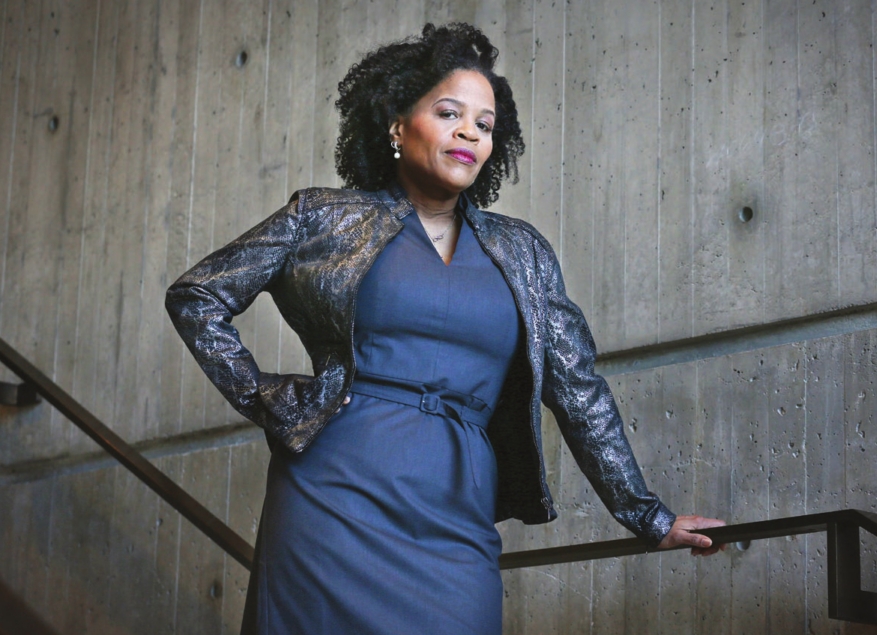
Kim Janey assumed office Tuesday following outgoing Mayor Martin Walsh’s confirmation as Secretary of Labor in the administration of President Joe Biden.
City faces COVID pandemic, push for racial equality
Kim Janey made history this week when she was sworn in as acting mayor of Boston, becoming the first African American and the first woman to hold the office.
On Tuesday, her first full day in office, Janey spent the day in meetings with key City Hall staff. She faces a global pandemic, pressure from the state to reopen schools full-time, struggling small
businesses and demands that the city respond to calls for equity that have been percolating during a year of racial unrest.
In a statement sent to news media, Janey said she is prepared to take on the challenges facing the city.
“In the days ahead, partnering together, we will focus on recovering from the COVID-19 pandemic, safely reopening our city and renewing our communities,” she said. “And, as we reopen, we will take the steps to become a more equitable, more joyful, more resilient Boston.”
Though she won’t have full mayoral power, Janey can sign ordinances into city law, make temporary appointments to city agencies and make decisions affecting issues citywide.
In remarks delivered during the Boston Municipal Research Bureau’s annual meeting March 11, Janey said she will continue efforts Walsh undertook to tackle inequality as the city grapples with the COVID pandemic.
“Patterns
of disproportionate impact cannot persist,” she said. “As we roll out
vaccines, we are actively developing programs to deliver them more
equitably.” That includes mobile vaccination clinics.
Massachusetts
is entering Phase 4, Step 1 of reopening as of Monday, March 22,
removing the travel order that requires out-ofstate visitors to
quarantine, and allowing large and small entertainment and sports venues
to reopen at limited capacity.
Boston
will enter a modified version of the state’s Phase 4 on Monday. Indoor
recreational activities with greater potential for contact, like roller
skating and laser tag, can reopen. Movie theaters and live performance
venues can open at 50% capacity and Fenway Park can reopen at 12%
capacity. Boston won’t move past this phase until the city remains below
a 2.75% COVID-19 positivity rate for two consecutive weeks.
This
step forward received backlash from some state representatives and more
than 20 organizations, including the Massachusetts Public Health
Association.
In
Boston, Janey will be dealing with the controversial choice to help the
economy by removing business restrictions during a time where COVID-19
cases remain high. Suffolk county remains at high risk for contracting
the virus, with about 23 cases per 100,000.
Racial disparities
In
her remarks to the Municipal Research Bureau, Janey said that systemic
racism is one of the most urgent issues facing the city.
“Healing
includes beginning to address the trauma of the dual devastation of
COVID-19 and the reckoning of racial injustice, by tapping into our
collective joy,” she said, and stressed the importance of moving forward
in equity.
Civil
rights activists echo these sentiments, including legal expert Ivan
Espinoza-Madrigal, executive director of Lawyers for Civil Rights. He is
calling on Janey to be responsive to racial justice matters in the wake
of police violence concerns and inequities in minority business
contracts.
“There are
these issues that remain unsolved,” Espinoza-Madrigal told the Banner.
“We did not need a disparity study to confirm that we know the extent of
the exclusion that we have suffered from municipal contracting
opportunities. In the policing arena, we’ve dedicated so much time and
attention as a city to talking about police reform.”
He
says he has seen a lot of talk among city officials, but not enough
action. Janey has a chance to move reforms forward, he said, including
the recommendations of the city’s police reform task force. As those
recommendations become ordinances in the City Council, or home rule
petitions come back from the State House, Janey will be responsible for
carrying them out.
“Over
the past few administrations, the bottom line is that racial justice
and civil rights issues have remained an afterthought,”
Espinoza-Madrigal said. Janey now has the chance, as a woman of color in
the mayor’s office, to infiltrate what Espinoza-Madrigal calls the “old
boys network.”
Helping businesses
Recent
news about the city’s lack of contracts for Black- and Latino-owned
businesses sparked a conversation about Boston’s Black economy. The
Black Economic Council of Massachusetts (BECMA) responded with advice to
the mayor on how to help people of color — recommendations that are now
under Janey’s discretion.
BECMA
Executive Director Segun Idowu said the city should enhance its
partnerships with organizations like BECMA, Amplify Latinx, CommonWealth
Kitchen and other small-business support organizations.
“This
partnership should not only utilize these organizations as vessels of
information-sharing for their business members, but each should be
relied on to inform policy and programmatic decisions, as well as be the
agencies [to which] the city directs small businesses in need of
support,” Idowu said.
In
her remarks to the Municipal Research Bureau, Janey mentioned that she
will be working with Main Streets organizations to help businesses
struggling with the digital divide between them and their customers.
“We
will design additional programs in the months ahead. Reopening our city
also means supporting the people who make our city run,” she said.
The expectation is now on her to prioritize minority contractors and ensure that they are included in the process.
“We
can no longer be satisfied with awarding one-time $5,000 or $10,000
contracts to small minority firms,” Idowu said. “There must be intention
and the removal of barriers in connecting our firms to lucrative
multi-year contracts at much higher percentages than was achieved by the
Walsh Administration.”
In
her media statement, Janey cited her Boston roots, making the case that
she is ready to take on the challenges facing City Hall.
“This is the city I love,” she said.
“This
is the city where I have been a student and a parent, an organizer and
an advocate, a city councilor and the City Council president. I am proud
to continue my work with you, as your mayor.”


