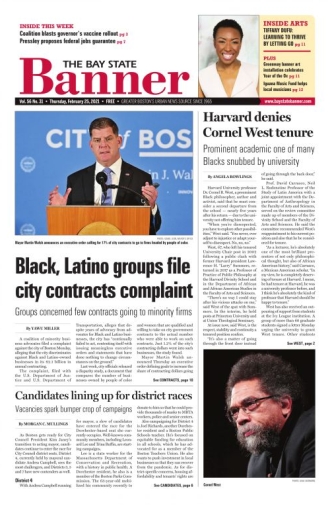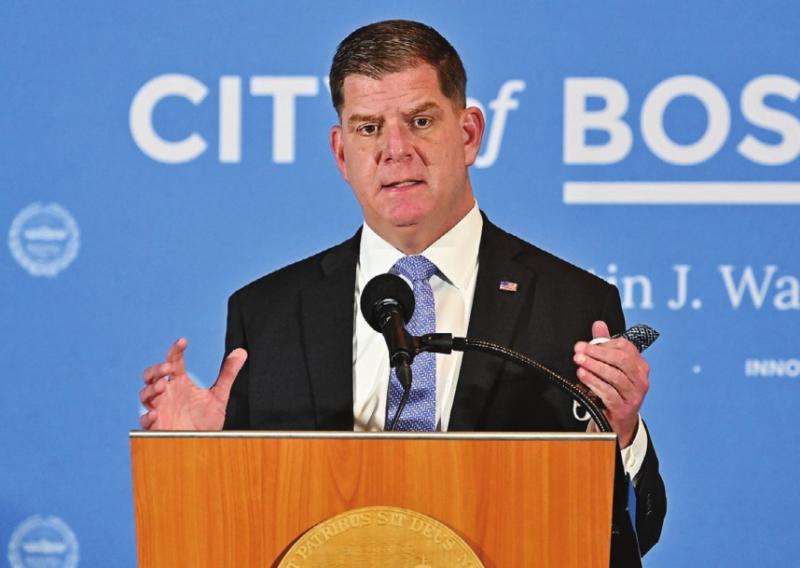
Mayor Martin Walsh announces an executive order calling for 17% of city contracts to go to firms headed by people of color.

Celina Barrios-Millner, who leads
the Equity and Inclusion Unit within the Mayor’s Office of Economic
Development, speaks to reporters about the city’s new minority
contracting goals.
Groups concerned few contracts going to minority firms
A coalition of minority business advocates filed a complaint against the city of Boston Monday, alleging that the city discriminates against Black and Latino-owned businesses in its $2.1 billion in annual contracting.
The complaint, filed with the U.S. Department of Justice and U.S. Department of Transportation, alleges that despite years of advocacy from advocates for Black and Latino businesses, the city has “continually failed to act, contenting itself with issuing meaningless executive orders and statements that have done nothing to change circumstances on the ground.”
Last week, city officials released a disparity study, a document that compares the number of businesses owned by people of color and women that are qualified and willing to take on city government contracts to the actual number who were able to work on such contracts. Just 1.2% of the city’s contracting dollars went into such businesses, the study found.
Mayor Martin Walsh announced Thursday an executive order defining goals to increase the share of contracting dollars going to minority- and women-owned businesses.
“With
the study now complete, we look forward to enacting meaningful reform
and policy changes that will bolster opportunities for underrepresented
businesses,” Walsh said in a statement.
Under
the new goals, 15% of contracting dollars will go to women-owned
businesses and 10% to businesses owned by people of color.
Despite
Walsh’s announcement, representatives of the groups that filed the
complaint — Amplify Latinx, the Black Economic Council of Massachusetts
(BECMA) and Lawyers for Civil Rights — say they do not plan on
withdrawing their complaint.
City
officials could have taken concrete steps to improve its contracting
allocation well before the study was undertaken three-anda-half years
ago.
Segun Idowu,
executive director of BECMA, noted that many state and federal agencies
have for years been splitting large contracts into smaller pieces, which
allows the smaller businesses owned by people of color to bid
competitively. Yet Walsh and Chief of Economic Development John Barros
have not taken similar steps, despite repeated requests Idowu and others
have made for that type of change.
“We have literally been saying the same thing in every single meeting we’ve had with Mayor Walsh and John Barros,” he said.
“They keep saying they’re going to do something about this — and yet here we are.”
Lawyers
for Civil Rights Executive Director Ivan Espinoza-Madrigal said the
groups’ complaint will give business owners of color the opportunity to
weigh in on city policy, noting that the Walsh administration’s
executive order gives a “vague and uncertain timeline” and leaves out
information on how objectives will be met.
“The
Walsh administration has acted unilaterally to create an executive
order that doesn’t completely address the problem,” Espinoza-Madrigal
said. “The devil, here, is in the details. What Mayor Walsh released
today is much too vague to give us comfort that the allegations of
discrimination will be addressed.”
In
addition to setting goals, Walsh’s executive order requires the city to
track progress on meeting its goals during the annual budgeting
process. Each department that issues contracts will be required to
disclose whether or not it met its goals and provide details on how it
plans to meet them in the next year. The order also calls for the
establishment of a supplier diversity program to help departments meet
their goals.
Walsh,
who is expected to leave city government to head the Department of Labor
under the Biden administration, will not likely remain in Boston to
oversee the implementation of the order. Barros is considering a run for
the mayor’s seat.
The
complaint was filed with the federal Department of Justice because the
agency has traditionally taken on such cases and has expertise in
discrimination complaints, Espinoza-Madrigal said. It was filed with the
federal Department of Transportation because the city has ongoing
contracts with the agency that are subject to federal civil rights laws.
“It makes a lot of sense for them to review the city’s work,” he said.
Amplify
Latinx Executive Director Rosario Ubiera-Minaya said the complaint will
keep the concerns of Black and Latino businesses at the top of the
city’s agenda even as the mayoral role shifts to Council President Kim
Janey.
“What we are
hoping is that this brings attention and bold leadership to resolve the
situation,” she said. “We’re looking forward to working with Councilor
Janey when she takes over as acting mayor.”