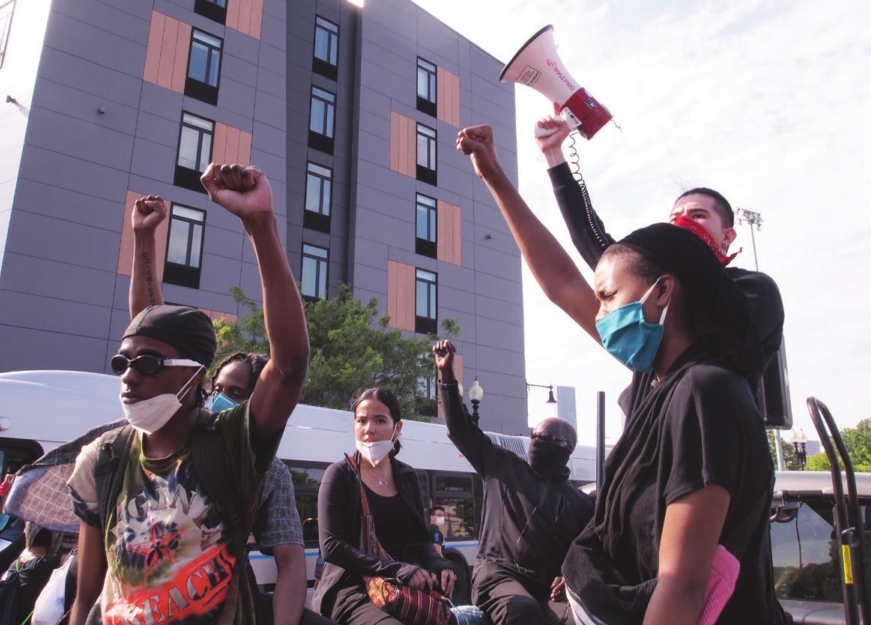
Demonstrators lead a June anti-police violence march through Roxbury en route to the State House.
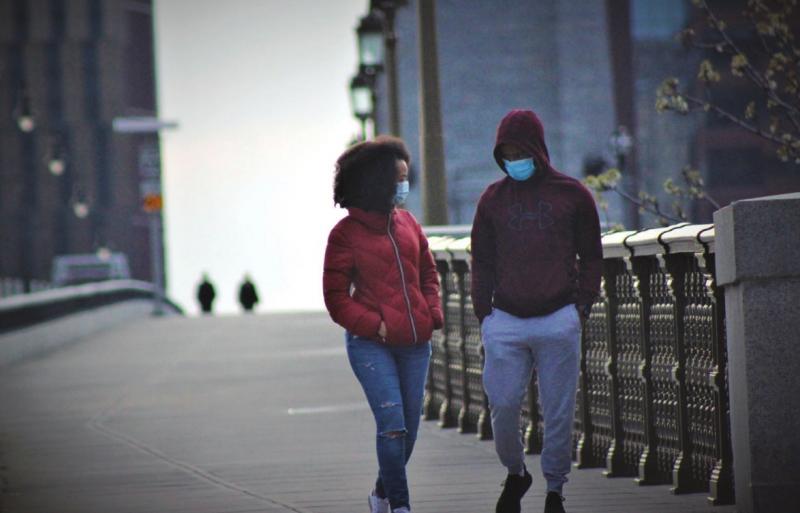
A couple crosses a traffic-free Longfellow Bridge in May during the statewide stay-at-home order.

Volunteers painted ‘Black lives matter’ on Washington Street in Nubian Square on a July weekend.
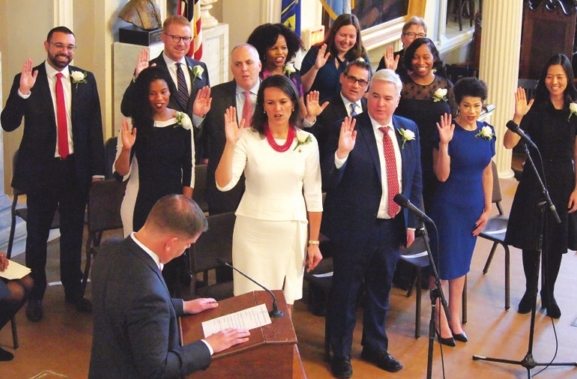
Mayor Martin Walsh swears in the most diverse City Council in the city’s history in January at Faneuil Hall.
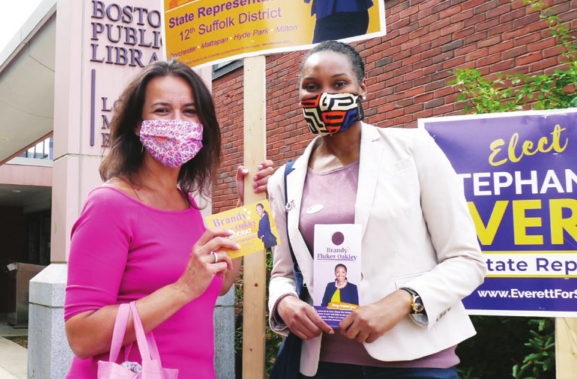
City
Councilor Annissa Essaibi George and state Rep.-Elect Brandy
Flucker-Oakley greet voters at the Lower Mills Branch of the Boston
Public Library during the Sept. 1 primary.
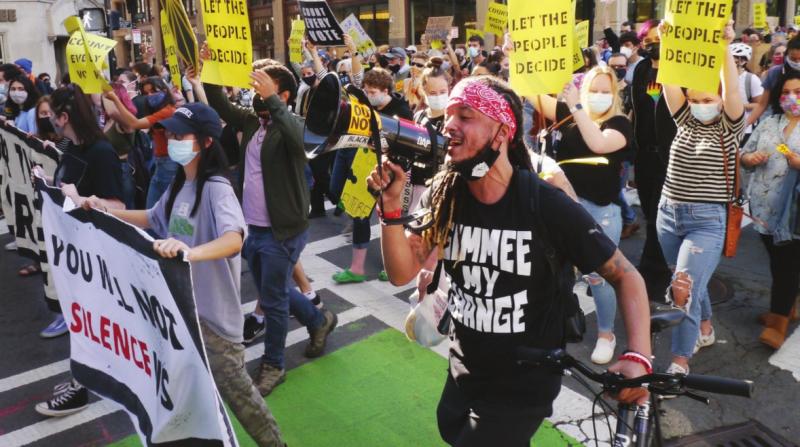
Ernst Jean-Jacques leads demonstrators in a cheer on Essex Street Nov. 7 as Joe Biden was declared president-elect.

Parents
at Boston Latin School demonstrate against a proposed one-year change
in the admissions policy for the city’s three selective admissions
schools.
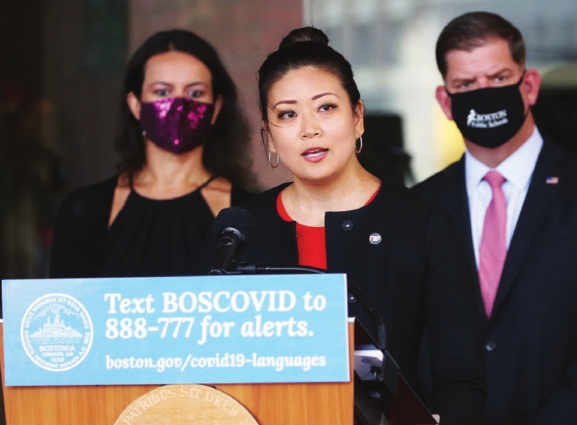
Boston
Teachers Union President holds a joint press conference on school
reopening plans after reaching an agreement with the Walsh
administration.
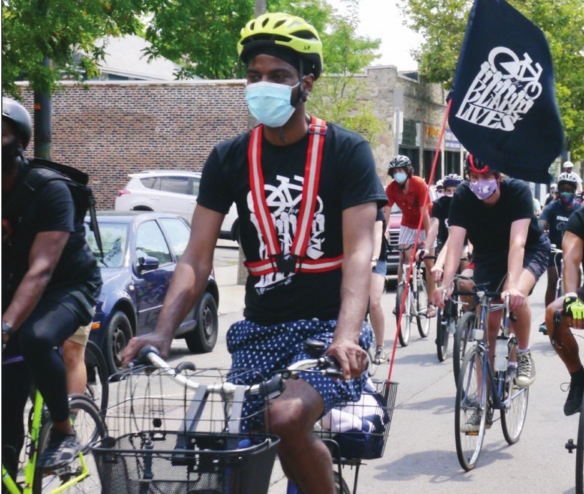
Cyclists with the Ride for Black Lives make their way down Centre Street in Jamaica Plain during a July ride.
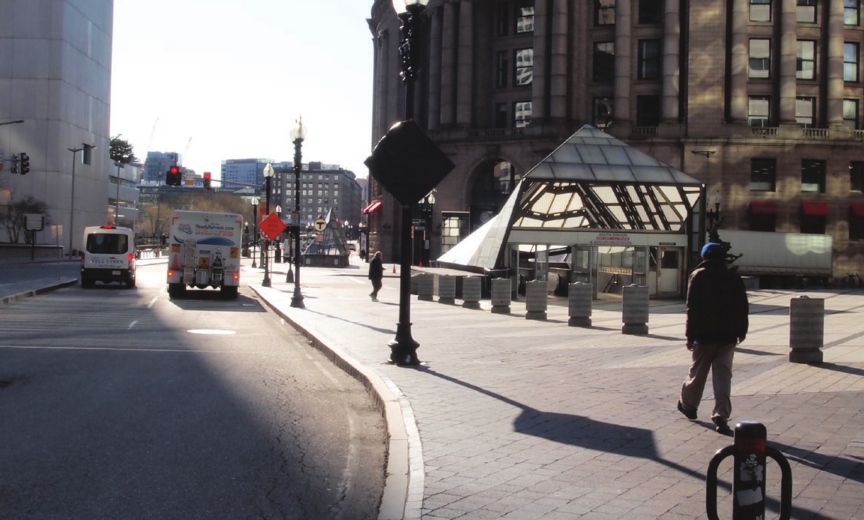
Scant traffic in Dewey Square during morning rush hour underscores the severity of the Governor’s stay-at-home order.
George Floyd murder kicked off wave of social change
When 2020 dawned, the coronavirus wasn’t yet considered a pandemic. A few experts were eyeing it as a worrisome development in China. The first U.S. case wouldn’t be confirmed until late January. By March, however, much of the nation ground to a halt as local governments geared up for a fight against an unfamiliar adversary.
While the COVID-19 pandemic came to define 2020, the Minneapolis police murder of George Floyd in May and the racial reckoning that came in its wake dominated headlines for much of the year as well, leading policymakers, business leaders and the news media to grapple with racial inequality in its manifold forms for much of the year.
The November election drew unprecedented voter turnout after a long and bitterly divisive campaign season.
Even as the year’s events shattered lives and drew out the worst and best in communities across the nation, local communities grappled throughout the year with typical issues affecting residents’ lives.
Here are a few of the issues that made news in Massachusetts and Boston.
Politics
The
year was dominated by presidential politics, as Bostonians settled on
Democratic nominee Joe Biden as the party’s greatest chance to defeat
Trump. While Massachusetts is not a battleground state and thus is not a
high priority for Democrats or Republicans, political activists and
observers in the Democrat-dominated state watched with considerable
anxiety as Republican-led states sought to restrict voting rights of
African American and Latino voters, dropping many from voting rolls,
closing voting locations and restricting early voting and mail-in
ballots, and the president himself sowed fears with false predictions of
widespread election fraud.
A
large majority of Massachusetts residents joined Democrats across the
country in heaving a collective sigh of relief when Biden’s win was
cemented during seemingly interminable late vote counts in November.
In
state contests, at the top of the Massachusetts ballot was U.S. Rep.
Joe Kennedy’s challenge of incumbent Sen. Ed Markey. The race dominated
the state’s political scene, drawing contributions and political talent
some argued would be better put to use in the battleground states where
Democrats were battling the Trump campaign.
In
the end, the Markey campaign’s push to cast the incumbent as the
progressive choice in the race seemed to prevail, with Markey winning
among voters of all age groups.
In
the state Legislature, the Massachusetts Black and Latino Legislative
Caucus gained new members. Among them were Springfield City Councilor
Adam Gomez, who secured a state Senate seat, knocking off an incumbent
senator, and Brandy Fluker Oakley, who won the 12th Suffolk seat
formerly occupied by Rep. Dan Cullinane.
Education
Schools
in Boston and many other cities closed in mid-March as the pandemic
emerged as a serious public health problem. Efforts to return K-12
students to in-person learning schools in Massachusetts became heated
battles, at times pitting state education secretary Jeffrey Riley and
Gov. Charlie Baker against local school districts in cities and towns
with high COVID infection rates and teachers unions whose members feared
for their safety.
While
many suburban and rural school districts reopened in fall, along with
private and parochial schools, public schools in major cities remained
either partially or fully closed. Boston opened schools only for
students with exceptional special needs, accommodating fewer than 2,000
of its more than 50,000 students. Like other districts with large
numbers of Latino and Black students, the city struggled with high rates
of COVID infection in the communities where most of Boston Public
Schools students live.
Tellingly,
a national survey of parents released in December found that among
black parents, racism and COVID were the top two concerns. Among Latino
parents, racism was their sixth highest concern and COVID their eighth.
Among white parents, however, neither racism nor COVID ranked in their
top 10 concerns.
For
the first time in more than 50 years, Boston’s three selective
admissions high schools will not use entrance examinations for next
year’s entering classes. City officials cited unsafe conditions for
administering standardized tests to large numbers of students in the
midst of the COVID pandemic. During the one-year reprieve, students will
be admitted by grade point average, with special weight given to
students from low-income zip codes.
Business
Black-
and Latino-owned businesses struggled during the pandemic. While a
majority of their businesses were unable to secure federal Payroll
Protection Program funding, local efforts such as the Black Economic
Council of Massachusetts (BECMA) Greenwood Challenge and the Business
Equity COVID-19 Equity Fund gathered nonprofit and for-profit entities
together to provide assistance, raising millions of dollars.
Black
bars and restaurants banded together to form the Boston Black
Hospitality Coalition to advocate for relief as their industry was
pummeled by limitations on indoor dining and limited space for outdoor
dining.
Real estate development
Although
the city ground to a halt in March, with Mayor Marty Walsh prohibiting
construction in the city for several months, Boston’s overheated real
estate development scene didn’t remain quiet for long. One of the
largest development projects to move forward this year is the Nubian
Ascends proposal, a Black-led project that in December won Boston
Planning and Development Agency approval to develop commercial, cultural
and culinary space on the Blair Lot in Nubian Square, currently a
surface parking lot. The proposal also includes artist housing and
parking.
Still in play in Roxbury are Parcel
8 at the corner of Harrison Avenue and Melnea Cass Boulevard and the
Nawn Factory on Washington Street, adjacent to the Eliot Burial Ground.
A
profusion of smaller projects moving forward in Roxbury and Dorchester
have continued to put pressure on neighbors and neighborhoods. At 52
River Street, neighbors appealed to Mayor Martin Walsh to halt a
four-story building abutting their back yards and blocking their
sunlight. After a monthslong pause, the project was permitted to move
forward over neighbors’ objections.
That
same scenario has played out throughout Boston’s neighborhoods as
developers push for greater density and higher profits over the
objections of abutters concerned about loss of parking, increased
traffic, rising housing costs, and loss of neighborhood history and
character.
Looking to 2021
As
a new year dawns, many are pinning their hopes on COVID vaccines to
vanquish the virus and allow the economy, schools and civic life to
reopen.
In local
politics, Walsh, should he decide to run for reelection, will face
challenges from City Councilors Michelle Wu and Andrea Campbell, both of
whom have been raising funds and building organizations to challenge
the two-term mayor.
Their
expected departure from the council to run mayoral campaigns, and that
of District 6 Councilor Matt O’Malley, who will not run for reelection,
could mean at least three council seats will change hands in a campaign
season that will likely see higher than normal turnout for a municipal
election.
Should the
vaccines succeed in restoring a modicum of normalcy to civic life,
Boston will see schools, restaurants, theaters and museums reopen. But
Bostonian families have experienced a wrenching year of remote
schooling, remote working, online shopping, virtual meetings and
performances and family gatherings canceled or taking place over Zoom
and other online platforms.
In
the coming year, Bostonians will find out to what extent life will
return to normal, if at all, and whether changes brought about by the
pandemic response and the groundswell of racial justice protests will
have lasting effects.