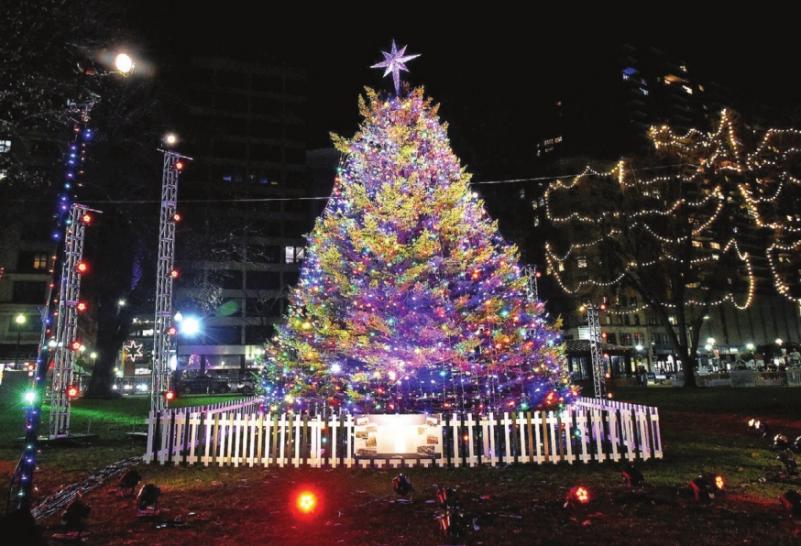
The official City of Boston holiday tree illuminates the Boston Common.
Governor to limit gatherings to no more than 10 people
Governor Charlie Baker introduced new restrictions that will take effect Saturday, Dec. 26, in anticipation of increased community COVID-19 spread during the holidays. During a media availability Tuesday, Baker announced that there were 410 patients in ICU being treated for COVID-19. Hospitals have reached 81% capacity, up from 67% at Thanksgiving. Many industries will be lowered to 25% capacity statewide. All public and private indoor gatherings will be reduced to 10 people, and outdoor gatherings reduced to 25.
Massachusetts remains above a 5% positive case rate for the third week in a row. The number of COVID-19 hospitalizations has risen steadily since November, reaching 1,895 on Dec. 20.
Though the governor announced a statewide rollback to Phase 3 of the reopening plan, four state legislators are calling for more restrictions to reduce the numbers. In a letter to the governor on Dec. 17, they asked for a state relief package while the rest of the country waits on a second federal stimulus bill.
Because the Centers for Disease Control and Prevention is now advising that people avoid indoor spaces, they wrote, “The governor should shut down indoor dining now
to tame community spread of COVID-19.” The letter, signed by Rep. Mike
Connolly, Rep. Michelle DuBois, Rep. Jack Lewis and Rep. Tami Gouveia,
highlighted several states that have put in more restrictions than
Massachusetts. California, New Mexico, Illinois and others have all shut
down indoor dining. Plus, Boston has gone back to Phase 2 of
Massachusetts’ reopening plan.
“That
is why we stand ready to support efforts to fund a statelevel relief
package that helps keep essential workers safe,” the representatives
wrote.
Schools in
Boston are at a partial opening, with the highest-needs students
attending in person. Calls to close schools have quieted while some
parents continue to rally for safe in-person learning. As of Dec. 9,
there had been 64 total cases counted in public schools among students
and staff. BPS only reports individual school data if there are more
than five cases in that school, and all 126 schools have reported less
than five cases. Total BPS school cases reached an all-time high the
week of Dec. 2, at 14 cases compared to just two the week before.
BPS
Superintendent Brenda Cassellius said the original reopening plan is
likely to resume in January once public schools are able to assess the
post-holiday case numbers. There is no projected date that other
students can come back into school buildings.
“Some of our teachers have found it to be quite a challenge,” she said.
BPS is providing professional development and encouraging teachers to share best practices with each other.
Transmission
in schools has come under recent scrutiny, with conflicting data on
children who contract COVID-19. Two studies from the United Kingdom
found that though in-school transmission is low, it does happen.
Children rarely exhibit the obvious symptoms of COVID-19, like a cough
or fever, but transmission exists among asymptomatic carriers the same
way it does outside of school buildings.
Cassellius
said there is no evidence of in-school transmission as of yet, just
individual cases not traced to a school outbreak. Highneeds students are
in in-person classes of about three to five students while the rest of
their classmates learn online.
“We’re
asking staff and students that they do a checklist prior to coming to
school,” she said, and attributed the low school case rate to strict
protocols.


