
A sergeant in this video laughs before describing hitting demonstrators with his cruiser in this clip.
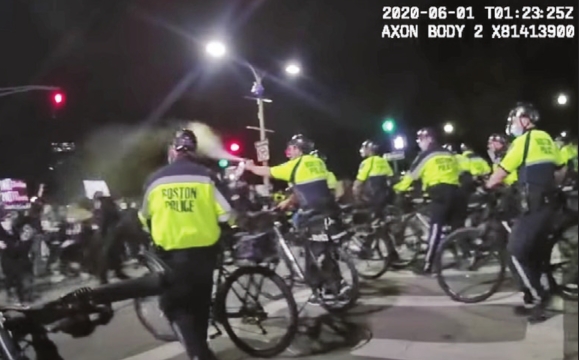
A police officer aims pepper spray at demonstrators.
Officers seen using force on non-violent protestors in videos released last week
As demonstrations against police killings and brutality erupted across the country earlier this year, police supporters in Boston sounded a familiar refrain: “It doesn’t happen here.”
Yet body camera footage that was taken the night of a May 31 anti-police-violence rally in Boston and released to the public last week shows police officers liberally dousing nonviolent demonstrators with pepper spray and indiscriminately striking protesters with batons in attacks that appear unprovoked.
In one video clip, published in an article on the news website The Appeal, an officer is seen striking a protester, whose hands are up, in the throat with his baton, knocking him to the ground. Another officer strikes a demonstrator whose hands are up in a similar manner, then steps on the protestor. After protestors are told to move back, the same officer knocks a man to the ground from his motorbike.
In another video clip, a sergeant appears to brag about having struck protestors with a police vehicle until he is told another officer’s body camera is on.
“Dude, dude, dude — I f---ing, I drove down Tremont …” he says laughing, before describing how he plowed through a crowd of demonstrators.
“I had to f---ing keep coming,” he says. “I’m f---ing hitting people with the car. Did you hear me—”
“It’s on,” the other officer says, apparently referring to his body camera. “This thing just f---ing went on automatically.”
The video footage, which attorney Carlton Williams secured for his defense of protestors who were arrested the night of the May 31 protest, has sent shock waves through the city’s political circles, drawing condemnation from some city councilors at the end of a year that has been marked by unprecedented efforts to rein in police abuse.
“What part of your mind tells you that when someone is complying with an order, you should just throw them on the ground?” said City Councilor Ricardo Arroyo, whose ordinance restricting police use of tear gas and other crowd control measures is now sitting on the desk of Mayor Martin Walsh awaiting his signature.
City Councilor Andrea Campbell said the mayor should sign Arroyo’s ordinance as well as one she authored to create a new Office of Police Accountability and Transparency.
“As a Black woman and someone who has listened to constituents detail their traumatic interactions with police, I didn’t need to see George Floyd’s murder or this footage to realize that our police department needed to create stronger systems of accountability and transparency,” she said in a statement sent to news media.
Walsh, in a statement to the Boston Globe, said the videos were “difficult to watch.”
“We never want to see police officers using more force than necessary, even when tensions are high,” Walsh said.
Boston
Police Superintendent William Gross said his department suspended a
sergeant, but he did not specify whom. In a statement, Gross said the
department’s Bureau of Professional Standards will conduct an
investigation into the matter and “the totality of the circumstances
involved.”
Gross’
reference to “the totality of the circumstances” struck a similar tone
to that taken by Boston Police Patrolmen’s Association President
Lawrence Calderone, who cited what he said were 30 police officers who
were sent to the hospital the evening of May 31 and appeared to question
the validity of the body camera videos.
“The
reality-altering effort and insult aside, the fact remains, the
violence and hatred perpetrated against our officers and our city that
night will forever be engrained in the minds and memories of our
officers and their families because of the damage done by the cop-hating
anarchists and agitators who showed up to a peaceful protest armed for
violence and looking for a fight,” Calderone said in a statement posted
on Twitter.
Calderone
posted video footage of a police vehicle being pelted with plastic water
bottles as it makes its way down Winter Street. The video footage
shared in The Appeal shows unarmed protestors with their hands raised in
the air being struck with batons.
Defense
attorney Williams, who was on the scene the night of the May 31, said
officers appeared to be indiscriminately pushing with batons, bicycles
and motorcycles into crowds of people in downtown Boston.
“It happened dozens of times,” he said.
That
evening, stores were broken into and looted. The MBTA cut service in
the downtown area, making it difficult for people to leave the area.
Officers appeared to make no distinction between people engaged in
criminal acts and the crowds who were not.
“Cops roved around pushing at crowds with no discernable objective,” Williams said.
One video clip shows officers indiscriminately spraying pepper spray at demonstrators.
“Start spraying more,” one officer says on video. “Are you out? I got a little left. I wanna hit this a---hole.”
In
all, 46 people were arrested that evening. Williams is representing
seven, six of whom were charged with disorderly conduct and one who was
charged with assault and battery on a police officer for allegedly
throwing a plastic water bottle at an officer.
Williams,
who says his client had a cart of water bottles he shared with other
protestors, said his client did not throw a bottle at the officers, who
were clad in body armor, helmets with face shields, and elbow and knee
pads.
He says the actions he witnessed and the footage on the video cameras show that officers were not acting lawfully.
“They
were not doing law enforcement,” he said. “They were being vindictive.
They were acting like a mob and they were hurting Black and brown
people.”
Williams says
the officers’ actions disprove the common Boston police narrative that
they’re an exemplary force that doesn’t engage in the type of behavior
that has sparked demonstrations across the country.
To those who think otherwise, Williams has words of advice: “Roll the tape.”


