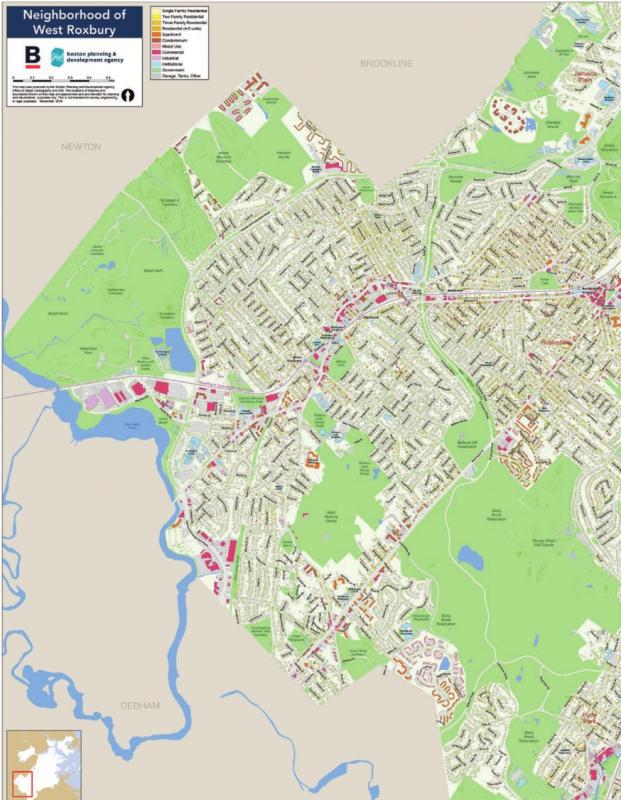
While West Roxbury has historically voted conservatively, the politics of City Council District 6 have shifted to the left.
Soon-to-be vacated seat draws candidates
Ten years ago, the two front-runners in the five-way preliminary race for the District 6 City Council seat were Matt O’Malley and Sean Ryan, continuing what is now a 37-year tradition of Irish-Americans representing the West Roxbury/Jamaica Plain seat.
Back then, West Roxbury voters accounted for as much as 60% of the vote in the district.
But by 2019, with a string of progressive candidates driving turnout in liberal-leaning Jamaica Plain precincts during successive elections, voters in that neighborhood grew to 54% of turnout in District 6.
“Jamaica Plain has increased its turnout dramatically in recent elections,” said Ziba Cranmer, a co-chair of Jamaica Plain Progressives, “and so has the West Roxbury share of progressives.”
Will the longstanding dominance of Irish-American West Roxbury residents finally come to an end? Kendra Hicks is counting on it. She has raised $36,277 since announcing her run in September. Hicks is one of four Jamaica Plain residents who are either committed to or considering a run for the seat, which O’Malley plans to vacate at the end of 2021. Housing advocate Alex Gray has raised $21,810 since September. Urban planner Gustavo Quiroga and former O’Malley staffer and current Yale Law School student Will Poff-Webster are considering runs.
On
the West Roxbury side Giovanny Valencia, a , community organizer with
the Jamaica Plain Neighborhood Development Corporation, is said to be
considering a run; former School Committee member Mary Tamer has opened a
campaign account and Paul Sullivan, a community liaison for at-large
City Councilor Michael Flaherty, confirmed he is mulling a run.
It’s
only December, and nomination papers won’t even be due until May of
next year, but the prospect of a seven-way race in politically evolving
district could confound the punditry.
“The
last time there was a competitive race, it was a very different
district,” Cranmer said. “The city is changing. The voting centers of
the past — South Boston, Charlestown and West Roxbury — are changing.”
West
Roxbury remains a 75% white neighborhood in a city that is now only 45%
white. While the electorate there has a reputation for leaning
conservative and backing Irish-American candidates, recent elections
have shown growing support for progressive candidates of color. In the
2018 race for Suffolk County District Attorney, the winner, Rachael
Rollins, garnered a respectable 2,957 votes in West Roxbury-based Ward
20 to neighborhood resident Greg Henning’s 3,158 votes.
Rachel
Poliner, a member of Progressive West Roxbury/Roslindale, points out
that women of color have done well in West Roxbury in recent elections.
“The top vote-getters in most precincts are women of color — Michelle Wu, Ayanna Pressley, Annissa Essaibi-George,” she said.
Issues
Poliner
says the decreasing significance of race in West Roxbury elections
means voters will pay greater attention to issues. School equity and
quality, an elected versus an appointed school committee, housing
construction and affordability, gentrification and the city’s COVID
response could come up in debates.
One
issue that could divide progressive and conservative voters is police
reform. Black Lives Matter and Blue Lives Matter protesters clashed
repeatedly this year at the traffic circle by the Holy Name church in
West Roxbury.
An issue
on which West Roxbury and Jamaica Plain residents may agree is charter
schools. Poliner expects the controversial schools will come up in
debates because Mary Tamer once served as director of strategic projects
for the Boston Charter Alliance.
“I can’t imagine she won’t attract a lot of donations from charter supporters,” Poliner said.
NAACP
Boston Branch President Tanisha Sullivan said the pandemic and
anti-police-violence demonstrations have elevated issues of racial,
economic and social justice.
“The
races in 2021 will give us an opportunity to consider candidates
through those three lenses,” she said. “The successful candidates will
be those who can articulate a clear, coherent vision as it relates to
those three areas in the city of Boston.”
Cranmer echoed Sullivan’s sentiment.
“Progressive
causes and issues are more viable than they ever have been,” she said.
“A truly progressive candidate has a really good chance to succeed.”
So
far, with most potential candidates still considering whether or not to
jump in the race, there has been little room for discussion of issues.
Hicks,
who entered the race months before O’Malley announced he would not seek
reelection, already has outlined the policy areas in which she intends
to work if elected, including educational equity, environmental justice,
affordable housing and an approach to public safety that emphasizes
prevention and resources over policing.
Hicks
told the Banner she already has held more than a dozen events, virtual
“house parties” hosted by activists representing all areas in the
district.
Alex Gray, a former aide to Gov. Deval Patrick, has launched a candidate website, although he has no specific issues listed.
Hicks
also this week released a list of endorsers, including Suffolk County
Register of Probate Felix D. Arroyo, District 5 City Councilor Ricardo
Arroyo and atlarge Councilor Julia Mejia.


