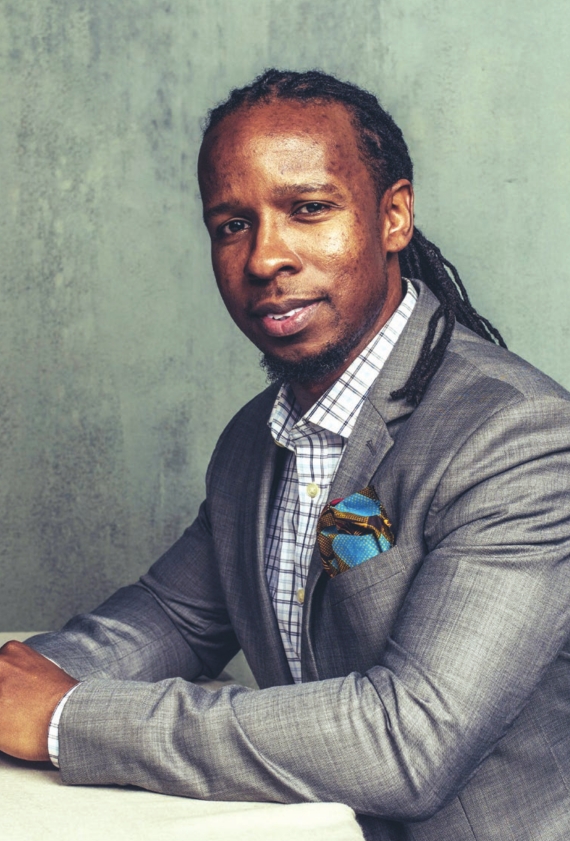
Ibram Kendi
Ibram X. Kendi, one of the nation’s leading scholars of racism, will launch Boston University’s BU Center for Antiracist Research on July 1. Kendi comes to Boston from American University in Washington, D.C., where he is a professor of history and of international relations.
He is the author of the 2019 best-selling book, “How To Be an Antiracist,” “The Black Campus Movement,” and “Stamped from the Beginning: The Definitive History of Racist Ideas in America.”
The Banner spoke with Kendi about his work and his aspirations for the new center at Boston University. The following interview has been edited for clarity.
How did you become interested in anti-racist work?
I’ve always been somewhat involved in anti-racist work. My parents came out of the black theology movement in the ’60s and early ’70s, so they came to their Christianity as part of the fight to liberate black people from racism and so I think, in a way, they raised me to see racism as a problem and to use my ability to try and challenge this problem.
What impact do you think the work of the BU Center will have on the conversation on race in the United States?
There are so many racial inequities and injustices that exist and that persist. The first step to reducing or even eliminating them is trying to understand the source of them. It takes a multidisciplinary research team to figure out the confluence of factors that could be leading to racial inequities. To give an example, it’s very easy for people to claim that the reason why black people were dying of COVID-19 more than white people is because black people don’t take their health seriously or black people weren’t taking the virus seriously. It ultimately became, ‘Black people have more pre-existing conditions.’ But recent studies have shown that it’s actually a confluence of factors — that it’s factors like employment, access to health care, access to medical insurance, the air and water quality of neighborhoods. So, in order for us to realize the true source of problems, we have to develop skilled research teams. Those are the types of teams we want to build. We want to build these research teams that will not only conduct that research but will ultimately develop policy solutions based on the research. Then we can put ourselves in touch with policymakers who can test out these policy solutions.
We’re in a moment with the current wave of demonstrations where there is national and international recognition of the pervasiveness of race bias in the United States. Do you see any encouraging signs that public officials will respond?
The two centers of the outrage against racism have been Louisville and Minneapolis. In Louisville, as a result of the murder of Breonna Taylor, there has been a move to stop using ‘no-knock warrants.’ This weekend, it was reported that a majority of the Minneapolis City Council is in favor of dismantling the Minneapolis Police Department and replacing them with something more protective of the people. So those are encouraging signs, and there are other policy changes afoot in different places. But at the same time, just as somebody can do away with ‘no knock’ warrants when people are demonstrating on the street, so too can a new administration in Louisville reinstate that policy. We need to ensure that these demonstrations turn into permanent policy changes that can protect black and brown people from police violence and racism.
Do you think this moment can produce the kinds of cultural and policy changes that occurred after the assassination of Martin Luther King Jr. in 1968?
I’m not sure. I think history will tell us what type of moment we’re in. I certainly want a moment that’s even more transformative than the reaction to King’s assassination, because if that moment had completely eliminated racism, then we wouldn’t be in this moment right now. I think history is going to tell us.
White people often say, “But I’m not racist” when confronted with their own biases. How do you think people should respond to that?
There’s no such thing as being not racist. When someone who just expressed a racist idea is challenged, a person who is racist is going to say that. But a person who’s striving to be anti-racist is going to admit, ‘Yes, that was a racist idea, and I was wrong and I’m going to change.’ The whole construct of being not racist has been to defend one’s own racism.
To what extent do black people in the United States harbor racist attitudes or anti-black attitudes?
I think that it’s hard to grow up in this country, no matter your race, and not believe that there’s something wrong with black people, or that there’s something ugly about kinky hair, or that there’s something dangerous about black people, or there’s something wrong with black women or black men. It’s very, very hard because those ideas are constantly being fed to us. And black people, too, internalize those ideas. And black people, too, think there’s something wrong with black people.
And black people, too, view the racial problem as black people, as opposed to racist power and policy. And black people, too, spend their time criticizing and going after and degrading black people, as opposed to going after and criticizing and degrading racist policy. We need people, no matter their race, to view the racial groups as equal. The only thing wrong with black people is that we think there’s something wrong with black people.
What concrete steps can people take to combat racial bias?
I think the most concrete step people can take is to recognize that there are only two explanations for any sort of racial disparity: either a racist idea or a racial policy. What I mean by that is that black people are disproportionately unemployed right now.
It’s either because there’s something wrong with black people, which is a racist idea, or there’s something wrong with our society, which are racist policies. And so every individual can ask themselves, ‘Why does this racial inequity exist, why does that racial inequity exist?’ And then, if they say it’s because there’s something wrong with black people, they’re saying their racist ideas. They can confront themselves and see those ideas and seek to get rid of them.
Do you believe racism can be overcome?
As an historian, in my second book, “Stamped from the Beginning: The Definitive History of Racist Ideas in America,” I followed the history of racism from its emergence in 15th-century Portugal all the way up to the present. Anything that can be created can be eliminated. Racism is a modern construct that in the span of human existence is only nearly 600 years old. In order to defeat racism, those of us who are serious about it have to believe that that is possible.


