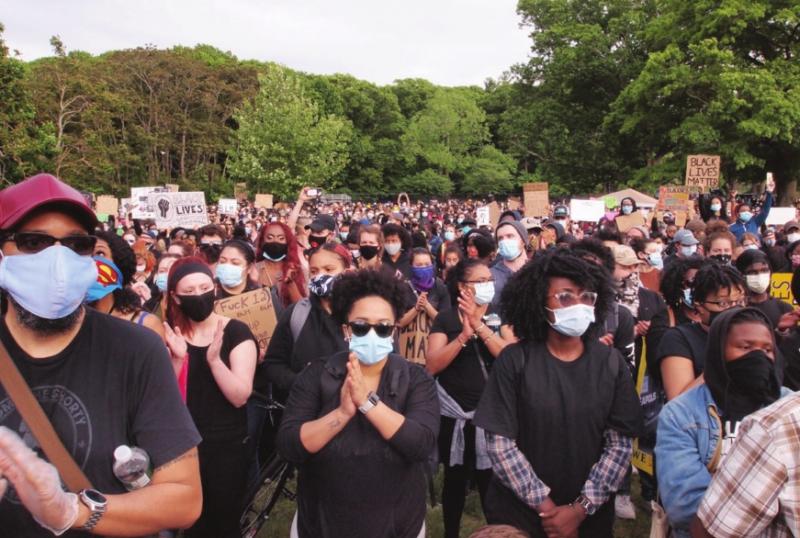
A crowd estimated at 10,000 gathered for a demonstration against police violence at Franklin Park last week.
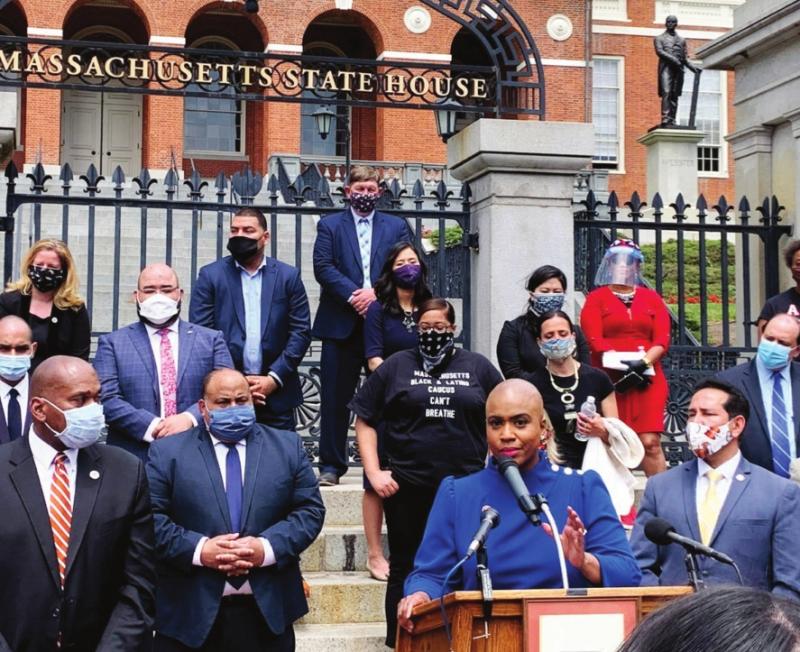
U.S. Rep. Ayanna Pressley addresses reporters during a press conference with elected officials of color.
Black elected officials seek movement on reforms
Black elected officials’ longsought efforts to reform police practices are getting a new hearing after more than a week of demonstrations across the nation over the police killing of Minneapolis resident George Floyd.
During a City Council hearing last Thursday, Councilor Andrea Campbell outlined her priority reforms including full implementation of body cameras, a civilian review board, transparency in the department’s database of stops and searches, and clear protocols for use of force by police officers — all issues activists and councilors of color have sought progress on over the last six years.
In recent years, those efforts have hit stiff headwinds in the council chamber. In 2015, when activists first brought a proposal for body-worn cameras to the council, white councilors praised the police for doing a “phenomenal job” with community policing and questioned the need for body cameras. While some officers have been outfitted with the cameras, five years later the department has not yet fully implemented a program.
At the state level, members of the Black and Latino Legislative Caucus have been seeking support for a raft of criminal justice reform
bills since 2015, with little success. Among the measures sought by
Caucus members are a bill requiring local police departments to report
data on the race of people stopped by officers, a bill that would
require professional certification and de-certification processes for
police and a bill that would require independent investigators for
allegations of police misconduct.
Those bills have stagnated in committees over the last five years.
“The
biggest roadblocks have been police unions,” said state Rep. Russell
Holmes of Mattapan, who has been pushing for a statewide police
certification requirement.
Holmes
isn’t the only one pointing a finger at the unions. New York
Congresswoman Alexandria Ocasio-Cortez called out the unions and the
elected officials seemingly under their thrall in a tweet last week.
“I’ll
just say it: a lot of politicians are scared of the political power of
the police, and that’s why changes to hold them accountable for flagrant
killings don’t happen,” she said. “That in itself is a scary problem.
We shouldn’t be intimidated out of holding people accountable for
murder.”
Ocasio-Cortez
signed on to legislation introduced by U.S. Rep. Ayanna Pressley and
U.S. Rep. Justin Amash of Michigan, who switched from Republican to
Independent this year, that would end qualified immunity prohibitions on
lawsuits against police officers for actions taken while on the job.
“Qualified
immunity shields police from accountability, impedes true justice, and
undermines the constitutional rights of every person in this country,”
Pressley said.
While
Pressley’s campaign coffers haven’t benefitted from large infusions of
police officers’ donations, the reach of the unions’ campaign cash is
considerable at the local level. The largest Boston police union, the
Boston Police Patrolmen’s Association, reports $467,731 in its political
action committee campaign account as of May 31. Individuals identifying
themselves as police officers have donated more than $400,000 to Mayor
Martin Walsh’s campaign account since 2013.
Police
officers aren’t shy about throwing their cash around. In the two weeks
after Walsh approved an 8% pay raise for officers in 2017, Boston cops
kicked in more than $30,000 to his campaign account.
Black
politicians have rarely been on the receiving end of police campaign
donations. Suffolk County District Attorney Rachael Rollins received
just $3,777 in donations from police during her 2018 run for office,
while rival Greg Henning, a former Suffolk County prosecutor, netted
$68,250.
When she
bested Henning in a race with two other women and two other black
candidates, Rollins joined a wave of reform-oriented district attorneys
around the country who ran and won on platforms that promised to end the
culture of police impunity and combat criminal justice practices that
have for decades led to disparate incarceration rates for people of
color.
Her victory,
four years after the Black Lives Matter protests ignited a wave of
demonstrations across the country, may have signaled a change in voter
attitudes toward law enforcement that until now hasn’t seemed to catch
the attention of the state’s political leaders.
But this week, the growing criticism of police violence was hard to miss.
During
a City Council budget hearing Thursday on federal and state
anti-violence grants the Boston Police Department receives, at-large
City Councilor Julia Mejia noted a large volume of correspondence from
constituents asking councilors to defund BPD.
“I
grew up in Boston,” she said. “I survived the busing era. I don’t know
whether I’ve ever seen so much distrust in our government.”
Councilors
Kim Janey, Lydia Edwards and Andrea Campbell expressed frustration that
representatives of the police department’s Boston Regional Intelligence
Center did not make available a representative to discuss how the
agency would spend federal funds. They said the council would not
support the funding without a thorough accounting of how the funds would
be spent.
“That grant isn’t going anywhere if we don’t have our questions answered,” Campbell said.
While
Boston’s majority-people-of-color City Council seems more willing to
challenge police practices than in the past, how the state Legislature
will react to reforms being backed by its black and Latino members is
still an open question.
House Speaker Robert DeLeo signaled to the Boston Globe that the Legislature is willing to discuss police bias.
“We
must have difficult conversations about race, bias, and
accountability,” he said in a statement sent to the newspaper. “We must
work together. And we will.”
Rep. Holmes remains hopeful that his bill for police certification will pass in this session.
“We did get it out of committee this time,” he said.


