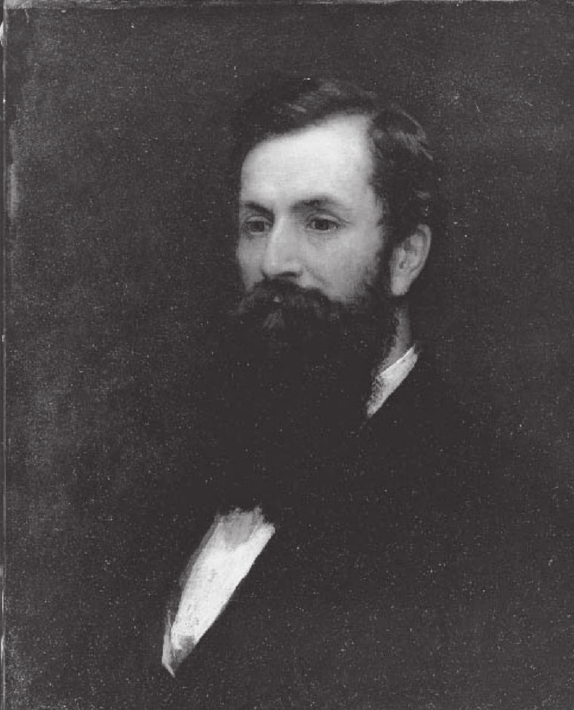
Isaac Fenno
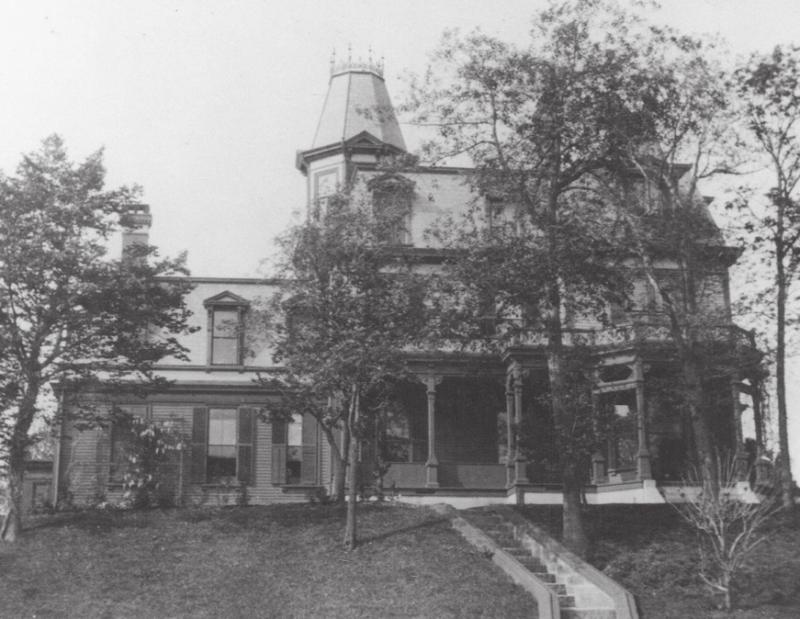
(Fenno’s mansion, as seen from Buena Vista Street.
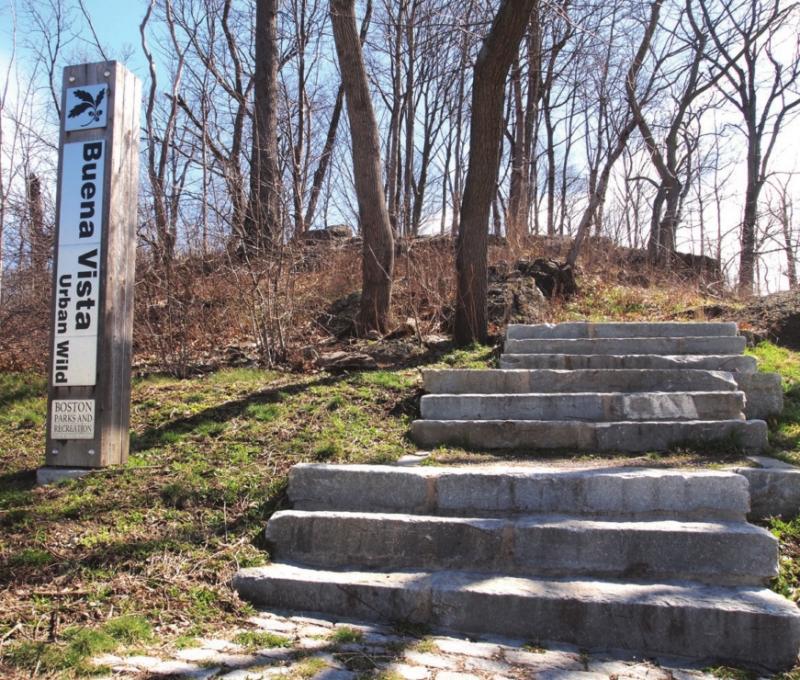
Granite steps lead to the site of the mansion built by 19th century merchant Isaac Fenno.
Buena Vista urban wild is a hidden gem
As far as city parks go, the Buena Vista Urban Wild seems nondescript. From Warren Street, the site is marked by a puddingstone cliff topped by a thicket of maple and oak trees.
From the Walnut Avenue side, however, two sets of granite steps lead up to the top of a hill that has been shaped by nearly 400 years of Roxbury history. On its grassy summit, the traces of an old foundation and fallen granite columns add to the mystery of the hilltop.
The site wasn’t always covered in trees. In the 17th century, the hill was the highest prominence in the 30-acre cow pasture of John Elliott, who, beginning in the 1630s, served four decades as the minister of the First Church of Roxbury.
But the urban wild gets its name from another prominent Roxbury citizen. In 1876, merchant Isaac Fenno, whose Summer Street clothing business was among the most profitable in the country, built an impressive manor house on the hill, which afforded him unimpeded views of Boston proper, two miles distant. That view gave birth to the name Buena Vista—“good view”— he used for his estate.
Born in 1823, Fenno founded Isaac Fenno & Co. Men’s and Boy’s Clothing at 28 Summer Street in 1853. At a time when store-bought clothing was gaining
prominence as a consumer good, Fenno was known for his forward-thinking
adoption and innovation of machinery to speed up the process of its
manufacture. He was credited with the invention of the Fenno cloth
cutting machine, which could cut as many as 3,000 garments per day.
“Their
well-ordered and symmetrically conducted establishment is well worth
the careful inspection of any one interested in this great industry,”
assessed the author of the 1885 book, “Leading Manufactures and
Merchants of the City of Boston.”
At
the time Fenno built his home, prominent Boston residents who in
decades earlier maintained summer homes in the bucolic town of Roxbury
were now seeing the neighborhood (annexed to Boston in 1868) as a
suitable place for year-round habitation. The expanding city of Boston
improved the road from the Shawmut Peninsula to Roxbury, making daily
travel by carriage more appealing.
“You wouldn’t get stuck in the mud driving into Boston,” says former state Rep. Byron Rushing.
The Fenno estate included a three-story Queen Anne Victorian and a large stable or barn.
The estate was bisected by a street called Buena Vista Place, now St. Richard Street.
After
Fenno died in 1897, his estate remained in the family for decades. It’s
unclear when the manor house burned down or was demolished, but it
appears on a 1930 map. In 1955, Almira Fenno-Gendrot willed the parcel
to the city, stipulating that “the unique and elevated location shall be
forever kept open, an object of beauty with its rocks and trees,”
according to the City of Boston Parks Department website.
By
the 1960s, Fenno-Gendrot’s vision for the land was in peril. The Boston
Redevelopment Authority, under Director Ed Logue, sought to radically
remake Roxbury.
“Logue’s
idea was to clear Roxbury from Dudley Square up to Monroe Street,”
Rushing says. “If Logue had his way, there’d be no Roxbury left.”
Urban
renewal did make its way up Warren Street, taking many historic
buildings along with it. The northern corner of what had originally been
the Fenno estate was shaved off to give Walnut Avenue a perpendicular
intersection with Warren Street. Despite Fenno-Gendrot’s stipulation
that the land be kept open for the enjoyment of all, the BRA gave nearly
two-thirds of the property to the Warren Gardens public housing
development.
For the following five decades, the site of the Fenno estate remained open to the public, but overgrown and inaccessible.
In
1976, the Boston Natural Areas Fund was launched as a nonprofit to
protect undeveloped land in the city. The city’s Parks Department took
on the maintenance of the urban wilds in 1989 and began making
improvements to some areas. Within the past 10 years, the Buena Vista
site has gained the two sets of granite steps, signage along Walnut
Avenue and a bench above the puddingstone ledge overlooking Warren
Street.
Within the
site lie a map etched in granite, showing Boston as it appeared in 1775,
and a granite stone into which has been inscribed a poem by Fenno:
“So
let our prayers be ever made bloom / that this fair flower may ever /
growing in sweetness and in grace / our faith, our hopes the world
illume.”
Gone is the
era of large mansions that dotted Warren Street in the late 1800s. With
its tree cover, the Buena Vista Urban Wild has returned to a natural
state that now more closely resembles how it may have appeared in the
17th century, before Elliott cleared the land for his cattle.
ON THE WEB
Buena Vista Urban Wild: www.boston.gov/departments/parks-and-recreation/urban-wilds-roxbury