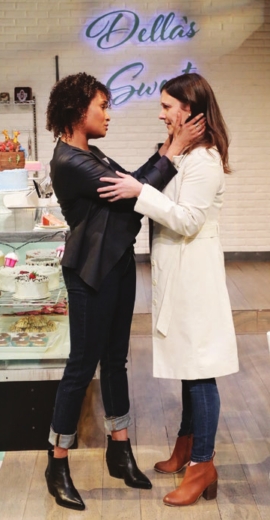
Kris Sidberry and Chelsea Dieh in “The Cake.”
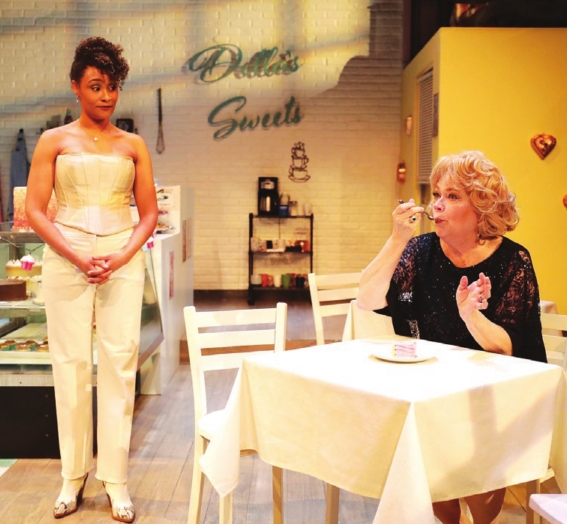
Kris Sidberry and Karen McDonald in “The Cake.”
Frosted with moral conflict
Through Feb. 9, the Lyric Stage Company debuts a show as sweet as its name. “The Cake,” written by Bekah Brunstetter, follows a traditional Southern baker named Della who is thrown into moral conflict when her deceased best friend’s daughter Jen asks for a wedding cake for her same-sex marriage.
The 90-minute production is both hilarious and heart-wrenching and is performed to perfection by the four-person cast, including Della (Karen MacDonald), Jen (Chelsea Diehl), Jen’s fiancée Macy (Kris Sidberry) and Della’s husband Tim (Fred Sullivan Jr.).
The plot harkens back to the 2018 Supreme Court case, Masterpiece Cakeshop v. Colorado Civil Rights Commission, wherein the owner of a similar cake shop in Lakewood, Colorado refused to bake a same-sex wedding cake on religious grounds. The court sided with the cake shop. But in “The Cake,” the dynamic is further complicated by Della’s love for Jen.
In
the play, Macy is a writer from New York City who has built up sky-high
intellectual walls due to the outsider treatment she’s always received.
She’s the urban, Northeast liberal who is armed with a thousand New
Yorker articles and a belief that everyone else is wrong. Though her
viewpoints are at times stubborn, it’s easy to see how she arrived
there. It’s also easy to see where these viewpoints are echoed in
Boston. Her strategy contrasts with that of Della, who is painfully
conflicted throughout the production. Della’s whole belief system is
based on the Bible, but her desire to love and support Jen causes her to
question her moral code.
For
Sidberry, the production hits close to home. “I am very similar to Macy
in a lot of ways. I, too, struggled with my weight when I was younger. I
was the only black female in my school the majority of the time,” she
says. “I’m from the South, so I understand the characters very well.
It’s great to see a show that makes people think.”
That
is the real beauty of “The Cake.” There is no black and white, right
and wrong. All the characters are striving to do what they think is
best, based on — or at times in spite of — what they have been taught.
There is no neat, perfect resolution in the show or in the contemporary
conflicts it mirrors. But “The Cake” shows that people aren’t innately
wrong or of poor character because of their belief systems, a lesson
that bears eternal repetition in today’s world.
“Disagreement
is what makes people grow,” says Sidberry. “I hope the audience comes
away knowing that people can disagree and still be good to each other.”
ON THE WEB
Learn more at www.lyricstage.com


