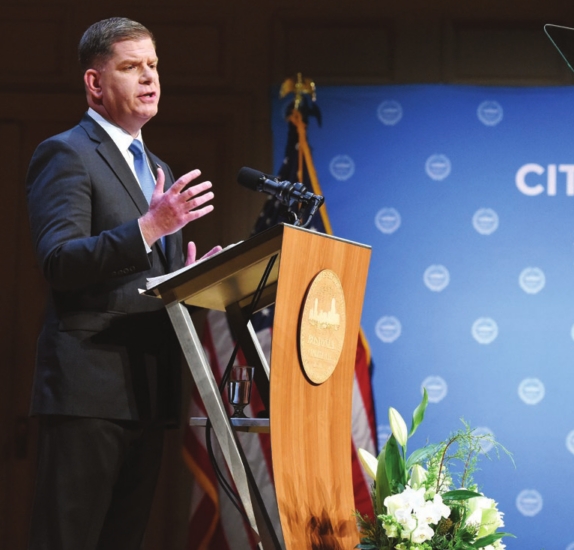
Mayor Martin Walsh delivers his annual State of the City speech at Symphony Hall last week.
New funds to be directed toward student support svcs, instruction
In his State of the City speech last week, Mayor Martin Walsh pledged $100 million in additional funding to Boston Public Schools, funds that he said would be above regular yearly cost increases and would be channeled directly to classrooms.
“We believe in a Boston where every single student has access to high-quality schools to reach their full potential, and this $100 million investment will make that vision a reality,” Walsh said. “This new investment will be carefully targeted to evidence-based strategies so that every dollar makes a difference.”
Walsh said the funding would be guided by Superintendent Brenda Cassellius’ strategic vision for the schools, a document that is expected to be completed in February. The mayor cited student wellness and mental health supports, curriculum enrichment, programming and activities as areas where the funding would be invested. He also cited what the district refers to as underperforming schools as early recipients of the additional funding.
“We’ll begin with intense support for underperforming schools, because kids who start with less need more and deserve more,” he said.
The mayor’s commitment of $100 million over the next three years represents roughly a 3 percent increase per year on top of the regular increases in the budget that cover rising costs, which average 3 percent a year.
The additional investment comes on the heels of the Massachusetts Legislature’s passage of the Student Opportunity Act, which is expected to increase state funding for local school districts by more than $1 billion over the next seven years. With that, Boston is expected to benefit from increased Chapter 70 state school funds as well as guaranteed reimbursements for funds the BPS district loses to charter schools.
The city may also be required to increase its spending on schools under the Student Opportunity Act over the next seven years, although it’s not expected that the required spending will exceed Walsh’s $100 million commitment over the next three years.
City Council President Kim Janey said she would like to see
the additional funds applied toward closing the opportunity gap between
BPS schools, citing a need for libraries, arts programs and sports in
all BPS schools.
“They’re
always the first programs on the chopping block,” Janey said.
“Unfortunately, these are the things that keep many of our students who
are teetering on the edge engaged in school.”
Janey also said decisions around the increased funding should be guided by the school communities.
“The
voice of the school leaders and students can’t be ignored,” she said.
“They have to be part of the decision-making process.”
Boston
Teachers Union President Jessica Tang said the new funding ought to be
applied to schools that are struggling with a lack of resources.
“We
welcome the much-needed investment in our schools, as the recent state
funding bill will not meaningfully impact Boston for several years,” she
said. “The funding should be used to stabilize schools and fill gaps in
staffing, particularly for our special education classrooms, English
language learners and students with high needs.”
Tang
also spoke in support of expanding schools’ baseline budgets, which
currently fund just two positions — a principal and a secretary. Under
the current system, teachers, specialists and support services staff are
often laid off when schools lose funding.
“All
of our schools should have baseline funding not just for academics but
for positions such as social workers, librarians and guidance counselors
as well,” she said.
Budget season begins
The
announcement of the funding increase came just before BPS officials
released their budget projections to the district’s schools, outlining
funding increases and cuts. Under the district’s weighted student
funding formula, school funding is tied to enrollment projections.
Schools in which enrollment dips are often forced to make cuts to many
of the student support service positions Walsh highlighted in his
speech, such as counselors and social workers.
“Guidance
counselors, social-emotional support staff — those are the first things
to go,” said Ruby Reyes, executive director of the Boston Education
Justice Alliance. “But they serve as the glue in a school. They’re the
ones who connect students and families to the services they need. They
help them navigate life.”
This
year, the Mather Elementary School in Dorchester is slated to lose five
positions, including the school’s librarian. Cuts are also projected
for high schools including Charlestown High School and Boston Latin
Academy. Although the school budget has not yet been made public, such
cuts usually stem from the effects of drops in enrollment on the
weighted student funding formula.
The
weighted student funding formula has generated controversy in recent
years and some schools whose student numbers declined have sustained
crippling cuts that have gutted student support services.
“It’s
a system-wide problem,” Reyes said. “If you’re cutting key services,
parents don’t want to enroll their children, and the enrollment
continues to drop. It’s a vicious cycle.”


