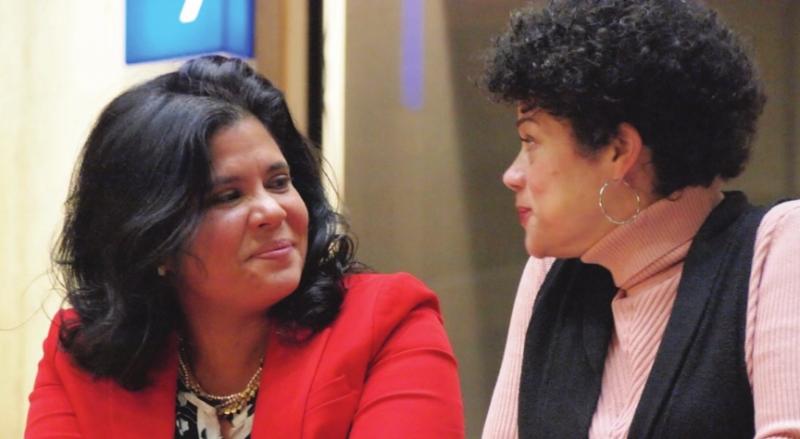
Candidates Alejandra St. Guillen and Julia Mejia chat during the recount of ballots from the Nov. 5 election Monday.
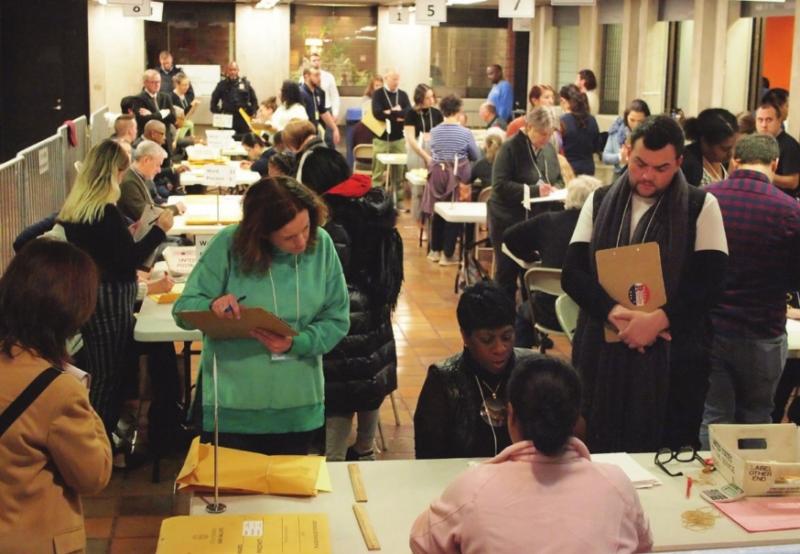
Campaign volunteers observe as city officials
check through some of the 67,011 ballots cast in the Nov. 5 election.
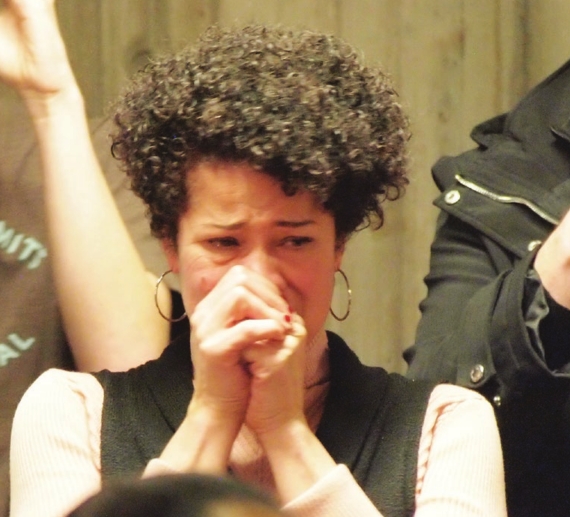
Julia Mejia reacts as Election Commissioner Eneida Tavares
announces her victory.
Three-day recount effort ends in narrow victory
It just may be the closest race in the history of the Boston City Council.
With just one vote separating Julia Mejia and Alejandra St. Guillen, the Boston Election Department called the election in favor of Mejia, bringing to a close a marathon, three-day recount process that saw dozens of volunteers, attorneys and city workers poring through the 67,011 ballots cast in the Nov. 5 election.
“I feel relieved because we worked so hard,” a tearful Mejia said after Election Commissioner Eneida Tavares announced the city’s decision. “There were so many people who joined our campaign because they wanted to believe in something. The fact that they have taken a risk, gone out and vote and their vote has really mattered speak volumes to how I feel.”
St. Guillen called for a recount after losing the Nov. 5 election by 10 votes in the city’s unofficial count. Her margin of loss was narrowed to five votes after absentee ballots were taken into account.
Mejia, too, filed for a recount, gathering at least 50 signatures in each of the city’s 22 wards.
The
recounting of the ballots began Saturday as a section of the second
floor of City Hall was cordoned off with folding tables for each of the
city’s 22 wards. Observers and attorneys for the Mejia and St. Guillen
campaigns worked alongside city Election Department workers reviewing
questionable ballots.
Voting
errors can cause ballots to be misread, such as those on which bubbles
are only partially filled in. Other errors can cause ballots to be
discarded, such as those on which more than four atlarge candidates are
selected.
In at least
15 cases, voters filled in the bubble next to Mejia’s name, then wrote
her name in the write-in space below. Gerry McDonough, an attorney
working with St. Guillen’s campaign, argued that state law dictates that
such ballots should be discarded “It’s meaningful in this race, because
it does affect the outcome,” McDonough said.
Boston election officials nevertheless allowed the ballots to be counted.
As
attorneys and city officials debated electoral policy, Mejia, St.
Guillen and their respective volunteers waited for the final tally. For
the candidates and the campaign volunteers, many of whom had been
working long hours through the electoral season, the recount was a
grueling process.
Despite
the fierce legal wrangling, Mejia and St. Guillen remained cordial, and
held a joint media availability in which both discussed the
significance of the election, the first in which women and people of
color secured the majority of the seats on Boston’s council.
“We’ve
been in this work, both of us, for a long time and know that we’re
looking at a vastly different city council,” St. Guillen said. “For us
to have a representative council that really reflects the city is a win
for the city. Either Julia or I would contribute to that diversity and
representation. Today is a victory for Boston either way.”
Mejia said she wants to make sure that more Latina candidates get elected to the council.
“The
whole idea is to build a pipeline to ensure that many more of us come
behind,” she said. “It’s really an opportunity to inspire other Latinas
to recognize no matter what the obstacles may be, or what their
socioeconomic status looks like, whether they’re a single mom or
whatever the case is, that if they strive to represent the city, they
can do it too.”