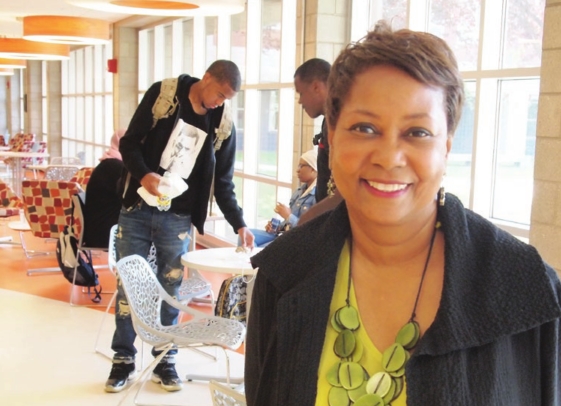
RCC President Valerie Robeson in the college’s new student commons.
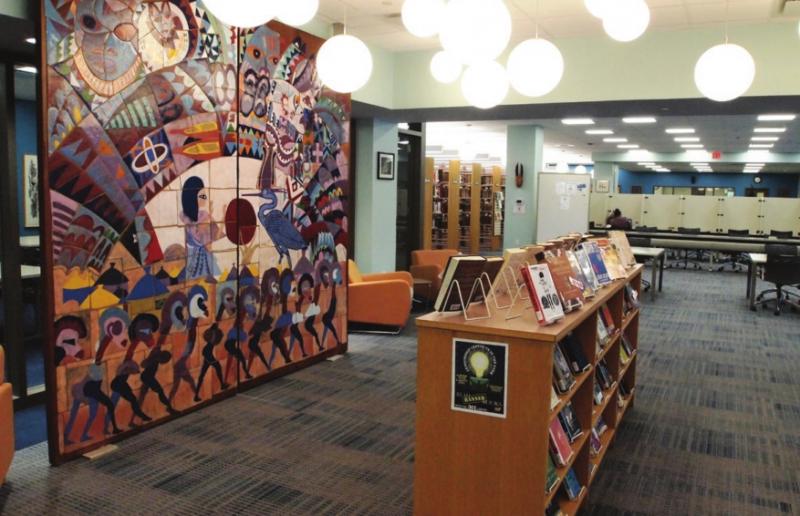
The newly-renovated library at RCC retains an installation by Roxbury artist Napoleon Jones-Henderson.
Roberson touts new investments in program
Roxbury Community College recently completed a $72 million renovation that included extensive upgrades to its buildings’ heating and cooling systems, a new cafeteria and student center, and a stateof-the-art nursing laboratory.
The college suffered a setback in June when the Massachusetts Board of Registration in Nursing withdrew accreditation, effectively shuttering RCC’s nursing program and leaving 37 students currently enrolled in the program scrambling to find placements in other schools.
The board cited high turnover in leadership — the nursing program had five directors in three years — and low scores on the state nursing exam.
RCC President Valerie Roberson said that while college began revamping its nursing program two years ago, making extensive changes to the curriculum, overhauling the admissions process and making changes to the faculty and staff, the changes did not come fast enough for the state board.
“We put all these things in motion once we realized changes were needed,” she said in an interview with the Banner.
While the pass rate on the licensing exam reached as low as 43 percent in 2015, the school had made strides in recent years with a pass rate of 78 percent in 2018.
“You could see the changes were having an impact,” Roberson said. Roberson
says the turnover at RCC’s nursing program is the result of competition
in Boston’s health care field. Some directors were lured away to jobs
with higher salaries. One nursing director, Kristin Lundsten, was
removed from the position after little more than a month on the job
after state regulators found that she did not have the requisite three
years of teaching experience for the job.
RCC hired the current nursing director, Simona Hankins, over the summer.
“She’s
been counseling students daily, and she took the lead in drafting and
submitting our application for reinstatement,” Roberson said. “We are
committed to retaining our faculty and staff to ensure that students can
connect with the same group of personnel throughout their educational
careers.”
RCC is in the process of submitting an application for reinstatement, Roberson added.
The
new nursing wing is in many ways emblematic of Roberson’s aspirations
for RCC, and a reminder of the challenges she has faced in turning the
school around.
The new
classrooms have new windows, carpeting, desks and chairs and are
outfitted with smartboards. In the new examination rooms, life-like
mannequins attached to vital sign displays simulate injuries and
illness, while in control rooms, instructors can simulate real-life
medical care situations.
“They
can simulate any type of injury with this control room,” Roberson says.
“Everything is recorded so the students can see themselves and
understand what they’re doing right and wrong.”
The
new space also features a radiology lab with a working x-ray machine, a
pharmacy and an obstetrics room in which a mannequin can simulate
childbirth.
RCC
leveraged partnerships with local health care providers, including
Partners Health Care and CVS, to help outfit the classrooms and train
instructors.
Widespread improvements
In addition to the nursing school, Roberson says RCC has made changes to instruction throughout the school’s disciplines.
“We’ve
changed the way we deliver instruction,” she said. “All our classes are
transferable. We give our students a good start. They gain confidence
in their abilities and they do well when they transfer to other
schools.”
One change
that seems counterintuitive was the elimination of remedial math
classes. In recent years, as much as 60 percent of the student body took
such classes. Now, students who are not able to complete a math course
such as algebra are given extra time in each class. The hours of
instruction in math classes have been doubled to accommodate the extra
instruction time.
In a
pilot project, students given the extra math instruction time had a 63
percent pass rate, a vast improvement over the 20 percent pass rate for
students who took remedial classes.
“When we extended it from the pilot project to all classes, the pass rate was 62 percent,” Roberson says.
The
elimination of the remedial classes saves students the time and cost of
taking an extra class — important advantages for the mostly low-income
student body at RCC.
“Our students are very busy,” Roberson said. “Their average age is 31.”
Roberson
has also doubled the number of high school students taking
dual-enrollment classes at RCC, an arrangement that enables them to earn
college credits while still in high school.
She
has opened an office to offer low-income students assistance with
public benefits programs including SNAP, transitional assistance, child
care assistance, housing assistance and health care.
“We’re really trying to connect the dots so students have a safety net so they can continue their education,” she said.
The
school now operates a tutoring center, with tutors fluent in Spanish
and other languages spoken by RCC students. The center remains open
during RCC’s hours.
The
instructional changes at RCC come on the heels of the school’s $72
million in renovations, which were mostly completed by 2017. The new
spaces at RCC give the 30-year-old buildings the look and feel of a new
school.
Roberson has
work to do to bring the nursing program up to date, but she expressed
confidence the college will pass its next state review.
“I think the changes we’ve made have fundamentally changed the culture of the college,” she said.


