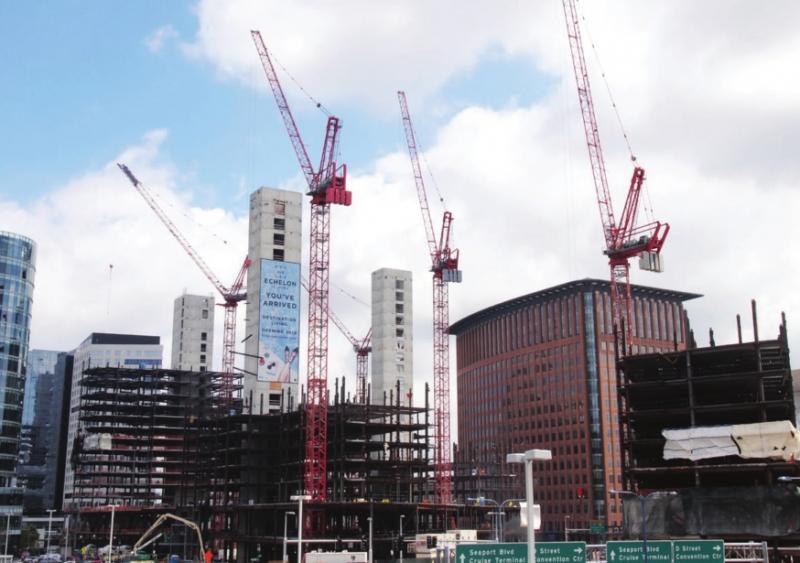
Construction cranes dominate the skyline in the Seaport District.
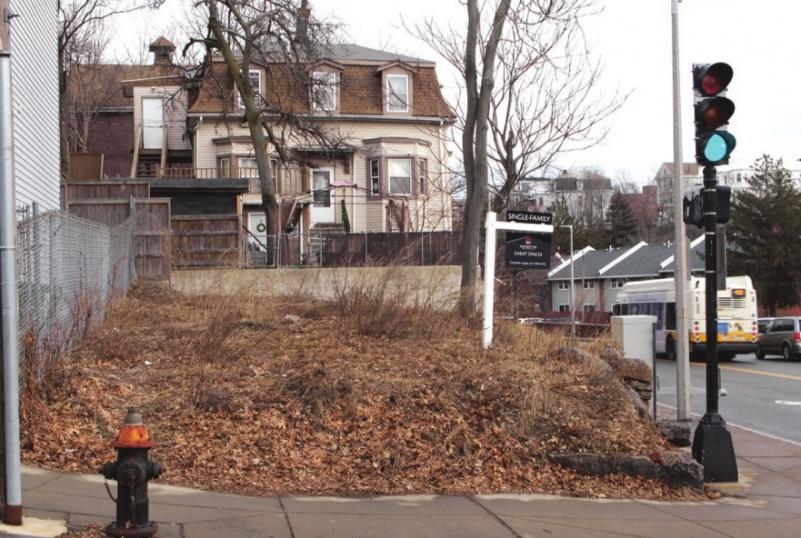
This 18,062 square-foot lot on Cedar St. is less
than half the size required under zoning code, but a City Hall-connected
attorney was able to secure the rights to build on it, before selling
it for a handsome profit.
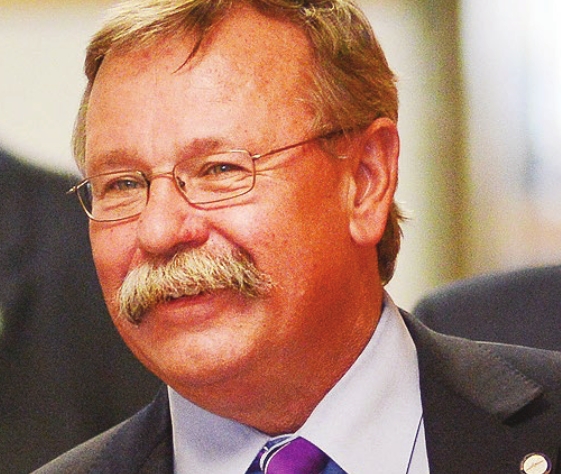
Former Inspectional Services Department
Director William Christopher took a leave of absence while an
investigation of a development project involving his son’s architectural
firm is ongoing.
Abutters are no match for politically-wired developers
The indictment of a former Boston Planning and Development Agency worker for receiving a $50,000 bribe from a developer has focused attention on the city’s Zoning Board of Appeal, the body that has final say over construction projects in Boston, but the case points to a much larger pattern of influence-peddling, most of which is legal under state law.
John Lynch, a longtime city employee, allegedly took payment from a real estate developer to secure an extension on a South Boston project. On Friday, the Boston Globe reported that the architect on the project was James Christopher, son of former Inspectional Services Division (ISD) Commissioner William “Buddy” Christopher, who is currently a special advisor to Mayor Martin Walsh. On Friday, the elder Christopher announced he is taking a leave of absence from his job while an investigator appointed by the mayor conducts a review of the Zoning Board of Appeal (ZBA). Over the weekend, ZBA member Graig Galvin tendered his resignation from the board without explanation.
Outright bribery cases are rare in City Hall, but a web of politically-connected lawyers ushering projects through the city’s approval
process, and the construction firms, architects and real estate
developers who depend on them play an outsized role in the
decision-making processes that govern what gets built in Boston.
In
many cases, city officials who engage in insider dealing and exploit
privileged relationships to benefit themselves, their friends and family
members appear to do so while complying with state ethics laws.
“This
is the tip of the iceberg,” said Jon Ellertson, a member of Roxbury’s
Highland Park Neighborhood Association, who has seen projects advanced
by wired developers glide through approval processes at ISD and the ZBA
despite fierce opposition from abutters and neighborhood activists.
“The
process favors those who have connections,” he said. “People shrug
their shoulders and say, ‘You can’t beat City Hall.’” In Boston’s
neighborhoods, where developers are reshaping the fabric of communities
with multi-unit condo complexes and luxury apartment buildings,
activists say the scales are tilted toward a handful of developers and
their lawyers.
The
BPDA (formerly Boston Redevelopment Authority), the ISD and the ZBA were
established to create checks and balances on the real estate
development process. While they were meant to serve as arbiters of
disputes between developers and neighborhood residents, neighborhood
activists across the city have long complained they are out-gunned by
well-connected developers and lawyers who leverage relationships in City
Hall to override local opposition to their projects.
Running roughshod in Roxbury
In
Highland Park, abutters in 2015 challenged a project advanced by the
late Joseph LaRosa, a developer who tore down a two-family home and
ultimately built a six-unit apartment building on the lot, which
neighbors argued was too small for the building. Roche-Christopher
Architects, LLC the firm co-founded by William Christopher and helmed at
the time by James Christopher, was listed on LaRosa’s project.
The
project never went before the ZBA. The ISD ruled against the abutters
and said LaRosa could move forward as-of-right, meaning without the need
for review from the board.
The
six-unit building, which overshadows the smaller twoand three-family
homes on Cedar Street, now houses mainly student tenants.
James
Christopher’s firm has been associated with other projects that have
rolled over fierce neighborhood opposition in Roxbury, Dorchester and
East Boston.
Before
LaRosa’s association with Roche-Christopher and Associates, he used a
law firm that employed Joseph Feaster ¾ who until 2004, was the chairman
of the ZBA. Feaster routinely recused himself from votes involving his
then-client, but LaRosa rarely lost a fight against abutters.
The
cozy relationships between city government and real estate developers
has by no means been limited to small firms. In 2009, at a time when
Suffolk Construction was working on multi-million-dollar city projects,
including the new Boston Police Department headquarters and several
school buildings, the firm hired then-Mayor Thomas Menino’s son, Thomas
Menino Jr., for a 20-hour-a-week job as a “safety engineer.” Menino Jr.
managed the Suffolk gig despite his full-time job as a police detective,
which included 310 hours of overtime for the department in 2009, the
Boston Herald reported.
The letter of the law
None
of these arrangements were illegal. Neither James Christopher’s
involvement with projects overseen by his father’s agency, nor Feaster’s
representation of clients on matters before his board, nor Suffolk
Construction’s hiring of the son of a mayor reputed to have an iron grip
on construction projects.
Under
the state’s ethics law, Chapter 268A, it clearly is illegal for
municipal employees to receive bribes, gifts and gratuities. Municipal
employees may not vote on, discuss or make decisions in matters in which
they, their families or immediate relatives have an immediate interest.
However, zoning board members who recuse themselves from votes on such
matters, as did Feaster with his client, are within the law.
“In
many cases, where not otherwise required to participate, a municipal
employee may comply with the law by simply not participating in the
particular matter in which she has a financial interest,” the state
Ethics Commission’s website advises. “She need not give a reason for not
participating.”
Beyond
the dealing that appears to happen routinely at the ZBA, individuals
and groups with a vested interest in real estate development exert
influence in city government through campaign contributions to mayors
and city councilors.
Some
cities bar owners and employees of businesses that bid on municipal
contracts from making political contributions, but Boston does not. As
is the case with most U.S. cities, in Boston, land is the most valuable
asset over which local government has control. Construction firms,
building trade unions and real estate developers, along with the
brokers, attorneys and architects who rely on their businesses together
constitute the largest bloc of political contributors to the campaign
accounts of Boston municipal officials.
In
the last two weeks in August, Mayor Martin Walsh, who is not up for
re-election this year, reported $3,716 in political contributions in his
campaign account.
Among
the 11 contributors were three real estate developers, who together
donated $2,025, three police officers, whose contributions totaled
$1,075 and two city workers, who gave $25 and $50.
Even
city councilors who are critical of the cozy relationship between
developers and the ZBA benefit from the largesse of the construction
industry. Michelle Wu, who last week criticized the city’s development
process as “a system built on who is able to have the greatest input to a
small number of decision-makers,” in the Boston Globe, is facing a
competitive race for the at-large council seats.
During
the last two-week reporting period in August, Wu received $7,510.90 in
contributions, including $1,455 from individuals and entities in
construction industry-related fields — $755 from real estate
professionals, $500 from the Carpenters Local 328 Political
Action
Committee fund, $200 from an architect — and $500 from consultant Randi
Lathrop, a former Boston Redevelopment Authority official whose areas
of focus include development consulting, government relations, and urban
planning and zoning, according to her website.
An impartial body?
With
the current bribery controversy focusing attention on the ZBA, some are
questioning the role that entities with a direct interest in real
estate development play in selecting members of the board. In recent
years, three of the seven ZBA members have been appointed by the Greater
Boston Real Estate Board, the Boston Society of Architects and the
Boston Building Trades. Recent and current members have included an
architect, two building trades leaders, two construction industry
managers and the head of a construction industry advocacy group.
The
preponderance of construction and development interests on the board,
and the lack of neighborhood activists, has skewed the review process in
favor of developers to the point where a $50,000 bribe seems hardly
necessary.
For
neighborhood activists, the cumulative effect of the privileged
relationships between real estate industry professionals and the city
officials who hold sway over development projects is an imbalance of
power between developers and the neighbors who ultimately will live with
what gets built on their block.
Lorraine
Wheeler, a member of Roxbury Path Forward in the Moreland Street
section of Roxbury, says her group has had little luck fighting against
zoning relief for projects she says are too large for her tight-knit
neighborhood.
“In the
last couple of years, we haven’t been very successful,” she said.
“Developers have been coming in with nine-unit buildings on lots that
previously had one- or two-family homes. There’s nothing we can do to
stop these projects from moving forward.”


