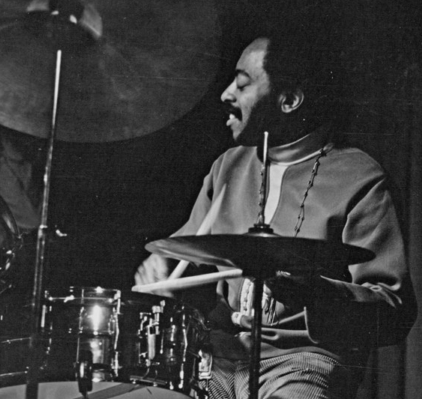
Roy Haynes.
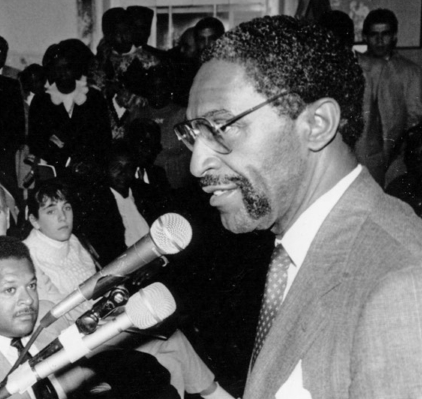
Michael Haynes.
Roy, Michael recall childhood in Roxbury
The Roxbury in which Roy and Michael Haynes were born in the late 1920s disappeared long ago, leveled by the urban renewal wrecking ball in the 1960s. Their family’s three-story frame house, were it still standing, would be next to the 20-yard line of the football field that now lies behind the John D. O’Bryant School of Mathematics and Science.
“The whole neighborhood is gone,” says Michael, 92. “Our house was in the middle of it.”
A drawing of the house hangs on the wall of Michael’s home, and memories of the home feature prominently in the recollections of the brothers, the last two of four sons born to Barbadian immigrant parents.
Roy, now 94, became one of the most influential drummers of the 20th century, joining the seminal Charlie Parker quintet, touring Europe with Sarah Vaughan, recording and performing as a member of the John Coltrane quartet and helming his own bands. He has recorded 34 records under his own name and appeared on dozens more between 1949 and 2011.
Michael rose to prominence as a civil rights leader in Boston’s black community, most notably as pastor of the 12th Baptist Church in Roxbury and representing Roxbury in the Legislature during the late 1960s.
In
a recent interview with the Banner at Michael’s Clifford Street home,
the brothers recalled their formative years in Roxbury, giving insight
into the culture of the community that shaped their lives.
“Haskins Street was our favorite place,” Roy recalls. “We lived across the street from a synagogue.”
“Do you recall working in the synagogue?” Michael interjects.
“Of course! I remember getting my little bit of money,” his brother returns.
Roy
wears a beige polo shirt and beige camouflage pants with an embossed
black leather cowboy belt. He reclines in an easy chair. Michael,
wearing a UMass Boston T-shirt and blue shorts, sits up straight,
leaning slightly forward on a couch. The brothers maintain an easy
rapport, with Michael, whose memory remains sharp, from time to time
gently prompting his older brother’s memory.
Near
their childhood Haskins Street home was a driveway leading to a large
Salvation Army facility, where goods were stored and sold.
“It
was almost next to our house,” Michael recalls. From there, Roy got his
first drum kit. A driver for the Salvation Army who was friendly with
the boys — Michael recalls his nickname as being “Lock the Gate” made
sure the Haynes family had first dibs on quality goods coming into the
facility.
The Haynes
brothers’ father, Gus, worked as a garbage collector by day. Evenings
and weekends, the classically-trained musician enjoyed playing the organ
— both the one in their local church and the one he had at home. Their
older brother Douglas played trumpet.
“Usually, I played drums for him,” Roy recalls. “He was too hip.”
Roy also dipped into his older brother’s record collection.
“My parents didn’t have too many records,” he recalls.
Other
musical influences included the St. Cyprians Bugle and Drum Corps and
school bands at the Timilty middle school and Roxbury Memorial high
school.
“In those days, schools had bands,” Michael notes.
Michael
also cites the Robert Gould Shaw House, a Lower Roxbury settlement
center founded in 1908, as a major influence in his development.
“It gave me the opportunity to learn leadership skills,” he says.
Both Haynes brothers recalled with some fondness their time at Breezy Meadows, the summer camp the Shaw House ran in Holliston.
“It was one of the blessings for the black community,” Michael says of the camp, which accommodated 80 children. “I can see Mrs.
[Melnea]
Cass sitting on the front porch with my mother and Ken Guscott’s
mother. That’s where a lot of the women who became leaders in the black
community went during the summer.”
While Michael worked with younger campers, Roy was given a job in the kitchen.
“Everyone complained because all you did was bang on the pots,” Michael recalls. “They fired you.”
“For
that?” Roy says. “Mr. Shelbourne fired you.” The incident simply
underscored his proclivity for beating out rhythms, according to Roy. “I
was a natural drummer,” he says.
“He was known for his style and his drumming,” Michael agrees.
In addition, all the Haynes men were known as sharp dressers.
Roy
Haynes left Roxbury Memorial to play with the Sabby Lewis Big Band. But
he was drawn to the burgeoning be-bop scene on New York’s 52nd Street,
and eventually landed a gig with tenor great Lester “Pres” Young. His
four-year gig with Charlie Parker put him at the center of the
avant-garde.
Michael
recalls with great fondness Roy’s time with Sarah Vaughan, the be-bop
virtuoso singer who one night gave him a ride back to his hotel after he
listened in on a gig. At the time, in the early 1950s, Michael Haynes
was in New York attending Shelton College.
“She
said, ‘So you’re going to be a preacher,’” Michael recalls. “She said,
‘So that’s why Roy is such a good boy.’ I remember that ride.”
Michael
also recalls an early job he had as writer for the Boston Chronicle, a
newspaper published by a West Indian family in Boston from 1915 to 1966.
He wrote a column covering sports, before passing the gig on to his
older brother, Vincent, a World War II veteran and accomplished
photographer.
“He
loved to write,” Michael recalls of his late brother. “We took notes on
everything. He had more Roxbury in him than anyone I know.”
Like
their old Madison Park neighborhood, much of the Boston of the Haynes
brothers’ childhood is long gone — the Chronicle, Breezy Meadows, the
majestic English High building on Warren Avenue in the South End.
The
legacy of these brothers and the institutions that supported them lives
on. The Haynes House, a seven-story apartment complex on Shawmut
Avenue, was named for Vincent Haynes, in recognition for his advocacy to
preserve housing in the Madison Park neighborhood. The Haynes Early
Education Center in Roxbury was named for Michael. The Gordon Conwell
Theological Seminary, where Haynes serves as a trustee, has endowed a
scholarship in his name. Former Robert Gould Shaw House director John
Shelburne’s name now adorns a Washington Park-area recreation center.
For
Michael, the Shaw House remains central to his memories of Roxbury. He
recalls when Martin Luther King Jr. came to Boston in 1965 to lead a
march for school desegregation. Haynes, who knew King from the latter’s
days as a graduate theology student here, was instrumental in putting
together the march.
“It was his last time in Boston,” Haynes recalls. “When I went to meet him, he was standing in the door of the Shaw House.”