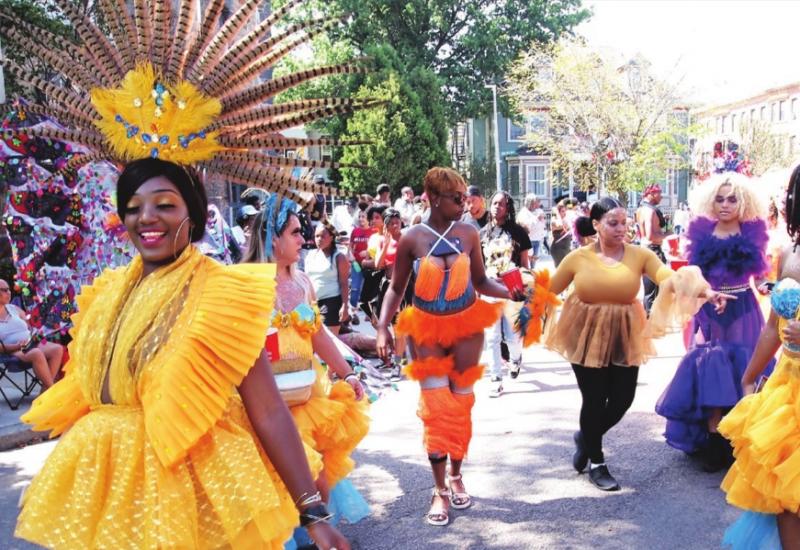
Djenaba Reynolds, a masquerader with the band Children of Wakanda, parades down Warren Street as band leader Tania Anderson (center) checks on costumes.
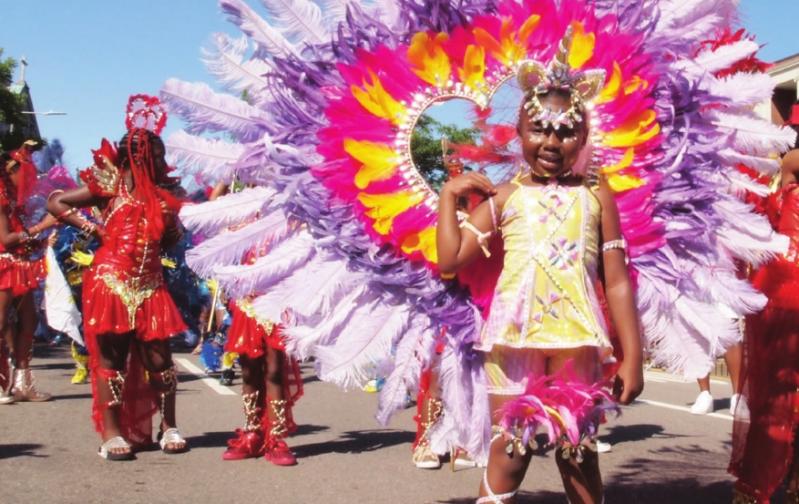
Dazia DePina in Socaholics’ “Showtime” presentation.
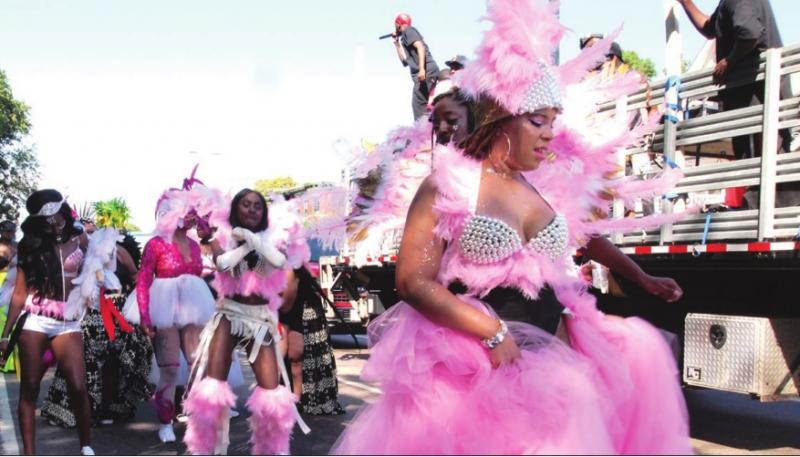
Masqueraders with Misfits Mas Band.
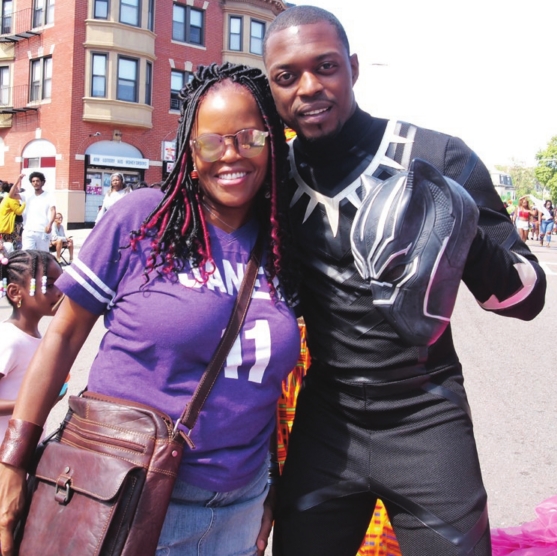
District 7 City Councilor Kim Janey and Children of Wakanda’s Ezekiel Olukoya
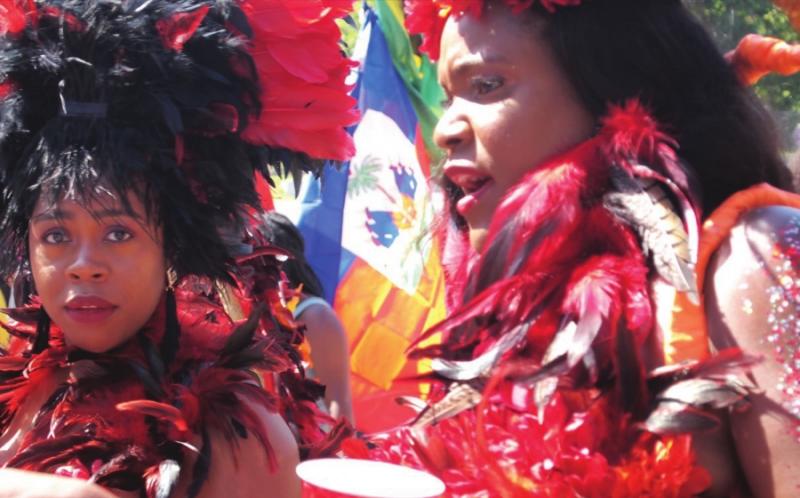
Masqueraders with Children of Wakanda
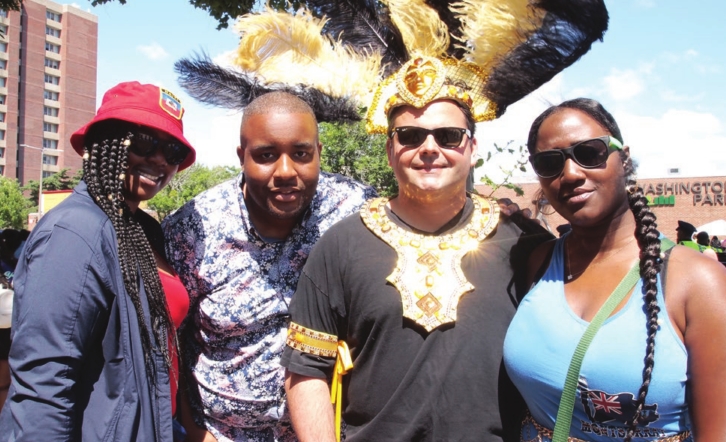
State Sen. Nick Collins (2nd from right) and supporters get into Carnival spirit
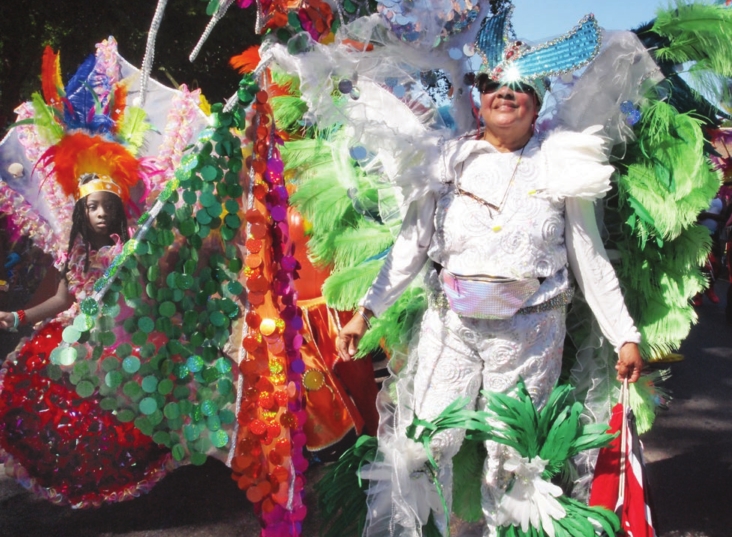
Misfit masquerader Elizabeth Daniel portrays a “fish underwater” as part of the band’s presentation.
Traditional bands, upstarts mingle on Warren Street
Spectators observing the mélange of African-themed, Colonial-era and indigenous Caribbean American-inspired outfits on Warren Street may have missed a major world event that apparently led to the Children of Wakanda marching in this year’s Boston Caribbean Carnival.
“After a global revolution, we decided to create a utopian society in Wakanda where all Afro nations came together,” explained Tania Anderson, the Cape Verdean-American mastermind behind the upstart carnival band. “That’s why we have a multitude of African and Caribbean people. We even have Mardi Gras costumes.”
Children of Wakanda is the newest entry into the evolving Boston Caribbean Carnival lineup, and one of many that breaks from the traditional Trinidadian masquerade band vernacular while incorporating elements of the tradition into its brightly-hued costumes.
Djenaba Reynolds, a Georgia-born Haitian-American masquerader with Children of Wakanda, assembled a feather headdress bejeweled with blue, gold and green rhinestones that could have come straight off any traditional carnival costume. But from
the head down, her costume, designed by Anderson, looked more like a
creation from an avant-garde fashion show than the rhinestoned-bikini
ensembles that have come to dominate carnival in recent years.
The
Wakandans shared the road with Misfits, another upstart now in its
second year of playing mas‘ in Boston’s Caribbean Carnival. Other
standouts included La Boue (aka Engine Room Section) and Branches Steel
Band.
Of course
Carnival wouldn’t be Carnival without the multi-sectioned Trinidad-style
masquerade bands with scores of color-coordinated players. Socaholics
and Soca & Associates were the two entries this year that fit that
bill, scooping up the awards in the King and Queen ceremony Thursday.
The bands dominated the road Saturday, with brilliant, multi-colored
sections of masqueraders and 15-foot high steelframed costumes that
swept bystanders off the street.
“I
think both did very well,” said longtime Caribbean Carnival Association
of Boston President Shirley Shillingford of the two dominant bands.
“Soca & Associates is a longtime player. Socaholics is a newcomer
and is making their mark in Carnival.”
With
just two major bands, Carnival this year was smaller than in past
years. But with the new bands, there’s promise for the future, said
Michael Smith, whose website Boston Carnival Village serves as an
information hub for carnival.
“Each
of the new bands brings their own perspective,” he said. “When other
islands get involved, you see other perspectives. It’s the beauty of
Boston Carnival, as opposed to everywhere else.”
In
addition to Anderson’s pan-African presentation, Boston’s Caribbean
Carnival has a strong Haitian-American contingent as well as mas’
players from Honduras and Panama.
“It’s
powerful to see all the descendants of African people coming together
as one,” said District 7 City Councilor Kim Janey, who walked the parade
route with supporters. “It’s a wonderful expression of what it means to
be of African descent.”
Smith
cautioned that the all-Trini judging panel should broaden their
criteria for evaluating bands in Boston, given the
pan-Caribbean-and-beyond presentations that are emerging on Warren
Street.
“The criteria we use for judging bands is Trinidadian,” he said. “We shouldn’t be holding everyone to Trinidadian standards.”


